

Spec sheets list “random copolymer” and “impact copolymer” as if they were sibling categories of the same thing. They are not.
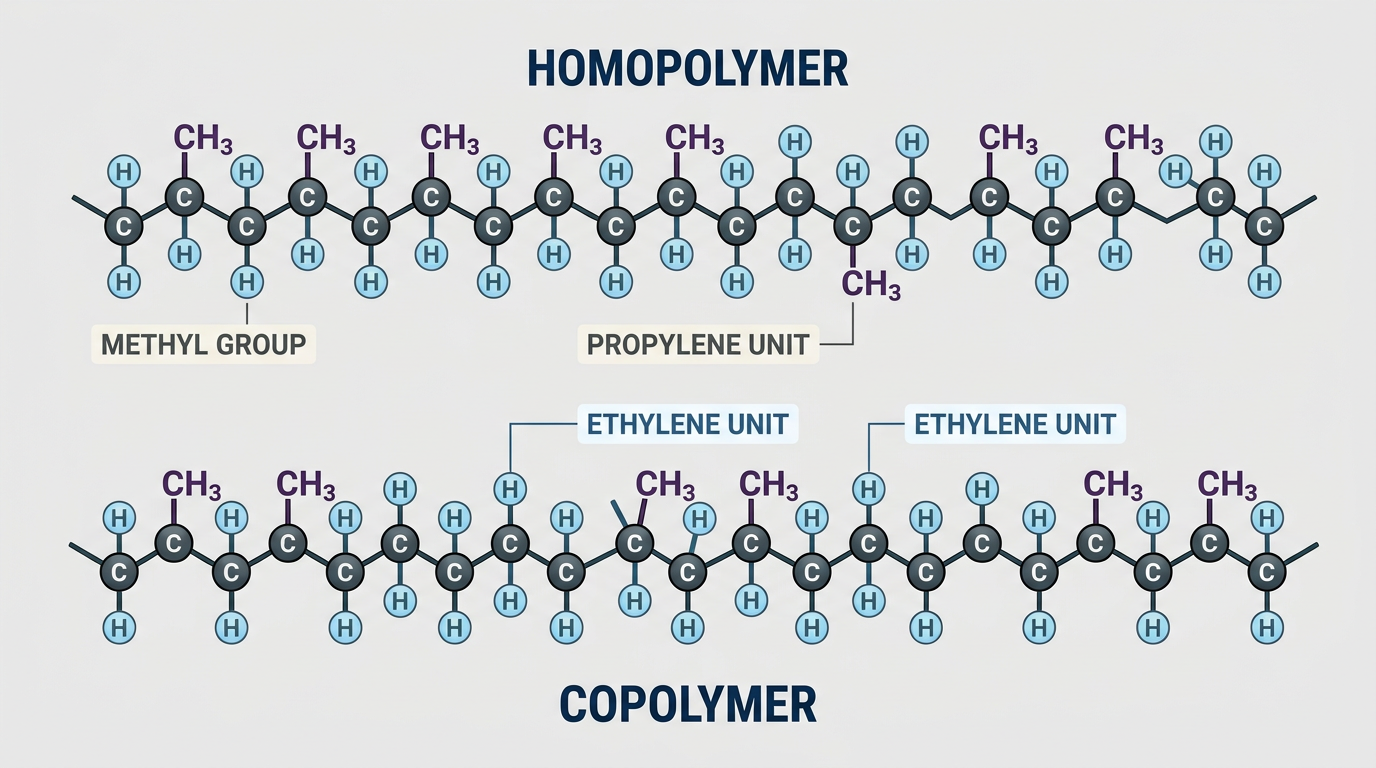
The chain is doing two completely different jobs. In one case ethylene units are scattered singly along a propylene backbone in a single phase. In the other, an ethylene-propylene rubber phase is dispersed inside an otherwise-homopolymer matrix.
Same input monomer, structurally different materials. The difference predicts almost everything you read on the property line of the datasheet.
What “Copolymer” Means on a PP Grade Spec
Copolymer polypropylene is a polypropylene chain into which a small amount of a second monomer — almost always ethylene — has been deliberately incorporated during polymerization.
Commercial PP homopolymer runs 85-95% isotactic and 30-60% crystalline, with melting in the 160-166 °C band. The methyl groups sit on the same side of the chain regularly enough for the chains to fold into tight crystalline domains.
Adding ethylene comonomer disturbs that regularity. How much it disturbs it, and where the ethylene sits, defines whether the chain becomes a random copolymer or a block/impact copolymer.
Bulk polymerization caps ethylene at roughly 5% by weight because of solubility limits in the propylene-rich reactor. That number is worth remembering: when a datasheet calls something “random copolymer PP”, the ethylene content is in single digits.
Higher ethylene loadings live in heterophasic grades, which are not made by simple chain-mixing — they need a two-stage reactor. The broader polypropylene resin family groups these heterophasic grades, the random copolymers, and the homopolymers into one commercial taxonomy.
Random Copolymer: Ethylene Scattered Along a Single Chain
Random copolymer PP — often labeled PP-R on pipe-grade datasheets — has ethylene units distributed singly and irregularly along the propylene chain. There is one chain and one phase.
The structural job ethylene does here is disrupt crystallinity. Each ethylene unit is a defect site that propylene sequences cannot fold around cleanly.
Total crystallinity drops below the 30-60% homopolymer baseline, the melting point shifts downward, and the resin becomes more transparent and easier to weld. The melt typically lands in the ~135-150 °C range as the scattered ethylene disrupts crystal packing.
That trade is what makes random copolymer the default for pressure-rated hot/cold water pipe. PP-R rated under ASTM F2389 holds 160 psi at 73 °F continuously and 100 psi at 180 °F (82 °C).
The dropped crystallinity gives the long-term hydrostatic creep resistance plus the cleaner heat-fusion welds the application needs. Pipe-grade random copolymer PP such as PetroChina Dushanzi T4401 sits in this part of the structural map: roughly 5% ethylene, MFI in the low single digits, weldable, PP-R certified.
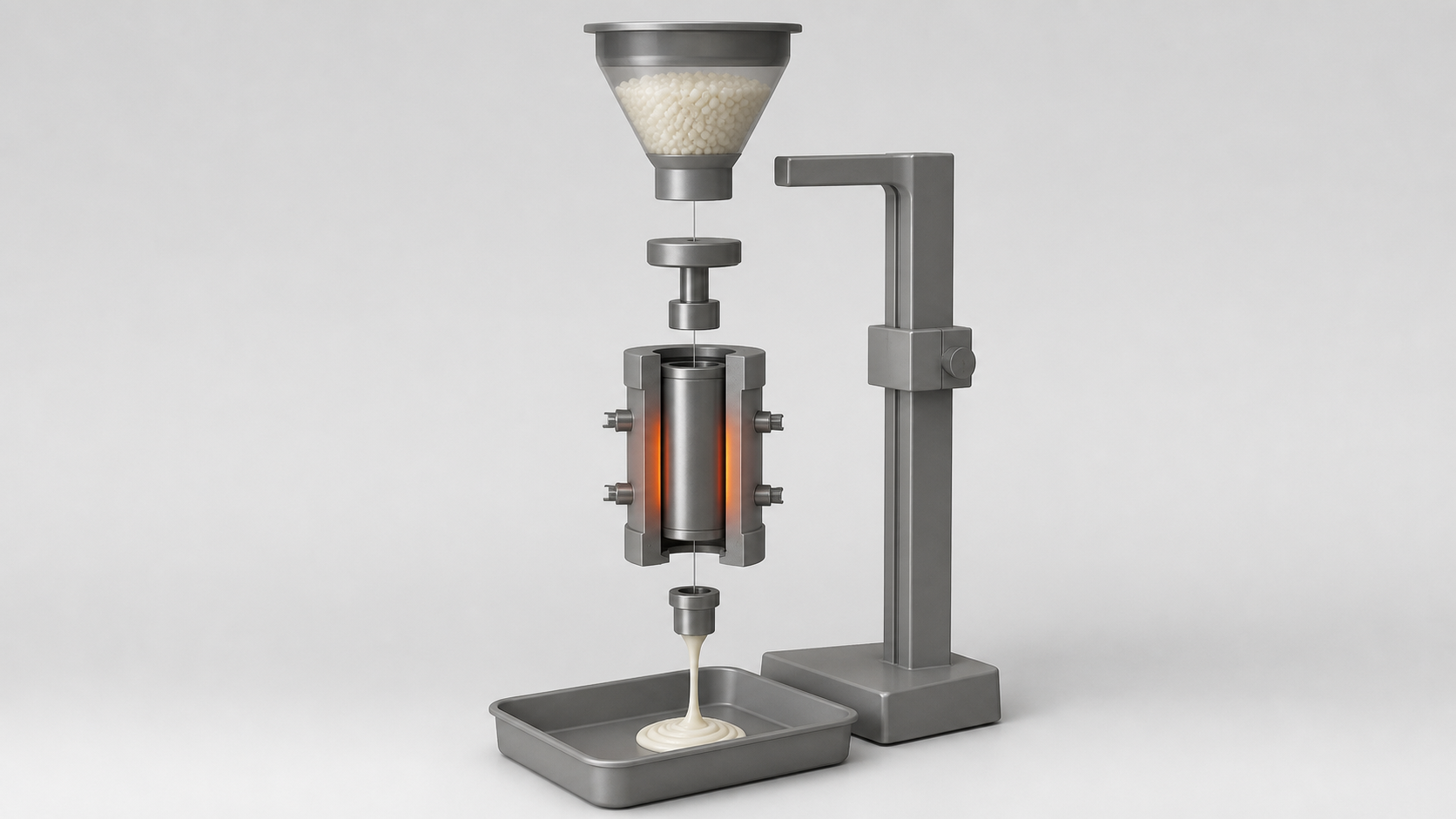
Across the wider random copolymer portfolio, MFI windows run from roughly 2 to 24 g/10 min, measured under ASTM D1238 at 230 °C / 2.16 kg. The chain architecture is the same; molecular weight gets dialed differently for blow molding, thin-wall injection, medical sterilization, and film.
The architecture is fixed; the molecular weight moves the spec.

Block/Impact Copolymer: Rubber Phase Dispersed in a Homopolymer Matrix
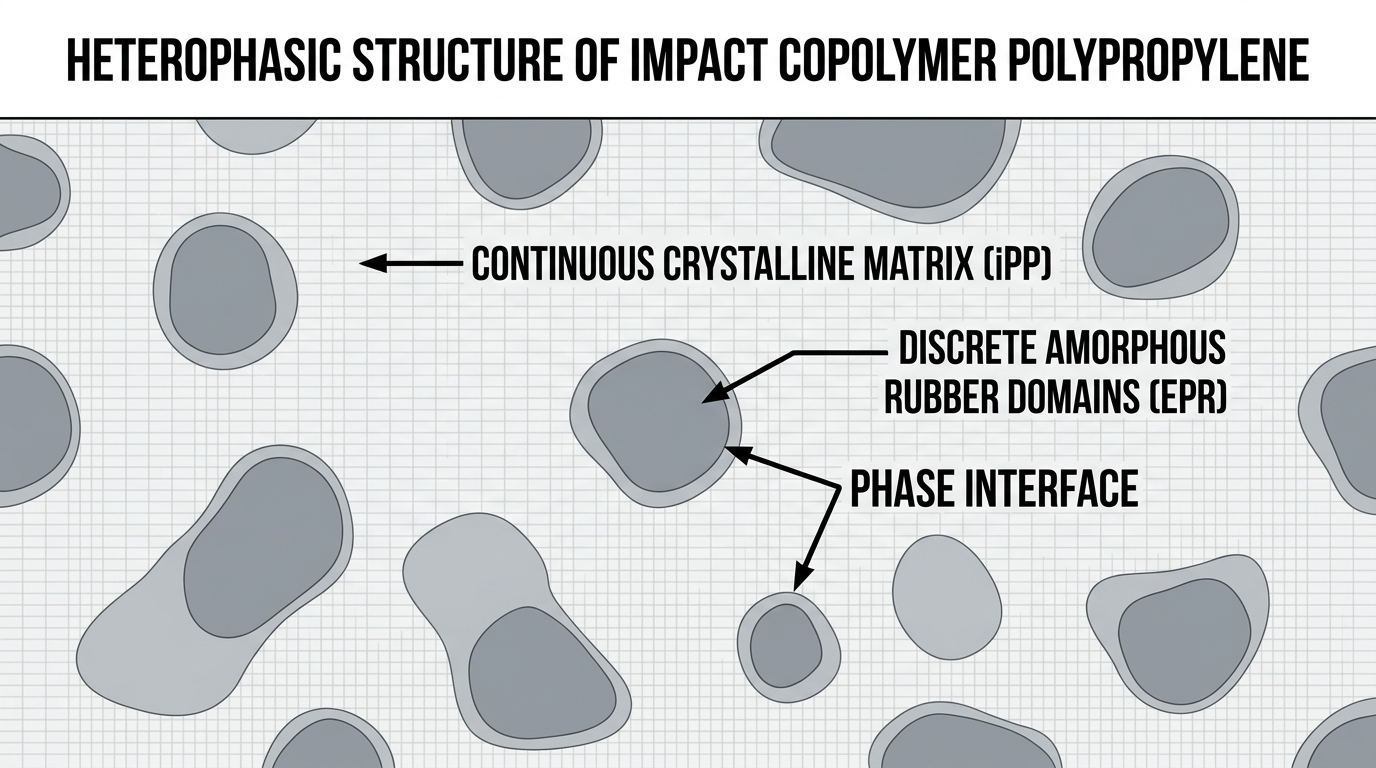
Block or impact copolymer PP — sometimes labeled heterophasic or HIPP — is not a single chain. It is a composite.
A continuous crystalline isotactic homopolymer matrix carries discrete amorphous ethylene-propylene rubber (EPR) domains dispersed throughout. The EPR runs up to 20% by weight of the resin, and ethylene content inside the EPR phase ranges 5-15%. Two phases, one resin pellet.
The matrix keeps its homopolymer crystallinity, so stiffness and heat resistance are preserved. Peak melting stays in the homopolymer-like ~160-165 °C band (TotalEnergies prints 165 °C for its heterophasic grades), unlike the random copolymer’s depressed Tm. The rubber domains do something completely different.
When a sudden mechanical load arrives, the EPR particles cavitate and trigger shear yielding in the surrounding matrix. The result dissipates impact energy that would otherwise propagate as a brittle crack.
Notched Izod for impact copolymer grades typically runs 80-150 J/m at 23 °C and 40-80 J/m at -20 °C — well above the brittleness floor of straight homopolymer.
The same starting monomer can produce opposite property outcomes through these two architectures. Random copolymer drops crystallinity across the whole chain — transparency and weldability gain, modest stiffness loss.
Impact copolymer leaves matrix crystallinity intact and adds a rubber phase — stiffness intact, low-temp toughness added. Reading “copolymer” on a datasheet without knowing which one is missing 90% of the information.
How to Read What Copolymer Polypropylene Is Made Of from the Spec Sheet
Once you know the chain architecture, the rest of the datasheet reads predictably.
Lower melting point + higher clarity + weldable → random copolymer. Notched Izod above 50 J/m at room temperature + clear separation between flex modulus and impact strength → impact copolymer.
MFI tells you molecular weight, not architecture — a 2 MFI random and a 2 MFI impact are very different resins.
Density barely moves between subtypes. Random copolymer runs around 0.90 g/cm3 and impact/heterophasic around 0.905 g/cm3 (ASTM D792 / ISO 1183), both essentially the 0.905 homopolymer figure. Unlike Tm or Izod, density does not disambiguate architecture.
Application context usually disambiguates before you read the architecture line: PP-R fitting, blow-molded transparent bottle, BOPP film → random copolymer. Battery case, automotive bumper, cold-storage crate → impact copolymer.
The COA gives you four numbers; the spec sheet gives you the window; the chain architecture tells you which corner of the window is reachable. Mapping crystallinity, ethylene content, and rubber-phase fraction onto a grade choice across homopolymer, random copolymer, and impact copolymer is the actual sourcing decision.
Where Most Buyers Get the Label Wrong
The most common mistake is treating “copolymer PP” as a single category and substituting one subtype for another on price.
A homopolymer is not interchangeable with a random copolymer in a PP-R pipe line. The chlorine resistance and hot-water creep performance come from the ethylene-disrupted crystallinity, not from molecular weight alone.
Don’t substitute homopolymer for random copolymer in a pipe application without re-qualifying, and don’t assume an impact copolymer accepts the same weld parameters as a random — the rubber phase changes the melt rheology.