

Specifiers usually arrive at this decision the same way. A supplier sends a quote with a four-character grade code and an MFI number, and the question shifts from “which PP family” to “is this the right family for what I’m building.”
For the China-sourced specifier, family selection and producer-channel selection are one decision, not two. A producer-coded grade is a PetroChina or Sinopec namespace identifier. Picking a family without picking a channel leaves you unable to map the decision to anything a supplier can actually deliver.
The three main grade families of polypropylene resin — homopolymer (HP), random copolymer (RCP), and impact / block copolymer (ICP/BCP) — answer different application questions. For the underlying chemistry, the three main grade families of polypropylene background article is the companion piece.
Five Criteria That Decide Which PP Family Fits Your Application
Five spec-sheet numbers decide the family pick:
- MFI window — processing speed, part geometry
- Crystallinity / melting point — stiffness, heat-deflection ceiling
- Impact at temperature — sub-zero survival
- Clarity — clear bottle vs. opaque crate
- Cost — homopolymer is the floor; ICP carries a premium for the EPR rubber phase
Each axis pushes you toward a different family: clarity and pipe-rated long-term strength land you in RCP, sub-zero impact lands you in ICP, pure stiffness and lowest cost land you in HP.
| Family | Tm (°C) | Density (g/cm³) | Low-temp ductility | Typical applications | China-channel SKU examples |
|---|---|---|---|---|---|
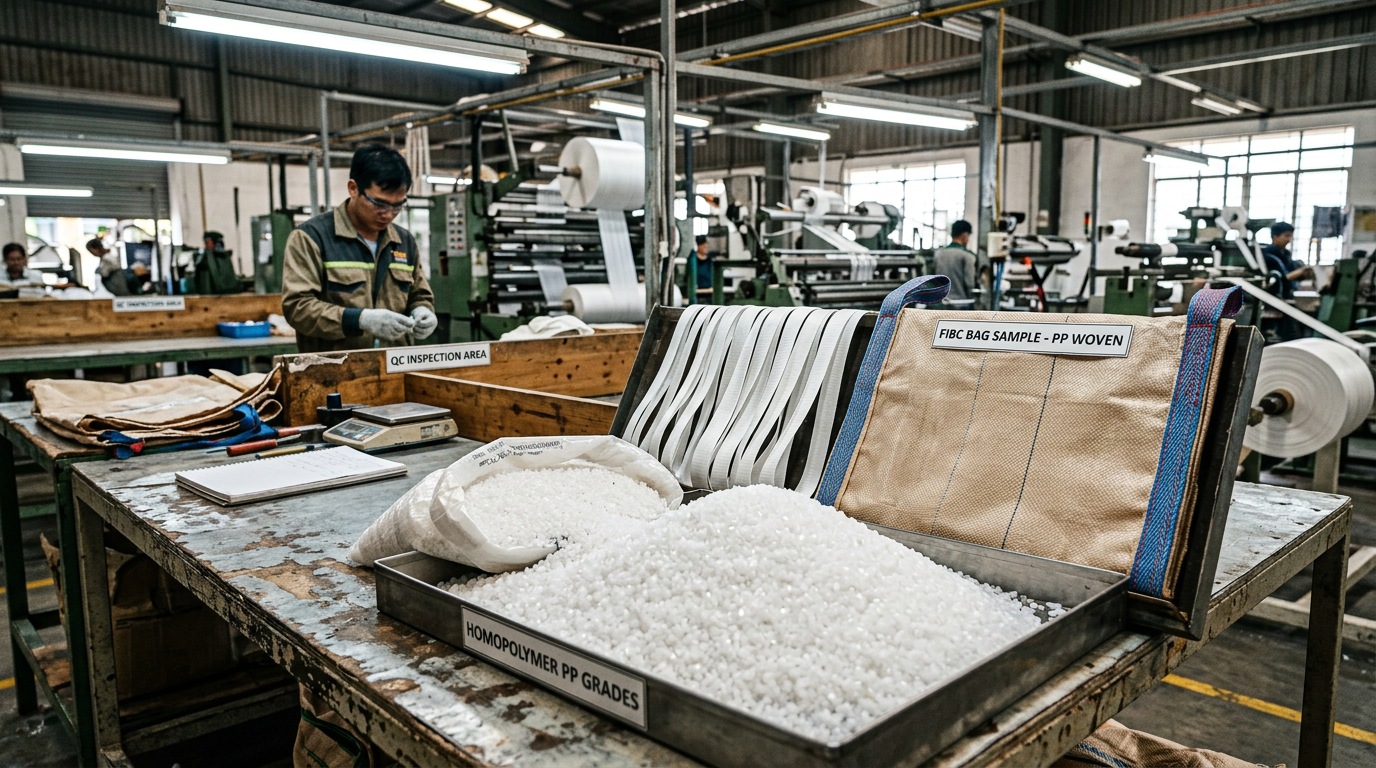
| Homopolymer (HP) | 160–165 | 0.904–0.908 | Brittle below 0 °C | Woven bag tape, FIBC, monofilament, fiber, non-woven, rigid injection | T30S, S1003, S2025 |
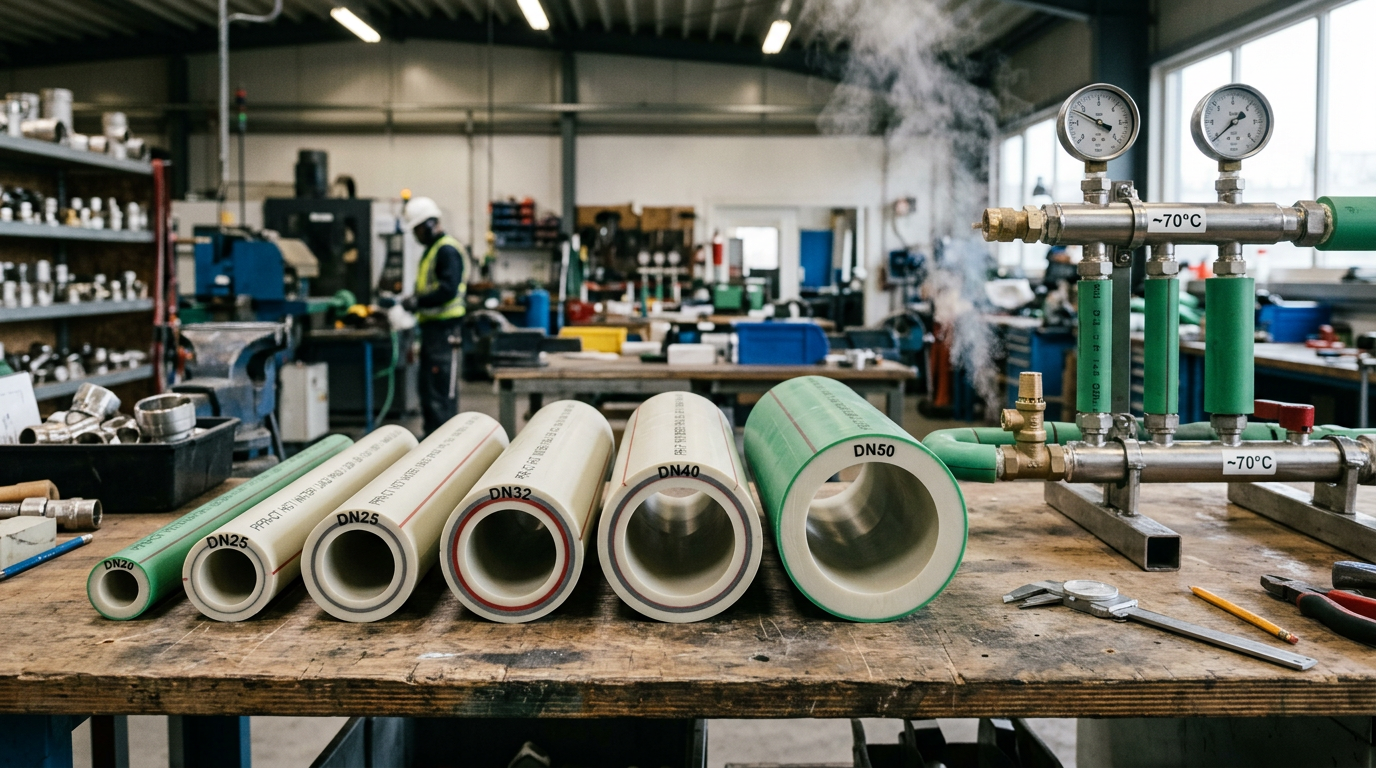
| Random copolymer (RCP) | 135–159 | 0.904–0.908 | Ductile near 0 °C | PP-R hot/cold water pipe, clear thin-wall packaging, blow-molded bottles | T4401 |
| Impact / block copolymer (ICP/BCP) | 160–165 | 0.898–0.900 | Ductile to ~−20 °C | Automotive bumpers, battery cases, freezer containers, drop-tested housings | ICP grades on PetroChina / Sinopec / CNOOC channel |
How to Choose Homopolymer (HP) for Stiffness-First PP Applications
Homopolymer polypropylene wins when stiffness, rigidity, and cost matter more than clarity or sub-zero toughness. Paul Martin’s Machine Design breakdown describes the chain as “only propylene monomer in a semi-crystalline solid form.”
That structure gives HP the highest melting point in the family (160–165 °C) and a density of 0.904–0.908 g/cm³. HP is brittle below 0 °C. A part that lives in a freezer or a winter outdoor loading dock should not be specified in homopolymer.
The HP slot is wide commercially across the PetroChina and Sinopec channels:
- T30S — canonical monofilament and tape grade for woven sacks, rope, and FIBC tape extrusion
- S1003 — same window with slightly different MFI tuning
- S2025 — fiber and spunbond non-woven applications
Tape-extrusion quotes I see most often run through this HP grade set.
How to Choose Random Copolymer (RCP) for PP-R Pipe and Clear Packaging
Random copolymer polypropylene wins for PP-R hot and cold water pipe and for thin-wall packaging where you need both clarity and some flex. Up to about 6% ethene is scattered randomly through the chain. This disrupts crystallinity, drops the melting point into the 135–159 °C range, and pulls the brittleness floor close to 0 °C while opening up clarity.
Pipe-grade random copolymer such as PetroChina Dushanzi T4401 sits in this family. Ascent Petrochem publishes T4401 at 0.25 g/10min MFI (230 °C / 2.16 kg), density 0.90 g/cm³, and 95 °C maximum operating temperature for PP-R hot/cold-water pipe.
PetroChina Dushanzi operates a 550 KTA Innovene PP plant licensed by INEOS — the published producer behind T4401’s PP-R slot in our channel.
If you’re sourcing PP for cold and hot water pipe, target a random copolymer in the 0.25–0.30 g/10min MFI band. T4401 is the most common reference, with Sinopec equivalents available as a second source.
Don’t substitute homopolymer for random copolymer in a pipe application without re-qualifying. Homopolymer is brittle near 0 °C and does not carry the long-term hydrostatic strength rating for PP-R. That’s a re-qualification gate, not a price-list swap.
How to Choose Impact Copolymer (ICP/BCP) for Sub-Zero and Drop-Test Applications
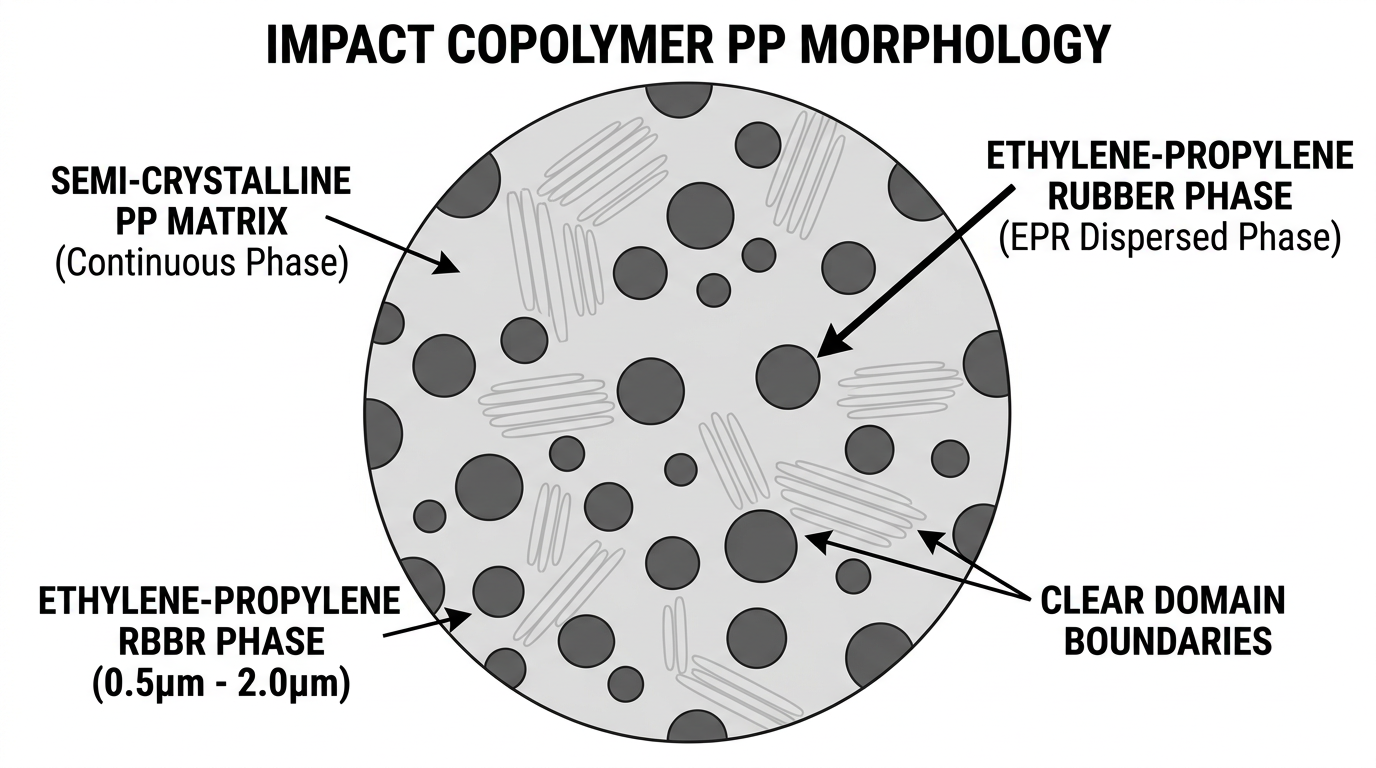
Impact copolymer polypropylene wins when the part has to survive sub-zero impact or drop-test abuse: automotive bumpers, battery cases, freezer containers. The morphology is a homopolymer matrix with a co-mixed propylene random copolymer phase carrying 45–65% ethylene in the rubber phase.
That dispersed ethylene-propylene rubber (EPR) phase is what survives cold impact while the matrix keeps overall stiffness reasonable. Density drops slightly to 0.898–0.900 g/cm³, and ductility holds down to roughly −20 °C.
Within the ICP family, the MFI window itself is a selection axis. Pedro Zaccaria of Syntex America reports that moving from P640J (MFI 10) to P945J (MFI 65) in the SCGC P-series drops notched Izod at 23 °C by about 34% (98 → 65 J/m). Flexural modulus rises about 17% (1,177 → 1,373 MPa) over the same span.
Zaccaria puts the cross-family version of the same point plainly: the decision between homopolymer and impact copolymer is “not flow — it is morphology” because the EPR phase is what survives sub-zero impact. ICP grades are available on request from PetroChina, Sinopec, and CNOOC channel suppliers. The specific code depends on the application’s target MFI and impact-temperature spec.
Why the Polypropylene Grade Code on Your Quote Decides the Family Choice
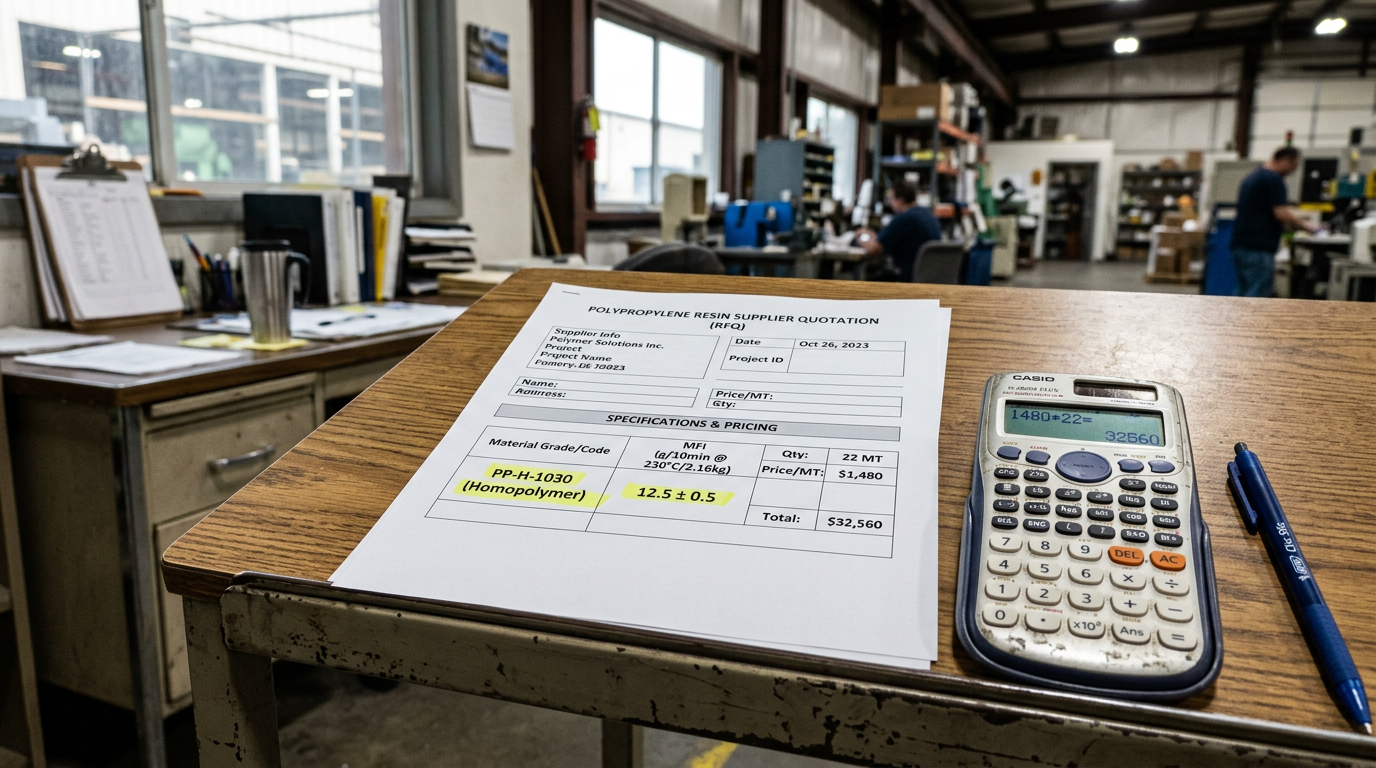
The grade code on a Chinese polypropylene quote is a PetroChina or Sinopec namespace identifier, not a generic ASTM ID. The MFI a buyer receives depends on which producer’s version of the code is quoted.
Ascent Petrochem publishes T4401 at MFI 0.25 g/10min for PP-R pipe. Chemdo lists “PP pipe grade T4401” aligned with PPH-Y40 / H39S at a nominal 40 g/10min per GB/T 3682.1-2018. Same five-character code, two distributor pages, roughly a 160× MFI ratio — but Chemdo’s 40 g/10min is the H39S spec, with T4401 only in the page title.
When I’m qualifying a new PP supplier — say adding PetroChina Dushanzi T4401 as a second source for a Sinopec primary — I run three lots through the line before signing anything. The original supplier stays on hot standby for the first quarter.
Before sending an RFQ, compare grades across PetroChina, Sinopec, and other producers. Work the channel side in parallel with the family side, not after.
Making the Polypropylene Grade Decision
Qualify before you commit. Send the spec-aligned RFQ with both the family (HP / RCP / ICP) and the producer-namespace grade code on the same line. Ask for the producer’s COA with MFI, density, and the relevant impact or Tm number — then run a real lot before locking annual volume.
Family selection and producer-channel selection remain one decision, not two. A family pick without a channel pick leaves the spec unfinishable.
Homopolymer for stiffness and lowest cost; random copolymer for pipe and clarity; impact copolymer for sub-zero and drop-tested service — and underneath each, a producer name your supplier can actually ship from.