

A snap-fit dispenser lid, a solvent-contact bin, and a painted housing are three different material decisions, and only one goes to ABS. The reputation that ABS is the better engineering plastic holds up right until a part has to flex repeatedly or sit in a solvent.
PP and ABS sit on opposite sides of the properties that decide most molding jobs: finish, chemical contact, hinge fatigue, and weight. The usual rule of thumb collapses that into “ABS is premium, PP is cheap” and steers people to ABS by reflex.
That reflex is wrong as often as it is right. ABS earns its premium on a clean painted or plated surface, backed by higher rigidity. The moment the controlling requirement is a solvent, a living hinge, or low weight, polypropylene (PP) is the correct call, not the budget compromise.
Which Resists Solvents, PP or ABS
PP resists the acids, bases, alcohols, and aliphatic hydrocarbons that craze ABS, so a part in chemical contact belongs in PP. ABS sits in the mid-to-high band for environmental stress cracking (ESC) and is attacked by ketones such as acetone and MEK, esters, and aromatic solvents.
The failure mode is not plain chemical attack. ESC is synergistic — molded-in stress plus a chemical agent that plasticizes the chains at a crack tip and lowers the barrier for a craze.
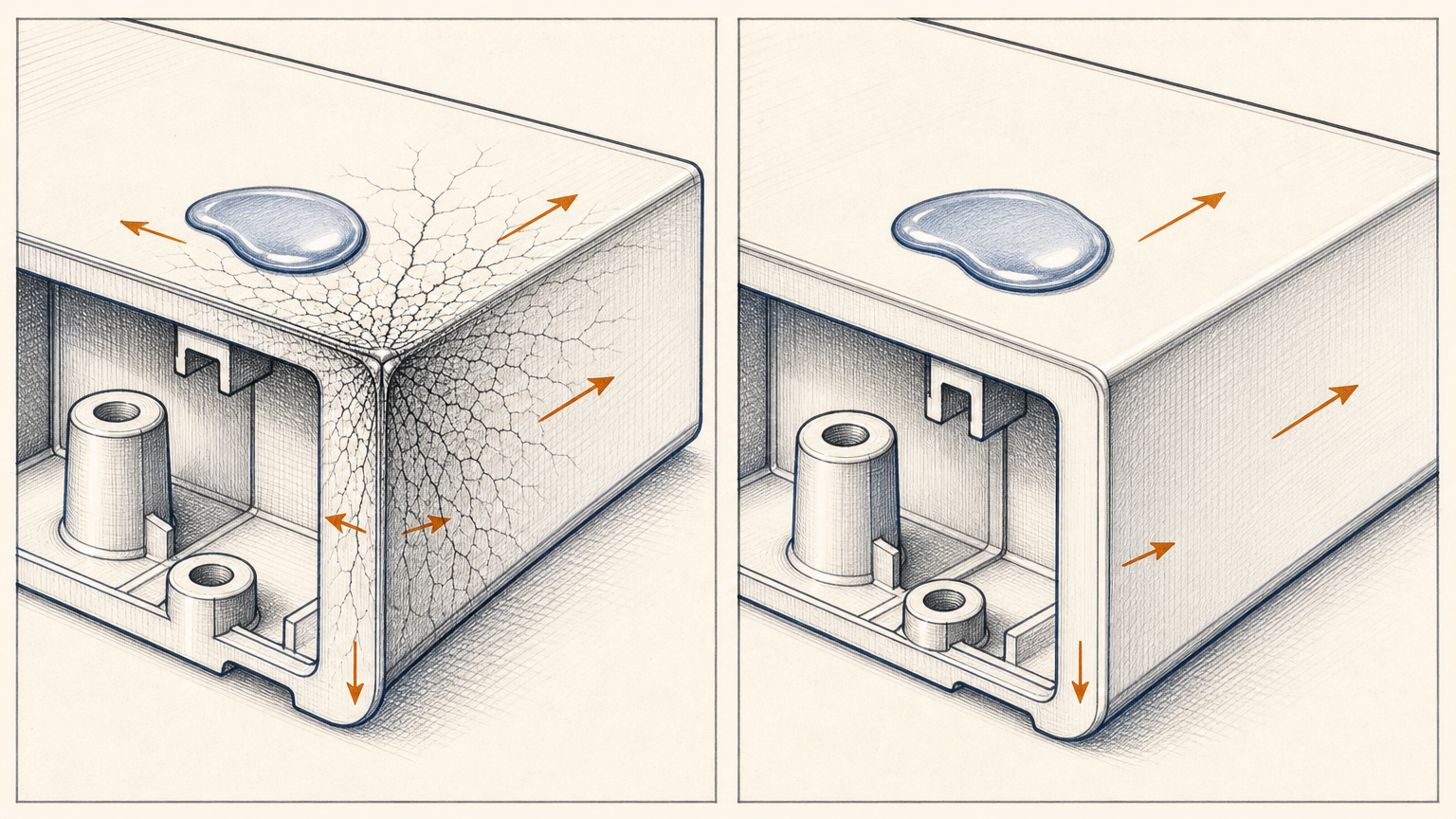
So an ABS housing under residual molding stress can fail on a “mild” solvent wipe that never touches an unstressed coupon. PP holds across roughly pH 2 to 12.
I treat this as a near-binary. If the part sees cleaning solvents, fuels, or fragrance oils, ABS is the riskier choice regardless of its impact number. A PP impact copolymer such as K8003 answers the duty when the part also takes knocks.
Why ABS Cannot Make a Living Hinge
A PP copolymer living hinge survives 1,000,000-plus open-close cycles; ABS fractures on the first or second fold and cannot make one at all. This is the cleanest binary in the comparison, and the fact most “ABS is tougher” reasoning misses.
The mechanism is structural. PP is semi-crystalline, so its chains reorient under fold strain and the thin web work-hardens into a durable hinge. ABS is amorphous; its chains cannot realign that way, so the web cracks on the first fold.
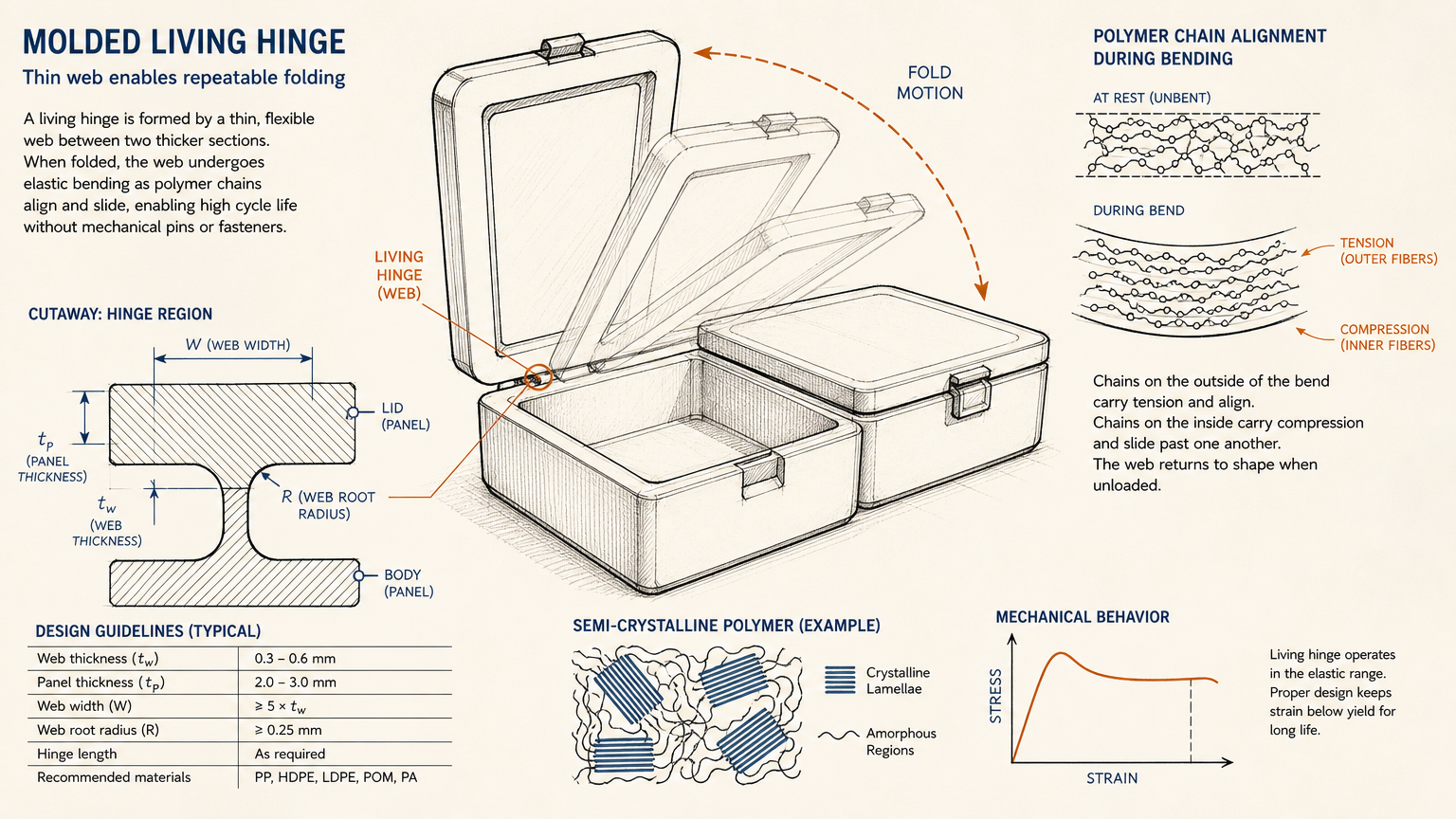
The design rule is worth carrying: hold the flex web to 0.25–0.5 mm at ±0.05 mm and keep maximum outer-fiber strain under roughly 40% (εmax = t / (2R + t)). Above it, hinge life drops from over a million cycles to 10,000–50,000.
Use PP copolymer, not homopolymer, and derate for cold, since PP loses about half its flex life per 20 °C below room temperature.
This is also why “ABS is tougher” misleads. ABS wins notched Izod (about 200–500 J/m versus PP’s 20–100, ASTM D256) on a single sharp blow, so a rigid bracket taking the odd hard knock belongs in an ABS high-impact grade such as HI-10.
A part that flexes repeatedly is governed by fatigue endurance instead, where PP impact copolymer wins. Shift to a stiffness, creep, and wear axis like acetal versus PP and the answer changes again.
When PP’s Lower Density Flips the Cost Math
PP yields roughly 13–15% more parts per kilogram than ABS, which can reverse a cost comparison that looked settled on the per-kg quote. PP runs about 0.90–0.92 g/cm³ against ABS at 1.03–1.07 (ASTM D792).
Per-part resin cost scales with part volume times density, not the headline price per kilo — so an ABS quote that looks competitive per kilogram still buys fewer parts from the same mass.
PP usually carries a lower per-kg price on top of that, and roughly 10–15% lower melt-processing energy. Its density is a decision factor disguised as a footnote — one that also cuts shipped mass on a handheld part.
Where ABS Earns Its Premium
ABS paints and electroplates to a Class-A finish without the surface treatment PP demands, and that is its genuine, decisive edge. PP sits at roughly 29–31 dyne/cm of surface energy untreated, while a paint, ink, or adhesive needs about 36–42 dyne/cm to bond.
Coating PP means raising its surface energy with flame, corona, or plasma plus a primer — and that treatment is perishable. Corona-treated PP can lose around 3 dyne/cm within a week, so a treated part carries a coat-by window ABS does not — which is why ABS is the default electroplating substrate.
ABS backs the finish with rigidity. Flexural modulus runs about 1800–2300 MPa versus PP’s 1200–1600 (ASTM D790), and water absorption is 0.2–0.4% against PP’s under 0.01% (ASTM D570), so it holds tighter tolerance on a precision part.
When the non-negotiable is a painted bezel, a plated trim, or a stiff housing, ABS is the right material — GP-22 covers most cosmetic housings, with a high-flow grade like GP-35 for thin, detailed sections.
Matching the Governing Property to PP or ABS
Pick the one requirement the part lives or dies on, then read it straight to a resin — do not average the spec sheet. A part almost never needs both a plated surface and a flexing hinge, which is why the single-governing-property rule resolves most borderline cases.
| Governing requirement | PP | ABS | Goes to |
|---|---|---|---|
| Solvent / chemical contact (ESC) | resists acids, bases, solvents | crazed by ketones, esters, aromatics | PP |
| Living hinge / repeated flex | 1,000,000+ cycles (copolymer) | fails on first fold | PP |
| Weight / per-part cost (D792) | 0.90–0.92 g/cm³ | 1.03–1.07 g/cm³ | PP |
| Single-blow notched impact (D256) | 20–100 J/m | 200–500 J/m | ABS |
| Rigidity (flexural modulus, D790) | 1200–1600 MPa | 1800–2300 MPa | ABS |
| Paint / electroplate finish | needs treatment + primer | Class-A without prep | ABS |
The split is clean: solvent contact, flex, and weight on the PP side; cosmetic finish and rigid precision on the ABS side. A PP grade resists the strong acids and solvents that craze ABS, the same property line that decides a chemical bin against a plated trim.
If the call lands on PP, the three main PP grades split along stiffness, clarity, and low-temperature impact — the next decision after the resin is settled.
Reading the Decision Off One Property, Not the Datasheet
Find the single property the part cannot compromise on and the resin is usually already chosen. Chase the all-around datasheet instead and you over-specify ABS onto parts that needed PP for chemical inertness, fatigue resistance, or low weight.
ABS keeps its premium only where it is decisive — clean paintability and plating, or the rigidity for a precision housing. The properties that decide the hardest cases are the ones no spec sheet prints: flex-fatigue cycles and surface energy in dyne/cm.
Those two unlisted numbers settle a hinge part and a painted part more often than the printed Izod and modulus columns do. Read for the governing property first, and ABS becomes one of two correct answers, not the default.