

_How molecular architecture controls particle separation and workability_
When engineers evaluate the performance of a polycarboxylate ether (PCE) superplasticizer, the first observations are usually made at the macroscopic level.
The concrete flows more easily.
The slump increases.
Less mixing water is required.
Fresh concrete remains workable for a longer period.
These improvements are immediately visible on the construction site.
What cannot be seen is that every one of these performance changes originates at a microscopic scale.
Millions of cement particles collide, attract one another, disperse, and reorganize continuously throughout hydration.
Understanding these microscopic interactions is essential for modern PCE formulation.
The objective of a superplasticizer is not merely to reduce water demand.
Its primary function is to control how cement particles interact with one another from the moment water is introduced until hydration gradually transforms the fresh mixture into hardened concrete.
Why Does Cement Flocculate When Water Is Added?
Dry cement appears to be a fine powder composed of individual particles.
Once water is added, however, those particles do not remain evenly separated.
Instead, they rapidly begin forming clusters known as flocs.
Several mechanisms contribute to this behavior.
Attractive electrostatic forces bring neighboring particles together.
Hydration products begin forming on particle surfaces almost immediately.
Very fine particles bridge larger particles.
Surface roughness increases mechanical interlocking.
The result is a continuously changing network of agglomerated cement particles.
Within these flocs, a considerable amount of water becomes physically trapped.
Trapped floc water contributes little to workability because it can no longer lubricate the mixture.
Mix designs then require additional water simply to maintain acceptable flow.
Without an effective dispersant, much of the available water becomes inefficiently utilized.
Why Electrostatic Repulsion Alone Is No Longer Enough
Earlier generations of superplasticizers relied predominantly on electrostatic repulsion.
After adsorption onto cement particles, negatively charged functional groups increased the electrical potential surrounding each particle.
Particles carrying similar charges naturally repelled one another.
For many years this mechanism proved highly successful.
Modern concrete technology now places heavier demands on dispersion.
Today’s mixtures frequently contain:
- Supplementary cementitious materials (SCMs)
- Limestone fillers
- Silica fume
- Fly ash
- Ground granulated blast furnace slag
- Calcined clays
- Viscosity-modifying admixtures
- Recycled aggregates
Each component influences particle interactions differently.
Electrostatic repulsion alone is often insufficient to maintain long-term dispersion under these increasingly complex conditions.
The development of comb-shaped PCE polymers introduced a second mechanism that fundamentally changed admixture technology.
How Steric Hindrance Keeps Cement Particles Apart
Unlike earlier dispersants, PCE molecules do not rely exclusively on electrical charge.
Once adsorbed onto the cement surface, their long polyether side chains extend outward into the surrounding pore solution.
These flexible chains occupy physical space around each cement particle.
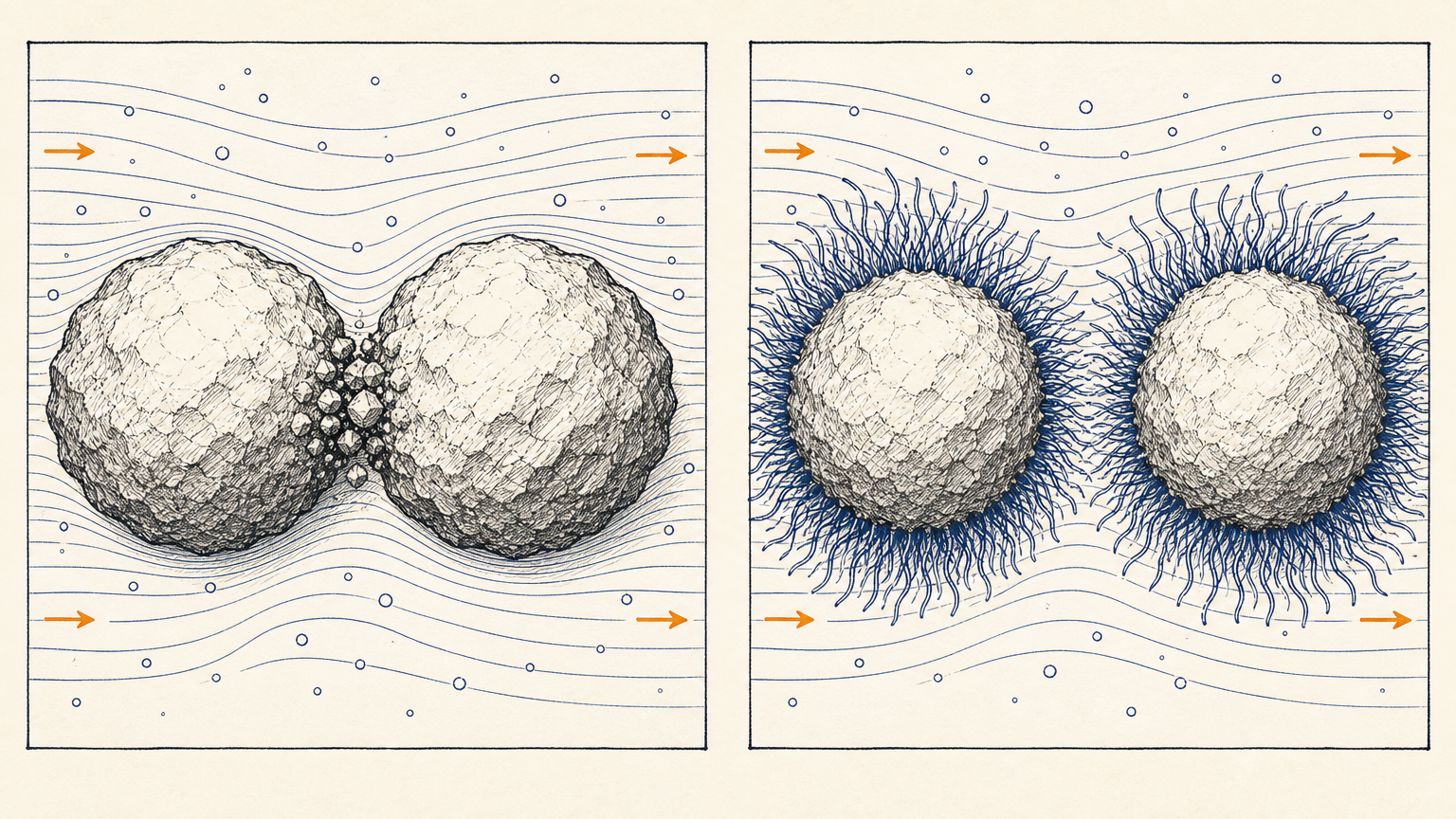
As neighboring particles approach, the side chains begin overlapping.
This overlap creates an energetic penalty that resists further approach.
Instead of allowing particles to contact directly, the polymer establishes a microscopic protective layer around each cement grain.
The process resembles densely planted trees whose branches prevent neighboring trunks from touching.
No rigid barrier exists.
Instead, the branches simply occupy enough space that direct contact becomes increasingly difficult.
This phenomenon is known as steric hindrance.
Unlike electrostatic repulsion, steric stabilization remains effective as pore-solution ionic strength changes.
For this reason, steric hindrance has become the defining feature of modern polycarboxylate superplasticizers.
Does Stronger Adsorption Mean Better Dispersion?
An important misunderstanding occasionally appears in technical discussions.
Some assume that stronger adsorption automatically leads to better concrete performance.
The relationship is more nuanced.
Adsorption simply anchors the polymer onto the cement surface.
Without adequate adsorption, the polymer cannot perform its dispersing function.
Excessive adsorption is not always desirable.
If adsorption occurs too rapidly or too strongly, polymer molecules may become concentrated on selected particles while leaving others insufficiently protected.
Conversely, weak adsorption may reduce overall dispersion efficiency.
The objective is therefore controlled adsorption rather than maximum adsorption.
Successful molecular design balances:
- Adsorption rate
- Surface coverage
- Side-chain extension
- Polymer mobility
- Desorption behavior during hydration
This balance varies according to cement chemistry, sulfate availability, and the composition of the surrounding pore solution.
How Side-Chain Geometry Changes Dispersion
The efficiency of steric hindrance depends heavily on the geometry of the polymer itself.
Longer side chains create a thicker steric layer, and higher grafting density puts more of them on the surface.
Backbone flexibility then decides how well the polymer adapts to an irregular particle, and molecular-weight distribution decides how uniformly any of it is expressed across the polymer population.
Those variables are why polymers built from different macromonomers, such as HPEG 2400 and TPEG 2400, disperse differently even at the same dosage.
Chain length in particular is a trade rather than an upgrade, and the production and consistency costs it carries are worked through in what a longer side chain costs.
What Changes When the Cement Is Not Ordinary Portland
A superplasticizer is designed against a cement, not in the abstract. Carbon reduction is now moving concrete off ordinary Portland faster than most formulations were built to follow.
The binders taking its place hydrate on different schedules and present different surface chemistry:
- Portland limestone cement (PLC)
- Limestone-calcined clay cement (LC³)
- High-volume slag cement
- Fly ash-rich binders
- Alkali-activated materials
Adsorption is where that shows up first, and dosage is where a plant notices it.
Five cement-side variables do most of the damage: C₃A content, sulfate balance, fineness, alkali content, and which supplementary materials are present. Two plants running the same PCE can report different water reduction and slump retention while following identical procedures.
A European producer found exactly this shape. One formulation held slump beautifully on locally made cement and lost workability once the same product was used in neighbouring markets, and the cause traced to gypsum balance altering adsorption during early hydration.
Engineers did not redesign that polymer. They widened its compatibility window until it held across several regional chemistries, which is the cheaper move in almost every case.
The practical consequence for anyone shipping into a blended-cement market is to re-qualify on the binder the customer actually runs, not on the reference cement the formulation was built against.
Widening a compatibility window is work done inside an architecture the macromonomer already set. A slump-retention platform such as EPEG 3000 starts from a different side-chain geometry than an HPEG one, so the range a formulator can reach without a redesign was decided at the monomer.
Which architecture a plant is working inside is a certificate question, settled by hydroxyl value and double-bond retention before the first trial batch.
The Three Stages a PCE Must Work Through
Three sequential processes determine fresh concrete performance.
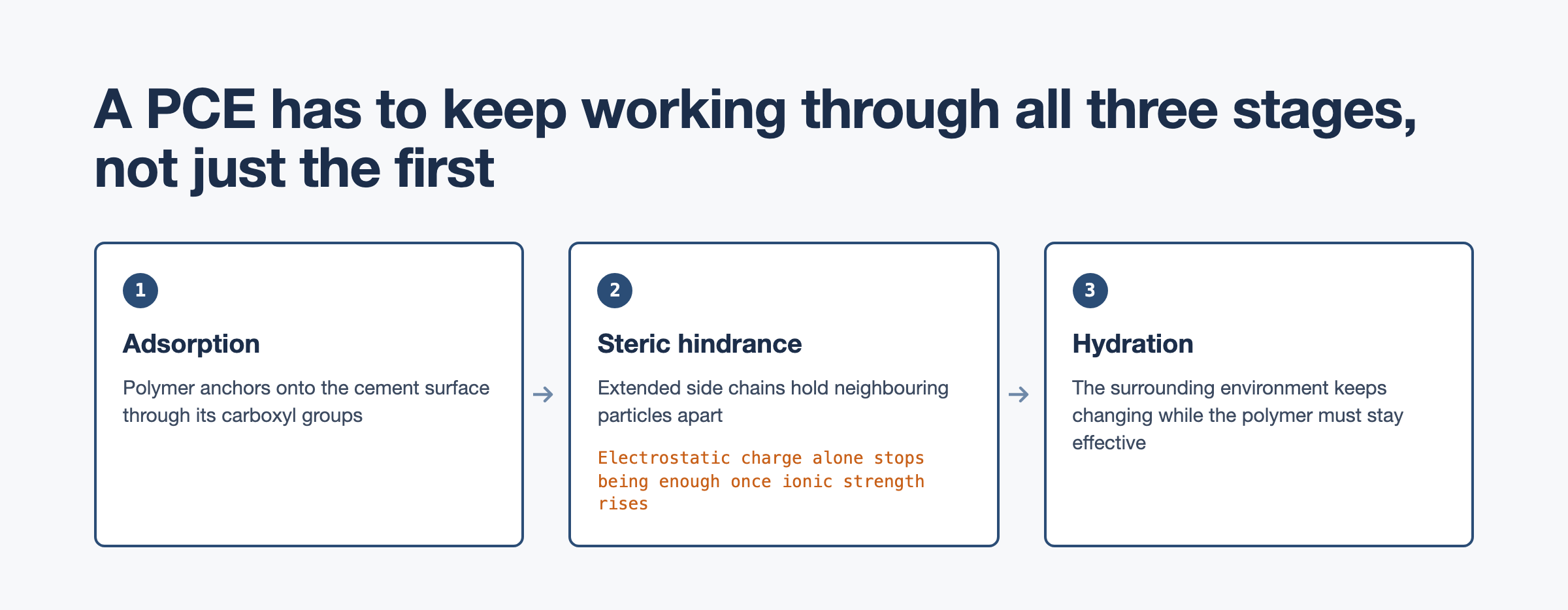
Adsorption anchors the polymer to the cement surface.
Steric hindrance maintains particle separation.
Hydration continuously modifies the environment in which the polymer must function.
A successful PCE formulation must therefore remain effective throughout all three stages rather than optimizing only the first.
Understanding this sequence shifts formulation development away from maximizing individual laboratory parameters toward designing molecular systems that hold up under real construction conditions.
What a Comb-Shaped PCE Polymer Is Made Of
Modern polycarboxylate superplasticizers are often described as comb-shaped polymers.
The description is more than a convenient illustration.
It explains why molecular architecture has such a profound influence on concrete performance.
The polymer backbone anchors onto the surface of cement particles through carboxyl functional groups.
Attached to this backbone are numerous polyether side chains extending outward into the surrounding aqueous phase.
These side chains create physical separation between adjacent cement particles. Separated particles flocculate less and disperse more evenly.
The effectiveness of this mechanism depends not simply on the presence of side chains but on how they are distributed throughout the polymer.
Several architectural characteristics become important:
- Side-chain density
- Side-chain length
- Spacing between graft points
- Backbone flexibility
- Overall molecular-weight distribution
Changing any one of these variables influences the spatial configuration of the entire polymer.
Modifying the polyether macromonomer changes the behavior of the finished PCE in ways that extend well beyond laboratory measurements.
What This Means in Practice
The useful question about a PCE is not how much water it removes from a mix design. It is how the particle system behaves from the first minutes of mixing through placement.
Adsorption only anchors the polymer to the cement surface. Steric hindrance is what holds the particles apart, and hydration keeps changing the surface conditions that both depend on.
A polymer that performs at the first stage and fades by the third will look strong in paste testing and disappoint on site.
The architecture set at the macromonomer stage therefore governs everything downstream. Side-chain length, grafting density, and backbone flexibility are fixed long before the first batch is mixed, and no dosage adjustment at the batching plant recovers what the molecule was never built to do.