

The 2400 in HPEG 2400 is a nominal figure, not a measurement. The line that pins the side chain is the hydroxyl value, and on published commercial specifications it spans a band about 18% wide.
HPEG 2400 is methallyl alcohol polyoxyethylene ether: one polymerizable double bond at the head, roughly 53 ethylene oxide units behind it, shipped as a white to yellowish flake.
Dosage, reactor temperature and clay sensitivity in the finished superplasticizer are all decided long before a concrete plant sees anything.
What HPEG 2400 Is at the Molecular Level
HPEG 2400 carries one polymerizable carbon-carbon double bond and one terminal hydroxyl per molecule. CAS 62601-60-9, roughly 53 ethylene oxide units grown onto a methallyl alcohol starter.
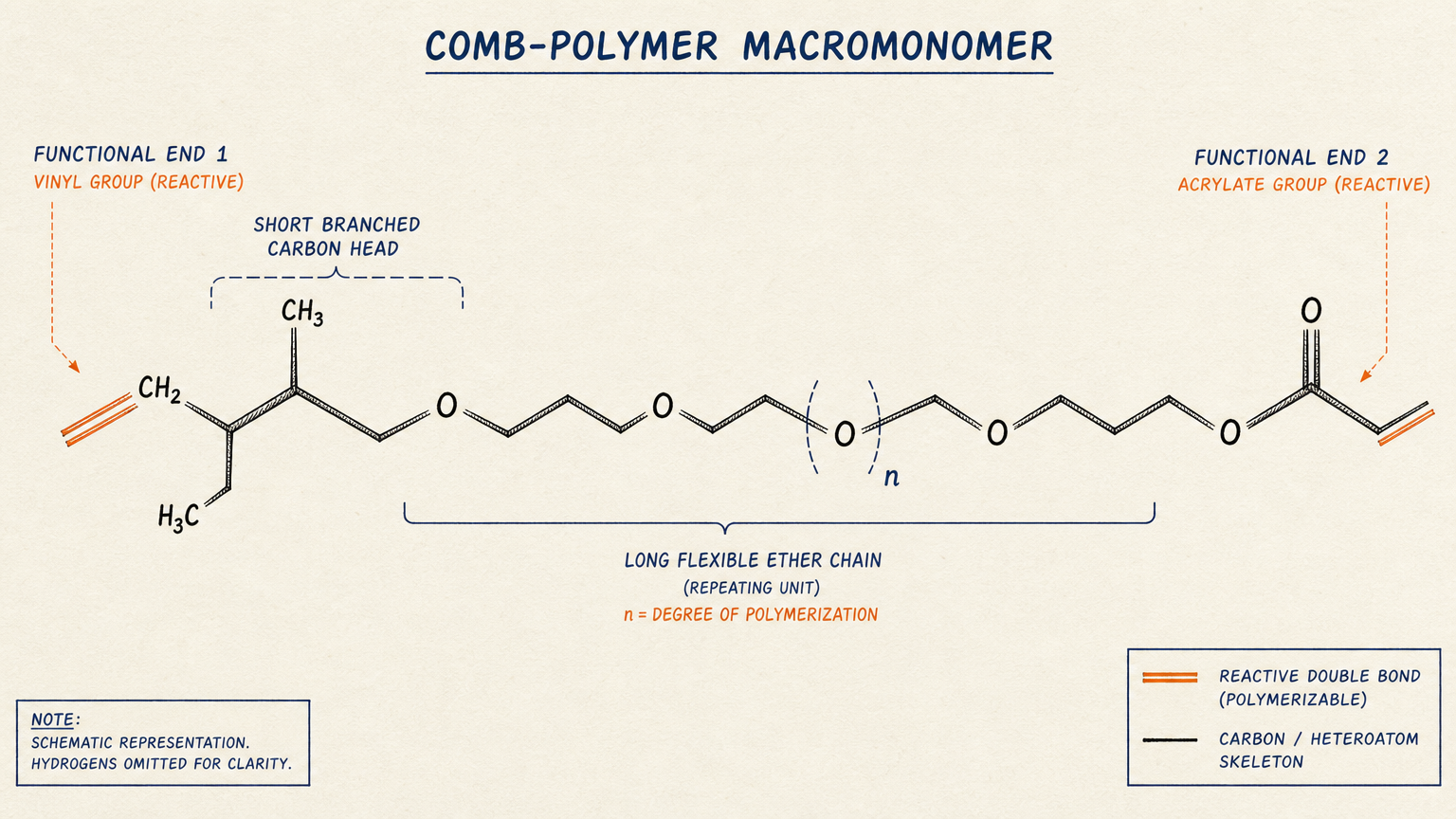
Commercial polyether macromonomers split into three families: methacrylate ester (MPEG), isoprenyl ether (IPEG and TPEG), and methallyl ether, which is where HPEG sits. Xinyi Li’s 2023 review called HPEG-PCE the mainstream choice, on dosage effectiveness and ease of preparation.
The double bond decides how much macromonomer enters the backbone; the ethylene oxide chain decides what the finished comb polymer does on cement.
What the HPEG 2400 Specification Numbers Control
Three lines on an HPEG 2400 certificate of analysis do real work: hydroxyl value, double-bond retention and water content. Hydroxyl value matters most, because it is the molecular-weight measurement wearing a different unit. The windows below come from Jiahua Chem’s published HPEG specification, quoted because it is public rather than because it is the grade you would buy.
Check them against the certificate your own channel issues. HPEG 2400 reaches this market through Kunlun, from PetroChina Jilin Petrochemical, and STL, from Lianyungang Petrochemical. A window binds only if it appears on that producer’s document.
| Specification line | Published window | Reported batch | What it sets in the finished PCE |
|---|---|---|---|
| Hydroxyl value | 21.40 to 25.40 mg KOH/g | 23.2 | Side-chain length, so grafting density |
| Double-bond retention | 92% minimum | 98.97% | Ceiling on macromonomer entering the backbone |
| Water content | 0.60% maximum | 0.22% | Water balance of the aqueous charge |
Divide 56100 by the hydroxyl value and that window resolves into a side chain of roughly 2210 to 2620 g/mol. The batch value of 23.2 works out at about 2418.
So two lots both labelled HPEG 2400 can differ by around 400 g/mol of side chain and both sit inside the same specification. A published HPEG 2400 specification window quoted in mg KOH/g is therefore worth more than a grade name, and the batch certificate is worth more than the window.
Going longer on the side chain is not the obvious upgrade it looks like. Xinyi Li’s review found three incompatible positions in the literature: length helps dispersion, length hurts it, or no clear connection exists. That disagreement is why a formulator trials a macromonomer rather than calculating one.
How HPEG 2400 Copolymerizes with Acrylic Acid
HPEG 2400 copolymerizes with acrylic acid by aqueous free-radical polymerization, with the methallyl double bond as the constraint. Allyl and methallyl unsaturation is comparatively unreactive in radical propagation, so the conventional route runs at 60 to 90 °C simply to get the macromonomer to react.
Acrylic acid and the macromonomer also carry unequal reactivity ratios. Production runs semi-batch with a metered addition profile, because the drip rate is what forces macromonomer incorporation.
Reactor temperature is an initiator decision, not a property of the monomer you buy. Anhui Conch’s granted patent CN108892753B runs HPEG-2400 at 30 °C on a redox pair: potassium persulfate and tert-butyl hydroperoxide against L-ascorbic acid and ferrous sulfate.
Its first example charges 260 g of HPEG-2400 and 100 g of HPEG-3000 against 38 g of acrylic acid, dripped in over three hours. Reaction then runs two hours at 30 °C to 40% solids.
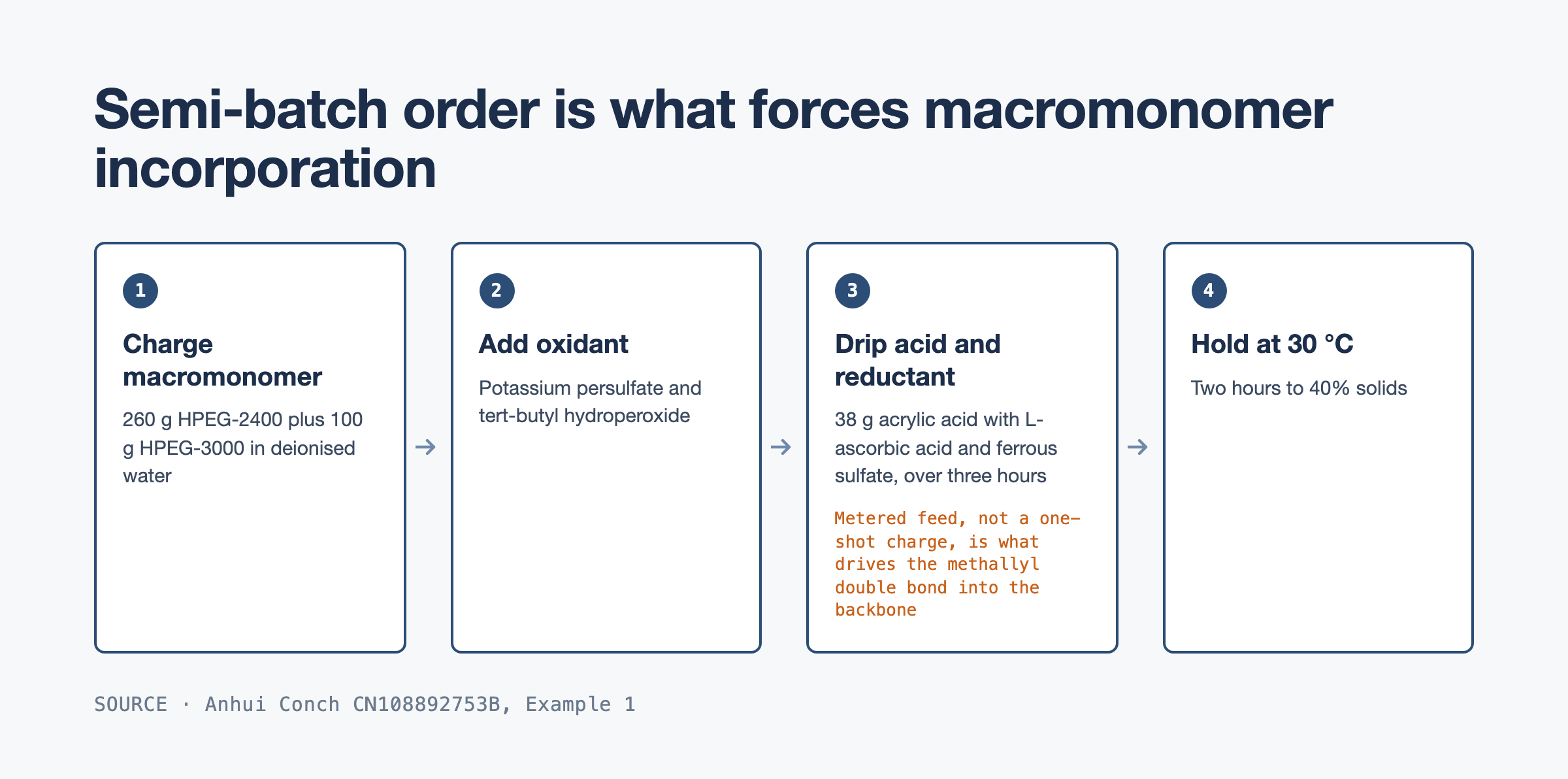
That polyether-to-acid ratio, close to 10:1 by mass, is the part to carry into your own recipe.
The redox pair bought the low temperature, not a shorter drip.
HPEG 2400 Against TPEG and EPEG Macromonomers
At equal nominal molecular weight, HPEG needed the most dosage of the three. Ke and co-workers at KZJ New Materials held synthesis conditions constant in 2023 and adjusted dosage until each system reached a matched slump of 165 to 170 mm.
| Macromonomer | Dosage (%) | Slump (mm) | 1-day (MPa) | 7-day (MPa) | 28-day (MPa) |
|---|---|---|---|---|---|
| HPEG-2400 | 0.53 | 165 | 16.8 | 33.9 | 50.0 |
| TPEG-2400 | 0.48 | 170 | 17.0 | 33.6 | 51.7 |
| EPEG-2400 | 0.43 | 170 | 18.2 | 35.6 | 52.2 |
Roughly 23% more HPEG than EPEG bought the same workability, tested to GB 8076-2008 on a P·O 42.5 cement. The paper’s own reading was that EPEG carries higher polymerization activity than TPEG and HPEG.
Xinyi Li’s review pointed the other way, with IPEG and TPEG dispersing more weakly than HPEG and compensating through slump retention. Ke’s numbers came from one screening step inside a single early-strength redox formulation, so neither result settles the general case.
Do not substitute TPEG 2400 for HPEG at equal molecular weight without re-qualifying dosage. The vinyl ether chemistry behind EPEG 3000 is a separate decision, because it is what makes formulating below 25 °C practical.
Where HPEG-Based Superplasticizer Is Used
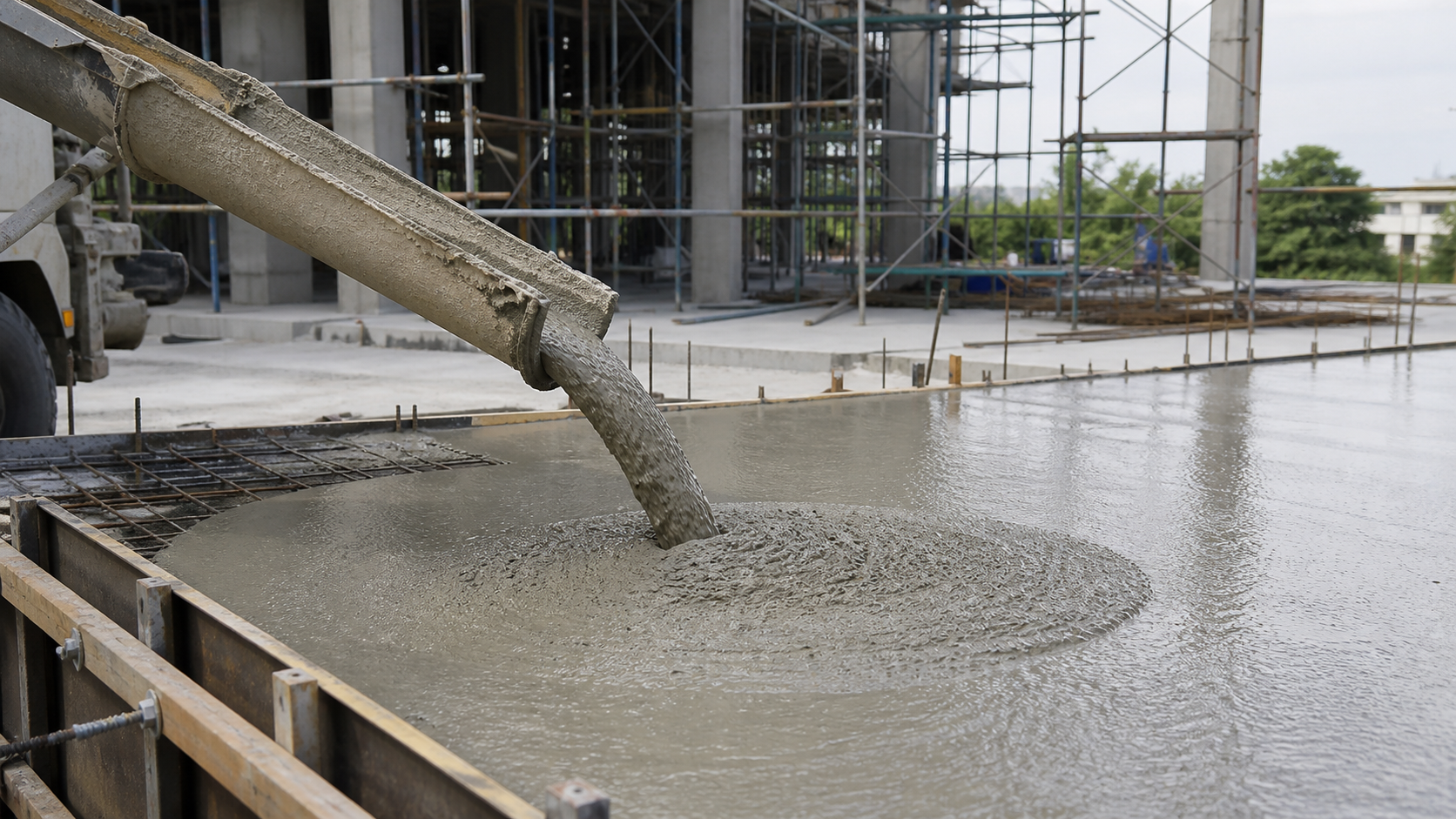
HPEG-based PCE goes into ready-mix, precast and high-strength structural concrete as the high-range water reducer. ASTM C494 defines that class in North America; EN 934-2 is the European counterpart.
Types F and G must cut water content by at least 12%, against 5% for the Type A, D and E water reducers. The National Precast Concrete Association puts the practical upper end above 30% off a control mix.
So the 30% to 35% figures HPEG-based PCE is marketed on sit at two to three times the Type F floor, as a class claim rather than an HPEG-specific one.
Manufactured sand is where an HPEG-type PCE gets expensive. He and co-workers modelled PCE side chains against calcium montmorillonite using density functional theory in 2024.
HPEG side chains still adsorbed favourably on the clay at polymerization degrees of 10 and above. The APEG and IPEG types studied lost that affinity over the same range.
Because the polymer prefers clay over the hydration products, dosage disappears before it disperses anything. Lengthening the side chain does not buy an HPEG-type PCE out of that, so high-fines aggregate stays a problem the macromonomer grade will not solve.
What This Means in Practice
Specify HPEG 2400 by hydroxyl value and double-bond retention, then qualify the lot in your own reactor. The grade name carries neither number.
The macromonomer is the cheaper half of the decision. Initiator system and addition profile move dosage further than swapping methallyl for isoprenyl will.
The honest question at a purchase order is not whether HPEG beats TPEG. It is whether your reactor gets the 98% of double bonds you paid for into the backbone.