

A GPPS spec sheet hands you about ten numbers, and four of them decide whether the resin fits your part. Melt flow index sets the molding window. Vicat softening sets the service-temperature ceiling.
Notched Izod tells you whether the part survives handling, and refractive index tells you whether the clarity reads as glass-like. Everything else on the sheet is decoration for most buying decisions.
General-purpose polystyrene is the amorphous styrene homopolymer that dominates clear-pack, cosmetic, and disposable injection. The cheapest way to fail at specifying it is to read its property list as adjectives instead of as windows.
What General-Purpose Polystyrene Is
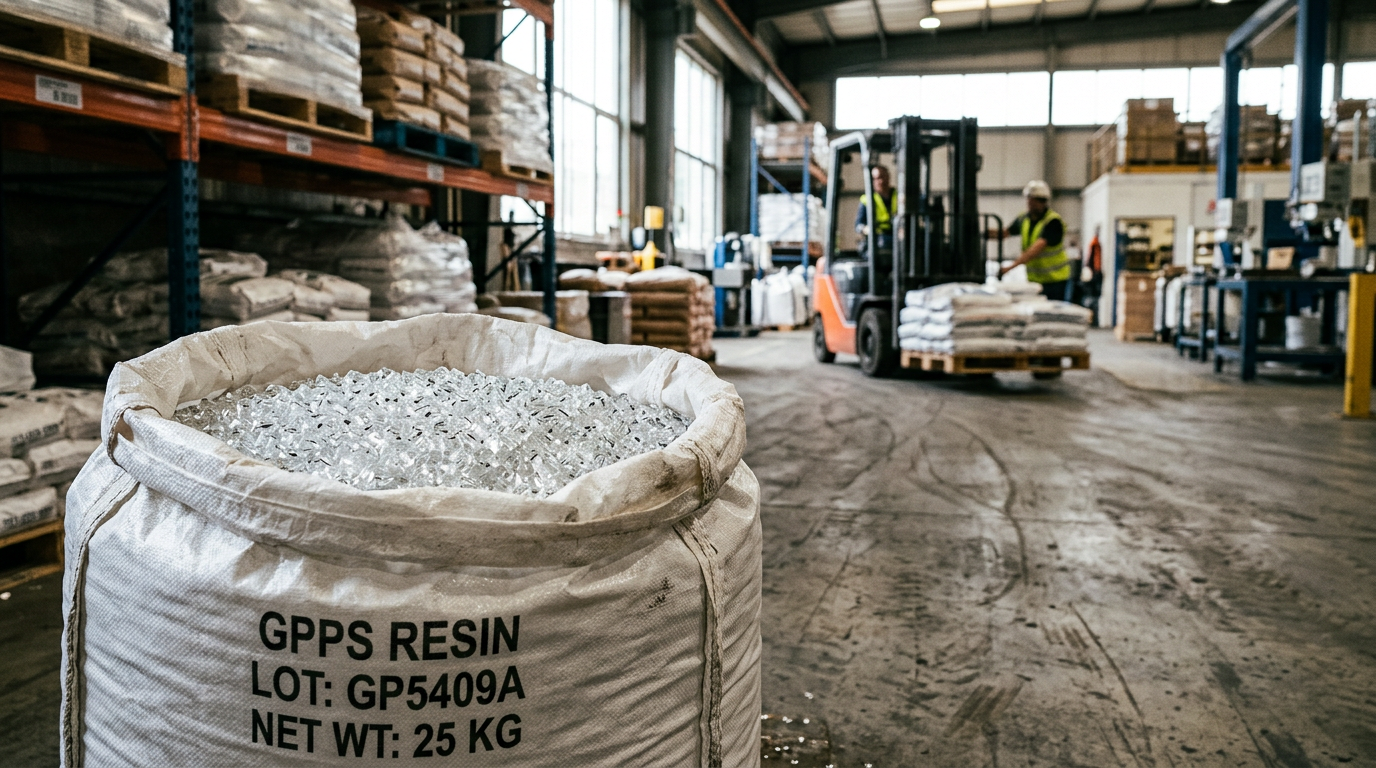
GPPS is the linear, amorphous homopolymer of styrene monomer, made by suspension or continuous bulk polymerization. There is no rubber phase, no copolymer block, and no impact modifier. The “general-purpose” qualifier means exactly that: no second-phase morphology has been introduced.
Three consequences flow from the single-phase amorphous structure. The chains pack loosely with no crystallinity, so density lands at 1.04-1.06 g/cm³ and refractive index hits ~1.59, glass-clear in thin sections. The glass transition sits at 95-100°C with thermal degradation onset near 300°C, giving a wide injection-processing window of 200-240°C.
The absence of a rubbery second phase means crack propagation has nothing to stop it. That is the entire reason the material is brittle. Every property a buyer cares about traces back to that single-phase architecture.
What Are GPPS’s Key Properties?
Four numbers govern whether a GPPS grade fits a part. The rest of the spec sheet is useful for finite-element work but irrelevant at point-of-quote.
- MFI (200°C / 5.00 kg): stocked grades span roughly 1.8 to 8 g/10min across the series. MFI sets the molding window and the cycle-time math.
- Vicat softening: 95-105°C across the family. Anything that sees autoclave, dishwasher, or hot-fill is out of scope, full stop.
- Notched Izod: 15-25 J/m. Fine for static parts on a shelf, marginal for parts that get dropped, wrong for parts under repeated impact.
- Refractive index 1.59 / light transmission >88%: the optical signature that puts GPPS in cosmetic packaging, transparent cutlery, and clear-pack lids.
Secondary specs typically include tensile strength at yield 40-55 MPa (ASTM D638), tensile modulus 3.0-3.3 GPa, flexural modulus 3.2-3.5 GPa, elongation at break 1-3%, and HDT 90°C at 1.82 MPa. These numbers confirm lot-to-lot consistency more than they drive selection.
How GPPS Differs from HIPS at the Polymer Level
HIPS is GPPS with 5-10% polybutadiene rubber grafted onto the polystyrene backbone during polymerization. The rubber doesn’t dissolve into a homogeneous mixture. It forms discrete particles dispersed in a continuous polystyrene matrix.
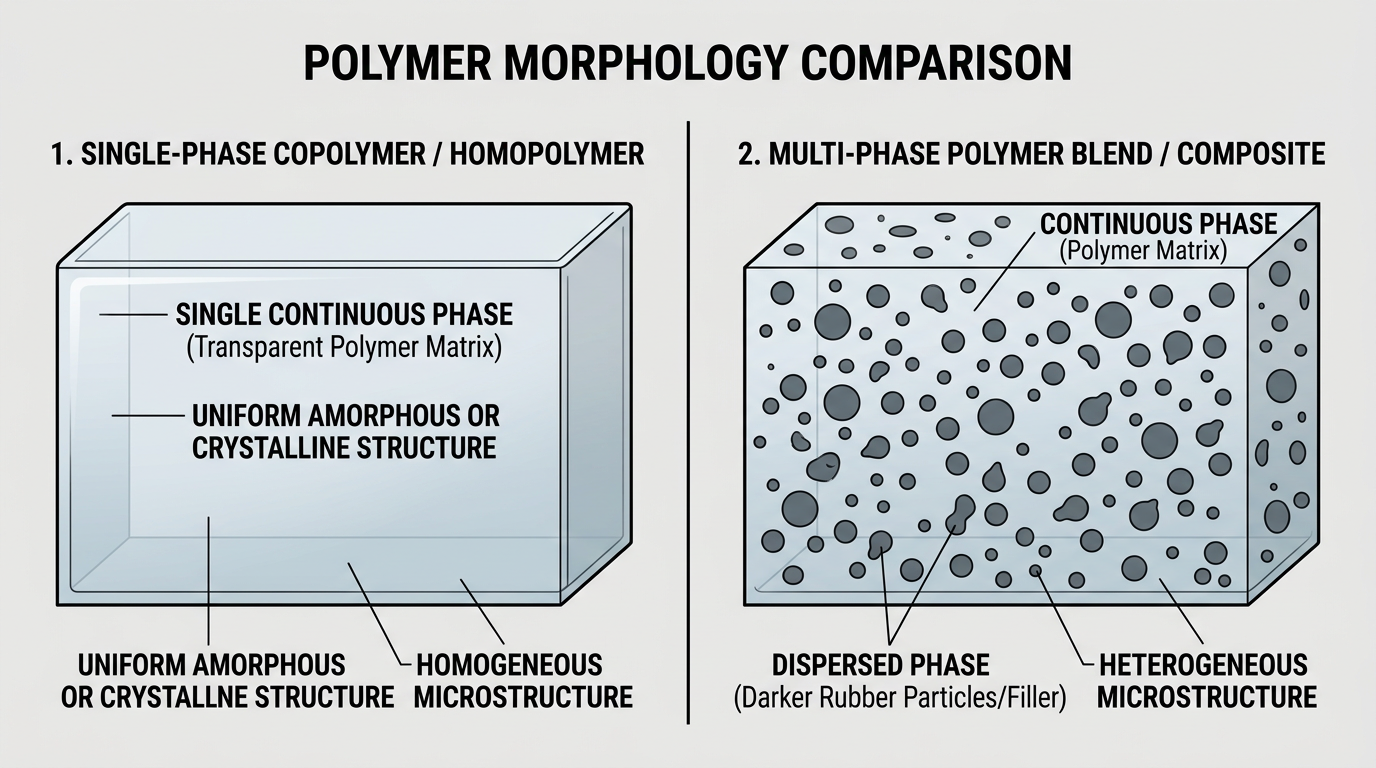
Two consequences follow from the two-phase morphology. The rubber particles are larger than the wavelength of visible light, so they scatter incoming light: HIPS turns translucent while GPPS hits >88% light transmission. The particles also deform under stress and arrest crack propagation, pushing notched Izod from GPPS’s 15-25 J/m up to roughly 50-100 J/m in HIPS.
The GPPS vs HIPS trade is binary at the polymer level. There is no “somewhat tougher GPPS” or “somewhat clearer HIPS”: these are structurally different materials. A part that needs both clarity and impact strength moves to PETG or polycarbonate, not a hybrid polystyrene.
When the decision tips to HIPS, two Dushanzi grades carry that side: HIE-1 (MFR 3.3 g/10min, Charpy 12 kJ/m²) and HIEM (MFR 3.9–5.7 g/10min, Charpy ≥7.0 kJ/m²). Impact here is ISO 179 Charpy, not the notched Izod used above.
What GPPS Grades a Buyer Will See on a Quote
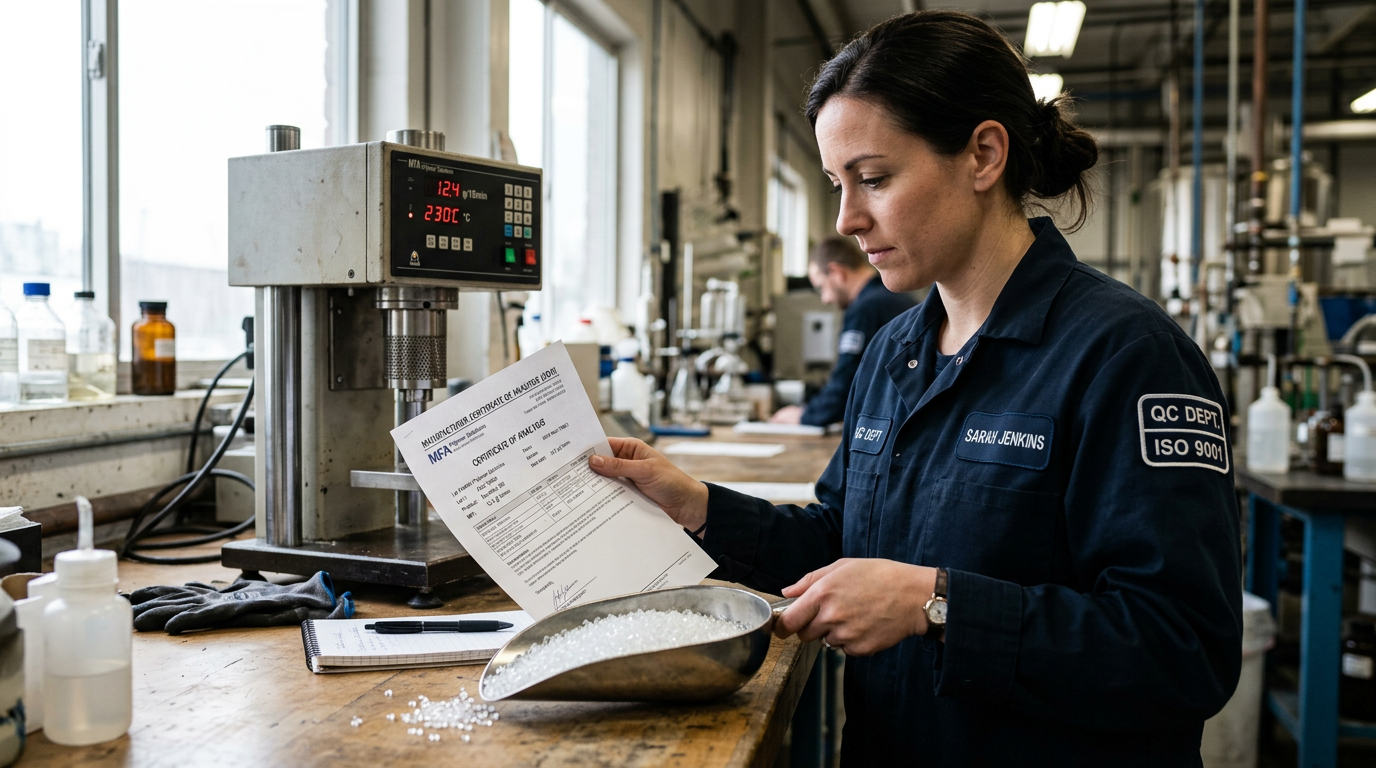
Asian commodity polystyrene producers typically use a numeric grade-naming convention that clusters by MFI band. Once you know the convention, you can read a grade code on a quote and infer the application slot without opening the full COA.
| Grade | Published MFI (g/10min, 200°C / 5.00 kg) | Typical application slot |
|---|---|---|
| 180NT | 1.8 ± 0.5 | XPS board, decorative panel, melt-strength-sensitive extrusion |
| 300NT | 3.0 ± 1.0 | Light-diffusion sheet, thermoforming, general sheet extrusion |
| STL-535 | 3.0 ± 0.5 | Injection molding, clear sheet, lighting and display panels |
| 500NT | 4.0–6.0 | LED light-guide plate, general injection, transparent parts |
| STL-525 | 8 ± 2 | Thin-wall injection, fast-cycle food packaging, disposable cutlery |
Low-MFI grades hold melt strength during the draw, which is why the bottom of the table lands in sheet extrusion and thermoforming. At the top, STL-525 fills thin-wall molds fast enough for single-digit-second cycle times in food-packaging runs.
The same MFI-band-to-application logic drives the three main grade-decision axes in polypropylene resin, where MFI, density, and impact behavior split that family into homopolymer, random copolymer, and impact copolymer slots. For GPPS grade selection, read the grade code first, the COA second. The code tells you which corner of the spec window the producer parked that lot in.
Where GPPS Wins and Where It Loses
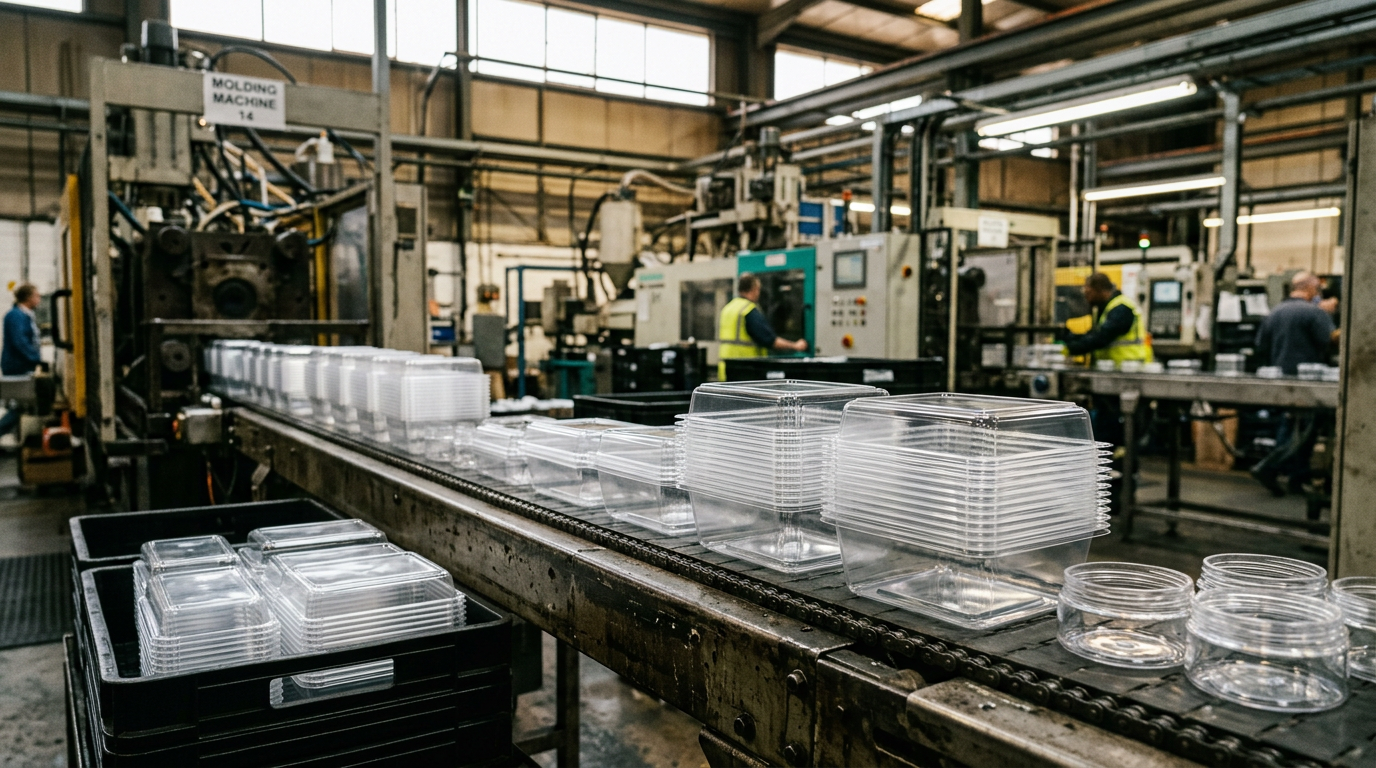
GPPS wins where clarity, rigidity, and unit cost matter and where the part lives a stationary life. Cosmetic primary packaging, jewel cases, disposable cutlery, clear food containers, lighting diffusers, refrigerator interior trim, and laboratory disposables all play to GPPS’s MFI breadth and 1.59 refractive index.
STL-525, at 8 ± 2 g/10min, covers thin-wall injection for clear food packaging, where the broad processing window cuts cycle times against competing transparent resins. That structural cost advantage survives even when clarified polypropylene reaches into the same clear-pack territory.
GPPS loses on three fronts. Where the part sees repeated mechanical loading or impact, the 15-25 J/m notched Izod fails fast. The conversation moves to HIPS for translucent parts or ABS for opaque structural ones.
Where service temperature crosses the 95°C Vicat ceiling, the part deforms, so autoclave, dishwasher, and hot-fill applications need PP, PET, or polycarbonate. Where the part takes a knock and a clarity spec at the same time, neither GPPS nor HIPS satisfies both. The design moves to PETG or polycarbonate.
GPPS is the right call when the duty is one-shot static load with a clarity premium. Once duty becomes repeated impact or thermal cycling, the conversation moves on.
What This Means in Practice
The most common GPPS specification mistake is treating the property list as adjectives — “rigid, transparent, brittle, cost-effective” — instead of as windows. Read the MFI band as a molding-window decision, the Vicat as a service-temperature ceiling, the Izod as a handling-survival number, and the refractive index as a glass-equivalence target.
The resin then maps to applications cleanly and the grade code on a quote tells you the rest. The COA gives you four numbers; the spec sheet gives you the window; the application tells you which corner of the window you actually need.