

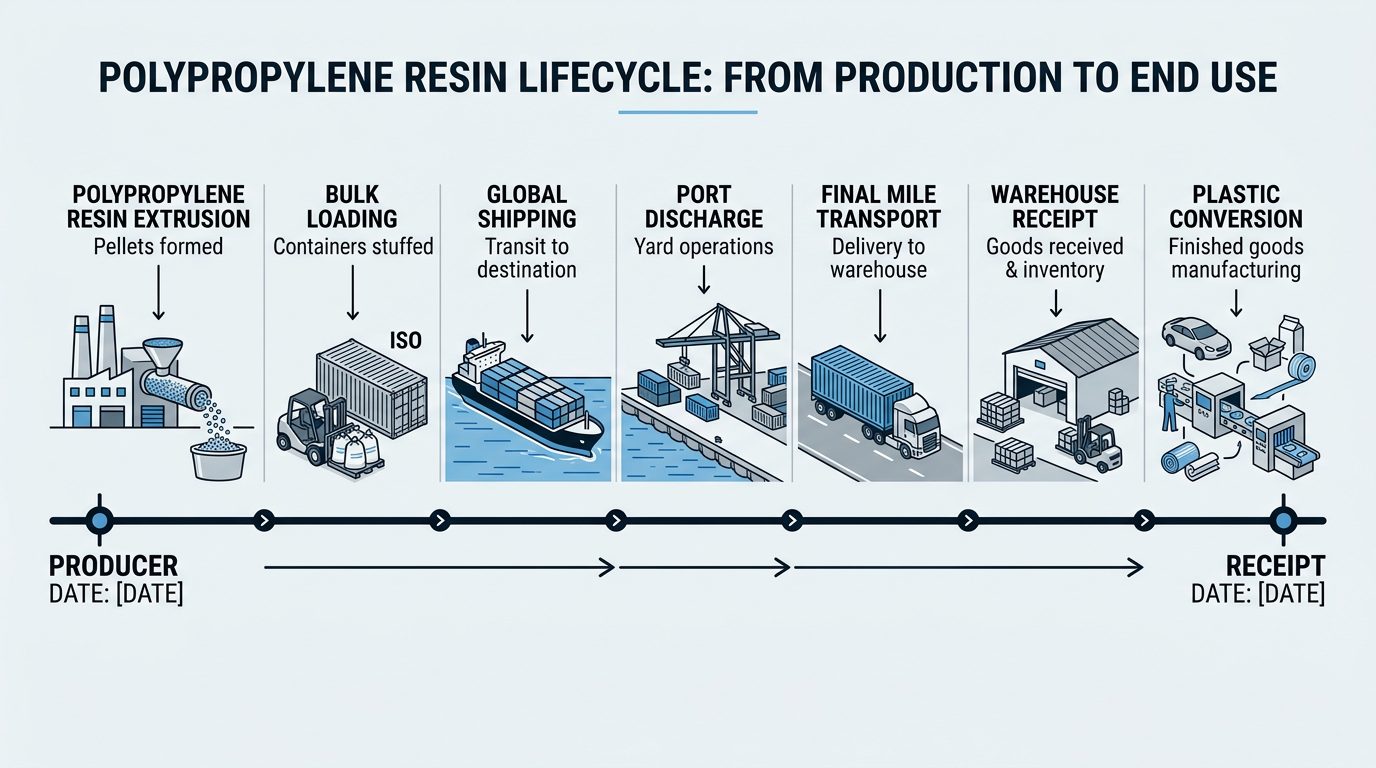
A 25 kg bag of PP pellets received last September is not “last September old.” The producer date stamped on the COA is the real starting point. That date is often 60-90 days earlier than the day the container cleared customs.
For most polypropylene grades, that gives a working window of 12 months minimum and 24 months in practice under spec storage. After 10 years buying PP container loads, I trust the COA date over the warehouse log every time.
How Long Can a Bag of PP Pellets Actually Sit Before You Need to Worry?
Polypropylene resin has a 12-month minimum shelf life declared by major producers. The practical window stretches to 24 months under spec conditions. Both are measured from the producer’s pellet extrusion date — not the day your container arrived.
Reliance’s REPOL declaration states “minimum one year from extrusion date.” Mangpol’s MRPL guide gives the same 12 months. Advanced Plastiform’s converter-side experience pushes it to “up to two years with proper storage.”
Longer figures circulate, out to three to five years, but they trace back to datasheets for resin sealed in original packaging under tight environmental control. Treat any number without a named producer and a stated storage condition as unusable, because it is the storage condition rather than the resin that sets it.
The 60-90 day gap between extrusion and warehouse receipt is the part most receiving teams miss. PP grades from PetroChina Dushanzi or Sinopec are stamped at the producer-complex at extrusion. They then sit in container yards, ports, and freight forwarders before they hit your dock.
If your receiving log says “January 2026” and the COA says “October 2025,” the real 12-month window closes the following October. Document the producer date on receipt. FIFO from that date.
Why Does PP Age At All — and Which Storage Conditions Actually Matter?
The polymer chain in polypropylene is stable for years. What runs out is the antioxidant package compounded into the pellet.
Michael Sepe, a materials consultant with 45+ years in plastics writing for Plastics Technology, calls the “expires like food” framing a “fanciful notion” for thermoplastics. The actual time-limited component is the stabilizer chemistry.
Most commodity PP grades carry a phenolic antioxidant (Irganox 1010 class) at roughly 0.1% loading. A phosphite antioxidant (Irgafos 168 class) sits alongside at 0.2-0.3%, for 2000-3000 ppm total.
Industry stabilizer literature shows that 0.1% phenolic loading reduces oxidation by about 80%. Once that loading depletes, the next processing cycle reveals the problem as MFI drift, yellowing, or smoke at the die.
Three storage conditions actually move the needle:
- Ambient temperature ≤30°C. Sepe describes a Chennai warehouse where temperatures “considerably higher” than 90°F (~32°C) measurably accelerated aging. Above that ceiling, antioxidant consumption climbs and the practical 24-month window shortens — sometimes to under 12.
- No direct UV. Direct sunlight accelerates degradation, period. Sealed bags inside a roofed warehouse handle this by default; pallets staged outdoors under tarp do not.
- Humidity ≤80% RH. PP itself is non-hygroscopic, so absolute humidity matters far less than for PA or PET. The real risk is condensation cycling on cold-warehouse mornings when humid air hits cold pellet surfaces.
Sealed octabins and woven bags with intact liners shield the pellet from UV and oxygen by default. Once a bag is open, the clock on the remainder accelerates. Stabilization-package loading also varies by grade selection, which affects how the lot ages.

How Do You Tell If a Lot Has Aged Out Before It Hits the Extruder?
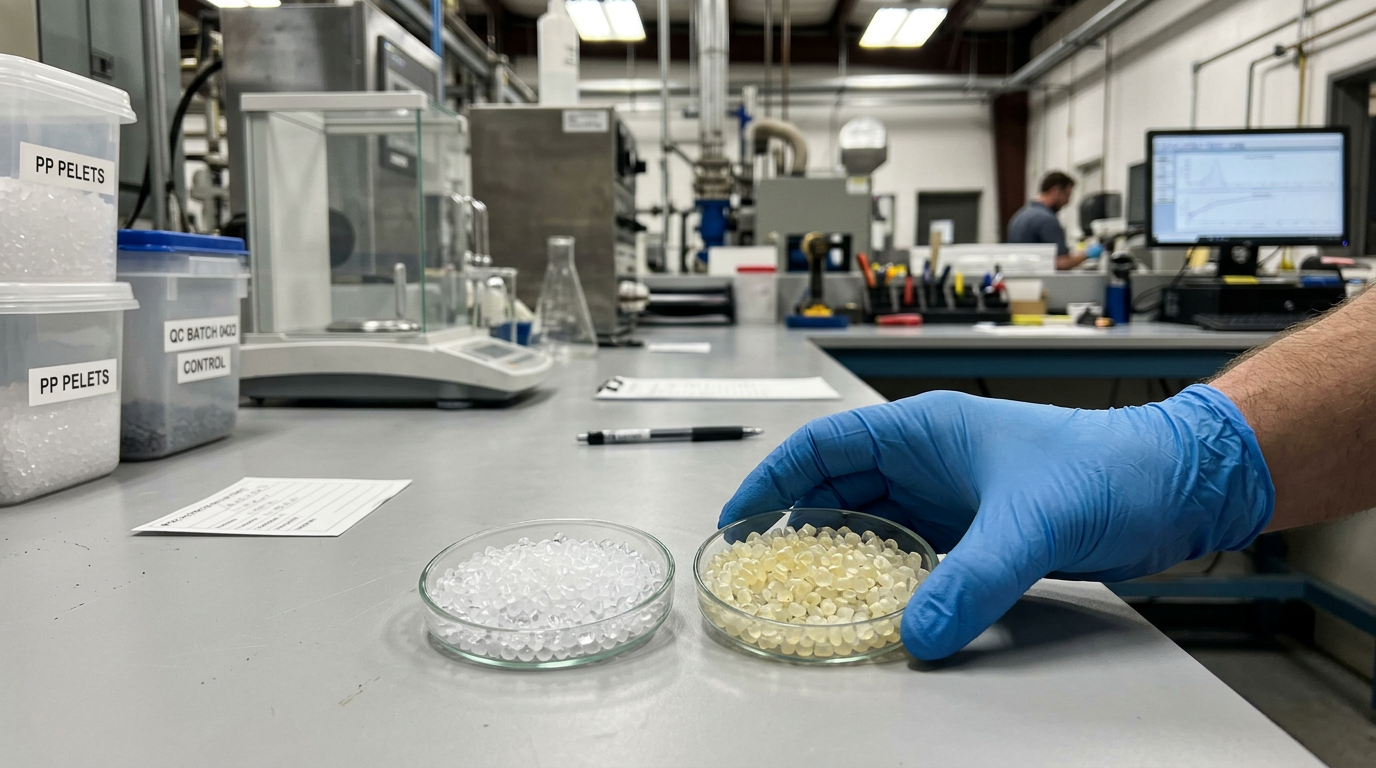
The 4-point sanity check below takes five minutes per pallet. It catches most aged lots before the extruder reveals them on a Tuesday morning when downtime is expensive. Pull a sample from the most-aged bag in the lot — pellet appearance lags the chemistry, so grab a meaningful number, not just one.
- Visual / color check. Fresh PP pellets are translucent-to-white with a uniform sheen. Aged pellets often show a faint yellow tint, especially when Irgafos 168 has begun hydrolyzing. Compare against a known-fresh pellet from the same grade in the same lighting.
- Smell. Fresh PP has a near-neutral odor. Oxidation byproducts — ketones and aldehydes — produce a faint sharp smell distinct from new resin. If you can detect it standing over an open bag, the lot warrants the MFI check.
- Pinch / brittleness on a test pellet. Aged PP loses tensile strength and embrittles. Squeeze a pellet between thumb and forefinger; fresh PP deforms slightly under firm pressure. If the pellet cracks or shatters under moderate pressure, pull the lot.
- MFI on a small sample. This is the definitive check when visual, smell, and pinch all sit borderline. Run a 5-gram MFI sample against the COA value. Drift above the spec band on the high side (chain scission) or low side (crosslinking) means the stabilizer is exhausted.
For lots older than the producer’s stated window but visually and smell-passing, the MFI check is the call. Don’t trust the 24-month upper bound on a lot you didn’t store yourself — that figure assumes spec conditions the whole way.
The Common Mistake That Burns Receiving Teams
The mistake I see most often: logging the receipt date as the FIFO start date. Receiving teams treat the producer’s 12-month declaration as if it begins when the container clears customs. That accounting error routinely over-runs a lot by a quarter or more.
The antioxidant package gives no external warning before the lot fails on the extruder. Read the producer date off the COA on receipt, write it on the pallet ticket, and FIFO against that.