

A melt flow rate of 0.9 g/10 min recorded under ISO 1133 and 0.9 g/10 min recorded under ASTM D1238 are not the same measurement, and ASTM says so in its own standard records. The method column on a lot certificate is where that gets decided, and it is the column most buyers skim past.
That one line governs whether a figure on the certificate can be compared with the specification you bought against. I read every lot certificate in the same order: which lines the purchase order made binding, which method and edition produced each number, and which properties the document never touched.
Work it that way and most accept-or-reject calls settle from the paperwork already in your hand.
Check Which Certificate Figures Actually Bind
A figure binds only if your purchase order named it as a limit, and producers say as much about their own published values. Arak Petrochemical’s LL0209AA datasheet carries the line “Values shown are averages & are not to be considered as product specifications.”
OPaL prints the same caution on its Opalene LLDPE M2525 sheet: its numbers are “Typical Values and not to be taken as specification limits.”
Both quotes come from datasheets, not lot certificates. Only the purchase order decides which of those measurements you can reject on.
Any line the order never named, ash and volatiles included, is information rather than a pass mark. I treat the order as the specification and the producer’s datasheet as a window.
Read the Method Column on a Resin Certificate
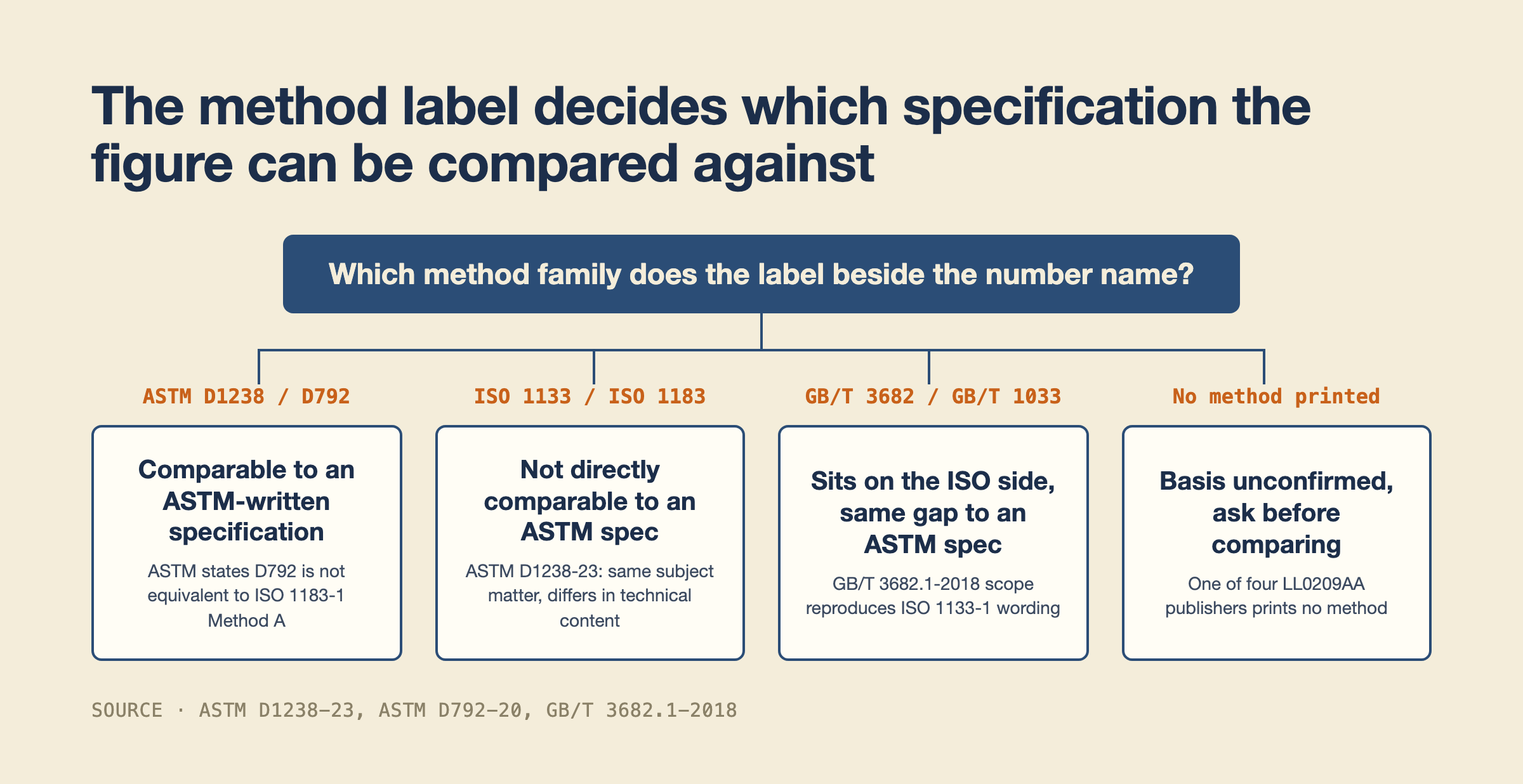
The method column decides whether a certificate figure and your specification sit on the same scale. ASTM’s D1238-23 record calls melt flow rate an “empirically defined parameter” rather than a fundamental polymer property, one influenced by “the conditions of measurement.”
Change the conditions and the number moves. Melt flow is the figure buyers lean on hardest, the number behind the three main polypropylene grades and the one most often copied from a datasheet into a purchase order.
Which Standard Family Produced the Figure
ASTM publishes a non-equivalence statement for both headline properties. Its D1238-23 record states that the standard and ISO 1133 “address the same subject matter, but differ in technical content.”
The D792-20 record drops the hedge: D792 “is not equivalent to ISO 1183-1 Method A.”
ISO 1183-1 allows an additional test temperature of 27 ± 2 °C. D792 gives more guidance on sample weight and dimension.
The procedural gap behind those statements is measurable on the bench:
- Preheat: 7 ± 0.5 minutes under ASTM D1238, at least 5 minutes under ISO 1133-1.
- Piston starting position: 46 ± 2 mm above the die under ASTM, 50 mm under ISO.
- Charge: 5 g specified by ASTM, left to the operator under ISO 1133-1.
ZwickRoell, which builds the instruments, calls the two procedures “equivalent but not identical.” Neither standard publishes the size of the shift between them, so there is nothing to correct for. Either both documents name the same method, or the comparison is not one.
Four producers publish a resin under the code LL0209AA, across three method families:
| Publisher | MFR (g/10 min) | MFR method | Density method |
|---|---|---|---|
| Iran Petrochemical Commercial Co. | 0.9 | ISO 1133 | ISO 1183 |
| Arak Petrochemical | 0.9 | ASTM D1238 | ASTM D2839 |
| Lotte Chemical Titan | 1.0 | not printed | not printed |
| PetroChina Dushanzi | 1.0 | GB/T 3682-83(89) | GB/T 1033-86 |
ASTM D2839 is the entry worth a second look. It derives density from an extruded melt-index strand rather than an annealed specimen, which makes it a different measurement, not a different label.
On paper they look identical, but I always qualify the second source on a real production run before I commit to dual-sourcing.
Which Edition of That Standard the Label Names
GB/T 1033-86 was superseded in 2009 by GB/T 1033.1-2008, and GB/T 3682-2000 was replaced by GB/T 3682.1-2018 with effect from October 2018.
The melt flow label above names the 1983 edition, a further generation back. A live product page can carry a method edition retired more than 15 years ago, so read the edition on your own document rather than assuming the current one.
A superseded edition does not mean the lot failed. It means the basis of the number is unconfirmed, and confirming it costs one email.
Which side of ASTM’s line a GB figure sits on is answerable from the texts. GB/T 3682.1-2018’s scope reproduces ISO 1133-1’s two-procedure wording sentence for sentence, and Part 2 is recorded as a modified adoption of ISO 1133-2:2011.
A GB-labelled melt flow figure therefore sits on the ISO side of ASTM’s statement. If your specification was written against D1238, that is the gap to close before you compare anything.
Know What a Resin Certificate Never Measures
A lot certificate reports what a small sample measured on a handful of properties, then stops. Four things that decide how the lot actually runs never appear on it:
- Molecular-weight distribution behind the melt flow figure.
- The additive package, including stabiliser loadings.
- Gel population in the delivered pellets.
- Contamination picked up after sampling, in transit or in your own silo.
The figures that do appear came from a sample, not from your tonnage. ExxonMobil’s 2018 technical brief on gels in polyethylene films describes its own tests as run periodically on “small amounts of resin sample that is assumed to be representative of the production lot.”
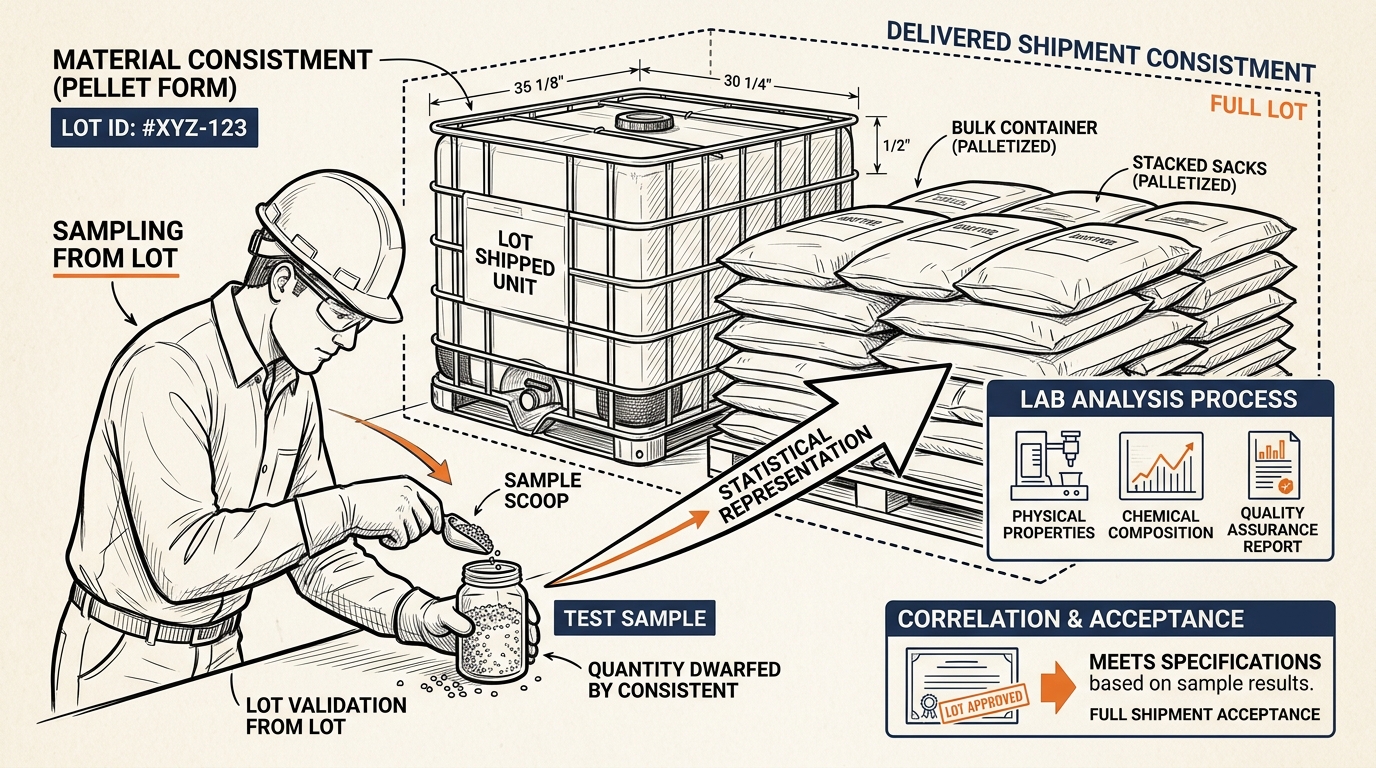
Any problem arising between those tests, in the brief’s words, “will naturally go unnoticed.”
No active ASTM method for gel count has existed since D3351-93 was withdrawn in 2000, and the record names no equivalent ISO standard.
ISO 1183-1:2012 notes in its own scope that plastic density “will depend upon the choice of specimen preparation method.”
Where that is the case, the standard says preparation details “will have to be included in the appropriate material specification.”
The certificate does not carry them. The density figure printed there is also a mean of at least three specimens, not one reading.
Melt flow hides the largest gap. Robert Nark and Karen Xiao of Celgard, writing in Plastics Technology, explain that shear viscosity falls as shear rate rises.
How fast it falls depends on long-chain branching and molecular-weight distribution, not on the melt index. Two resins matching at 190 °C and 2.16 kg can load a screw and a die differently at production shear rates.
If the certificate shows melt flow at the edge of your spec, ask for the molecular-weight distribution data before you accept the lot. That data sits with the producer’s technical team, and a sourcing route that passes batch documentation through directly, as Bastone does, turns the request into routine paperwork.
Specify the Resin Certificate You Want Before You Order
No polymer standard defines what a resin certificate has to contain or who has to sign it. The 2.1 through 3.2 document types buyers borrow in trade talk come from EN 10204, whose own scope covers “all metallic products.”
Asking a resin producer for a 3.1 certificate cites a standard that does not cover the material. The distinction underneath the vocabulary is still worth having.
Non-specific inspection reports results drawn from general production data. Specific inspection reports results from the lot supplied, validated by someone independent of the manufacturing department.
Nothing polymer-native exists to invoke, so it goes into the purchase order in words. Name four things for every property you intend to reject on:
- The property, its numeric limit and its unit.
- The test method and its edition year, written out in full.
- The specimen preparation, wherever the method says preparation moves the number.
- A statement that the reported results come from the delivered lot.
Agree that once in the frame contract covering all your resin lines, not order by order. Then write down who accepted what and on which figure, because six months later nobody remembers.
Next Steps Before You Accept the Lot
Put the purchase order and the certificate side by side and mark every line the order never named as a limit. Check each surviving figure for its method and its edition year before you compare it against anything.
A certificate is a record of one test on one sample, produced under one named document, not a description of the tonnage on your dock.
A superseded edition or an unnamed method is not a failed lot. It is an unanswered question, and the cheapest moment to ask it is while the containers are still sealed.