

Two observations make a processor certain the new lot is at fault: the gels started when the lot started, and they sit everywhere across the web instead of in a line. That is also what a new resin looks like while it purges an old, degraded one out of stagnant areas in the extruder and die.
Getting the call wrong costs a shift, because the two common gel families want opposite fixes. An unmelt wants more melting and mixing energy; a crosslinked gel wants heat and residence time taken away.
A razor blade, a hot plate and a look at where the defects sit separate them before the second roll runs.
Check Whether the Defect Is a Fish Eye or a Gel
A fisheye in ExxonMobil’s and Ingenia Polymers’ literature is an elongated hollow gel with a gas pocket at each end, caused by moisture or volatiles rather than polymer chemistry.
Gel is the wider word, defined by Mark Spalding’s group at Dow as any small defect that distorts a film product. The word carries no information about cause.
Report fish eyes meaning unmelts to a service group that reads fisheyes as moisture, and you spend a week diagnosing two different defects.
Moisture and volatiles point at drying, storage and handling, not at the reactor or the screw. Name which one you mean in the first line of the complaint.
Read Where the Gels Sit and When They Started
Geometry attributes a gel before chemistry does, and it needs nothing but film and light. A defect on the film surface rather than encapsulated in it comes from a source at or beyond the die.
Gels falling in lines parallel to the machine direction are forming in the die, because anything upstream would spread across the width of the web.
| What you see | Where it formed |
|---|---|
| Surface, not encapsulated | At or beyond the die |
| Machine-direction lines | Inside the die |
| One area of the width | Screen-pack hole, die burn, or side-fed die junction |
| Random across the web | Upstream of the die, or the old resin purging out |
Cut a cross-section of a white film sample: a colourless gel inside pigmented material clears masterbatch dosing, extruder and die in one observation.
Log the occurrence pattern too: start-up or after run time, constant or intermittent, whether it tracked a process change. Do it before you touch a setpoint, because it is the first thing a supplier asks for.
Melt the Gel on a Hot Plate
Excise the defect with a razor, lay it on a hot plate, and watch: a gel that will not melt is crosslinked, and one that melts was only an unmelt.
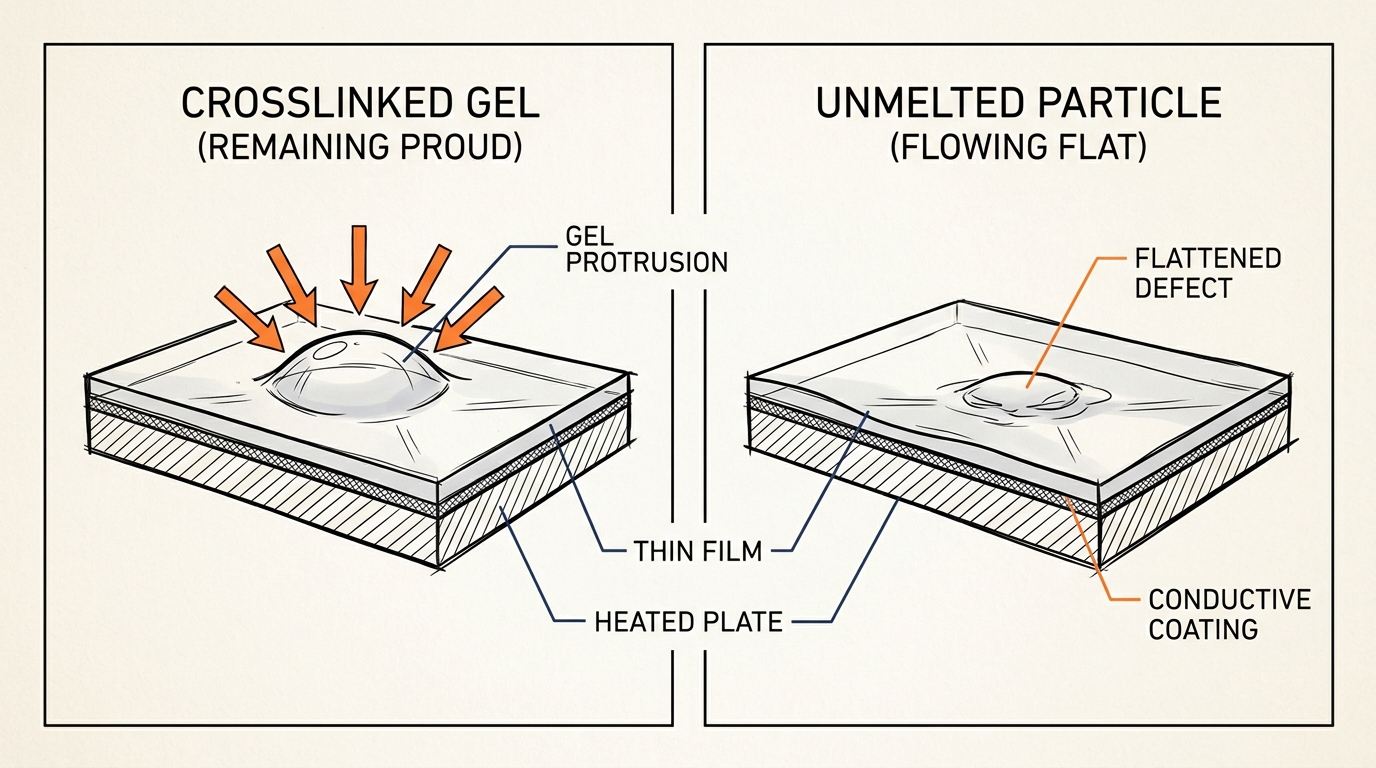
Appearance cannot make that call. The ExxonMobil gel morphology table lists crosslinked resin and unmelted high molecular weight resin as both glassy, which is why Ingenia Polymers routes the question to the plate.
The rule Chris Rauwendaal set out in Plastics Technology is narrower than it looks: contamination gels typically carry a dot at the centre, gels from high molecular weight material do not. Colour and inclusions catch foreign matter and oxidation. They do not settle crosslink versus unmelt.
| On the hot plate | What it is | Where to look |
|---|---|---|
| Melts | Unmelt | Fines, regrind fraction, a higher-melting contaminant, a worn screw |
| Holds shape | Crosslinked degradation | Melt temperature above the supplier’s range, a dirty screw, die or screen pack |
Fines are the quiet source on the unmelt side: small particles pick up less shear energy than whole pellets, and a heavy regrind fraction feeds in material the screw never works.
A blend partner sitting far from the LLDPE on melt index and density, usually the LDPE fraction, adds its own melt viscosity mismatch.
Rule Out Gels Made Inside the Extruder or in Transit
Two questions settle the lot correlation before it counts as evidence: when was the die last cleaned, and does the gel population thin out as the new resin runs? Contamination that arrives with a resin change and then fades was sitting in dead spots inside the extruder.
A 1999 LyondellBasell blown film brochure records the signature: clear to amber to black, random through the film, tapioca and arrowhead shapes.
The third family belongs to neither the grade nor the screw. Resin quality is controlled up to the point of shipment, and every handling step after that can contaminate prime resin.
- A delivery truck unloaded in the rain, putting moisture into the resin before it reaches the hopper
- Unlined fiber drums, which shed cellulose fibers that knock down a 1-mil bubble faster than it can be reblown
- Hopper interiors coated with dust from previous resins, falling in intermittently
No certificate of analysis covers any of that, which is why your receiving record belongs next to the film sample.
Assemble the Gel Evidence Your Resin Supplier Will Act On
A resin-side finding is an argument about a specification, not about presence. All resins carry gels to some degree, and ExxonMobil ties size and number to three producer-side variables: manufacturing process, manufacturing conditions, and thermal stabilizer level.
ASTM D3351, Standard Test Method for Gel Count of Plastic Film, was withdrawn in 2000 with no replacement named and no equivalent ISO standard, so there is no current method to cite.
What a lot gets judged against is the producer’s own film appearance specification. That rating comes from reference films, a manual count in small, medium and large size bands, or a Total Defect Area from an OCS optical scanner.
A 2018 ExxonMobil brief concedes that a test film matching no reference film makes the rating, in its own words, a very subjective measurement and in extreme cases irrelevant.
Your own counting is what lines up against that.
- A retained sample of the suspect lot and of a lot that ran clean
- A gel count in the same size bands over a fixed film area, both lots
- The location, timing and appearance log, the hot-plate result, and the lot’s certificate of analysis
None of that argues anything without a baseline. A grade bought with documented pellet cleanliness from the first lot, such as PetroChina DFDA-7042, gives you a lot history to compare a bad roll against.
What to Do Before the Next Lot Runs
Cut a gel out of the roll running now and put it on a plate before you change a single temperature. The geometry read and the melt test cost less than an hour, and they decide which department owns the problem.
The gate worth the most is the one that rules the resin out, because lot correlation is the cheapest evidence on the floor and the easiest to be wrong about.
Start the size-band count while the line is running clean. A specification argument needs a baseline, and a baseline is only collectable before you need it.