

Blown-film LLDPE grades cluster between 0.5 and 1.1 g/10 min melt index. Cast-film grades sit between 2.0 and 3.5, and across the twenty film grades in Westlake’s September 2022 polyethylene portfolio guide the two bands never touch.
I read a grade slate the way I read a price list. The applications a producer will and will not print next to a number are a selection rule written down without ever being stated.
Producer portfolio guides and lot datasheets hand you melt index, density and comonomer per grade. Turning that list into one purchase order needs an order of operations: fix the process-imposed melt-index band first, the end-use density band second, comonomer and catalyst technology last.
Melt index goes first because it is the hardest of the three to move, not because it cannot be moved. Density and comonomer then compete for whatever room the extruder, die and cooling stack leave inside that window.
Start With the LLDPE Melt-Index Band Your Process Allows
Each converting process runs LLDPE inside a narrow melt-index window, measured at 190 °C and 2.16 kg. Blown film takes 0.5 to 1.1 g/10 min. Cast film takes 2.0 to 3.5, rotomolding roughly 3 to 7, and injection 25 to 50.
The four bands span two orders of magnitude and barely touch, which is why the process fixes this number before any performance target gets a vote.
| Process | Melt index (190 °C / 2.16 kg) | Typical density | What sets the band |
|---|---|---|---|
| Blown film | 0.5 to 1.1 g/10 min | 0.915 to 0.925 g/cm³ | Melt strength has to hold the bubble |
| Cast film | 2.0 to 3.5 g/10 min | 0.918 to 0.925 g/cm³ | The chill roll carries the web, so flow wins |
| Rotomolding | around 3 to 7 g/10 min | 0.924 to 0.935 g/cm³ | Powder must sinter and densify without sagging |
| Injection | 25 to 50 g/10 min | 0.934 g/cm³ | Thin-wall fill at short cycle |
The Westlake slate makes the film split visible rather than argued. Fifteen grades in it carry a blown-film application and none exceeds 1.1 MI; five carry a cast application and none falls below 2.0. Not one grade is offered for both.
Rotomolding is the loosest row of the four. The usable range runs roughly 1.5 to 12 MI with a practical optimum around 3 to 7. Inside that row the end use decides more than the oven does.
At the far end, OPaL’s Opalene M2525 and M2550 injection grades run 25 and 50 MI at 0.934 g/cm³, an order of magnitude past anything a film line will take.
The band does bend. Converters who cannot hold a bubble on a 0.5 MI resin blend LDPE in for melt strength. Dow’s blend work found melt strength running well above the linear rule of mixtures at every ratio tested.
The bill arrives in toughness. Dart impact drops sharply with LDPE content, puncture energy falls almost linearly, and tear strength tracks the tie-chain concentration the LDPE dilutes.
Don’t substitute a cast-film grade into a blown-film line without re-qualifying, whatever the two density figures say.
Our own blown-film slot is filled by grades such as DFDA-7042 and LL0209AA. Cross-check your target window against a specific grade’s TDS before you request a COA.
Set the LLDPE Density Band From Your End Use
Density decides stiffness against toughness inside the melt-index window the process already fixed. The whole working film range spans about 0.010 g/cm³, with plastomers below it and injection grades well above.
- Heavy duty, maximum toughness: 0.915 to 0.918 g/cm³
- General-purpose film: 0.918 to 0.920 g/cm³
- Shrink, bakery and clarity film: 0.922 to 0.925 g/cm³
- Sealant and cold-temperature toughness (plastomer): 0.906 to 0.910 g/cm³
- Injection housewares and thin-wall lids: 0.934 g/cm³
That gradient is a dial, not a law, and the slate carries its own counterexample. Westlake’s clarity-line grade LF74580 sits at 0.925 g/cm³, and the 2022 guide lists it as high-strength film, because a clarity resin trades on a different axis.
Michael Sepe, writing on polyethylene fundamentals in Plastics Technology, names the assumption that breaks here. Two grades can share an average molecular weight and differ in density, and two grades can share a density and differ in molecular weight.
Density tracks branching and how closely chains pack. Molecular weight tracks chain length, and it buys ductility, impact and stress-crack resistance.
OPaL’s two injection grades prove the independence on a single datasheet pair. M2525 and M2550 both measure 0.934 g/cm³, and the only variable moving between them is melt index, 25 against 50.
Flexural modulus rises from 250 to 400 MPa across that step. Elongation at break drops from above 500% to above 400%, and the Vicat softening point does not move at all.
Commercial LLDPE grades cover roughly 0.915 to 0.934 g/cm³, and the plastomer floor at 0.906 overlaps polypropylene homopolymer on the density scale alone. Density identifies a slot inside a family. It never identifies the family.
Choose Between Butene, Hexene and Octene Comonomer
Hexene-1 builds a longer short-chain branch than butene-1, and the longer branch produces more tie molecules, the chains that bridge crystalline regions and carry load between them. Octene-1 extends the same mechanism one step further. The effect lands on dart impact, tear and stress-crack resistance, none of which the density figure reports.
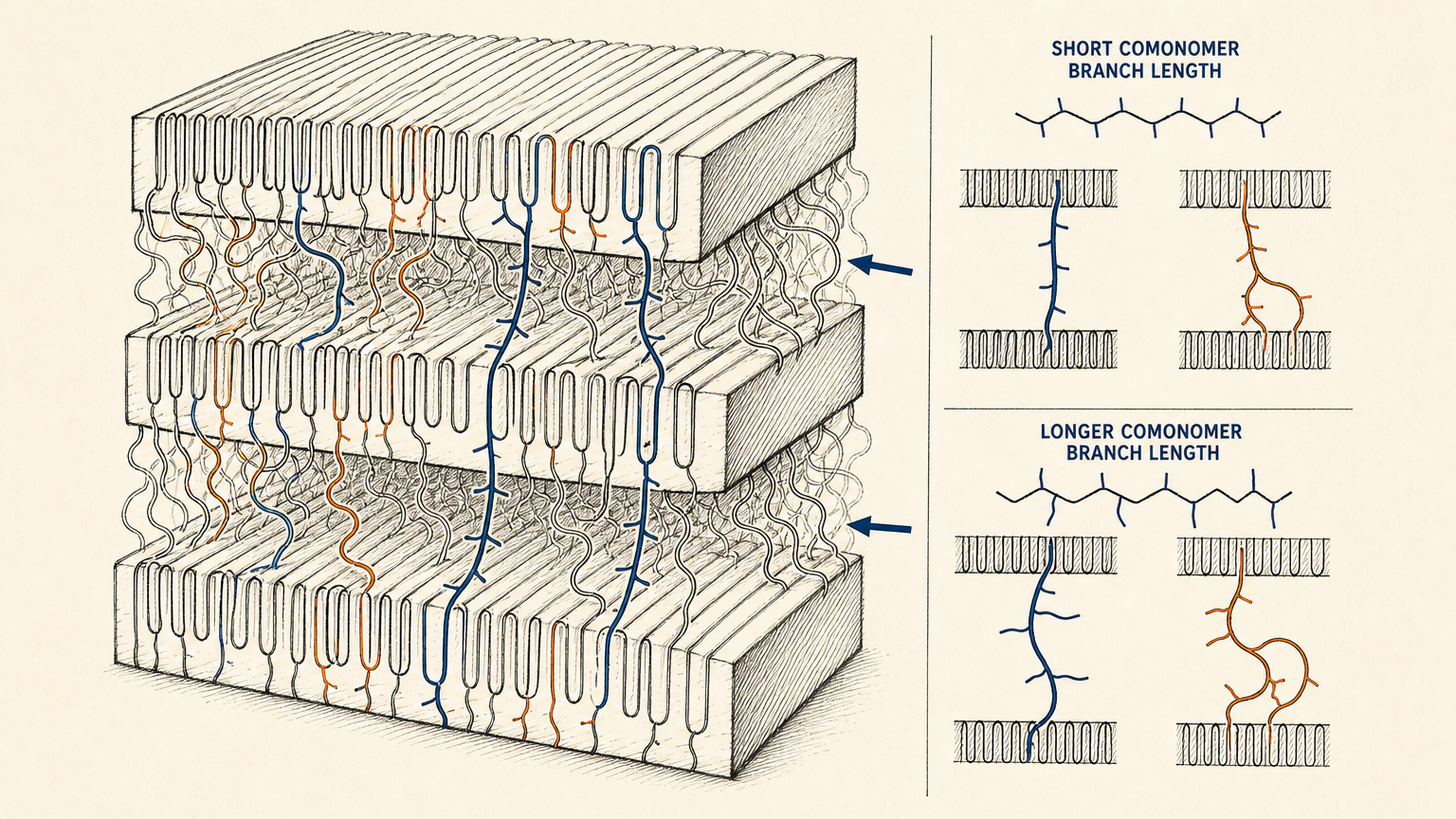
Dr. Nick Henwood, technical director at the Association of Rotational Molders, ranks the variables bluntly: melt index has a greater effect on ESCR than anything else.
At 5 MI and above, the difference between butene-1 and hexene-1 grades is minimal. At 3 MI and below, hexene-1 grades tend to show higher ESCR. Even then the gap only pays where the part carries continuous or cyclic load, such as underground chambers and storage tanks.
Westlake’s 2022 catalogue routes the same judgment through its grade assignments. Not one butene grade in it is offered for high-strength or heavy-duty film; every one of those slots is hexene.
Where the two comonomers overlap, the application is commodity. The hexene trash-bag grade sits at 0.85 MI and 0.918 g/cm³ and the butene one at 1.1 MI and 0.919.
Supply habit explains more of the split than chemistry does. North America runs predominantly hexene-1 and South Asia predominantly butene-1 for the same applications.
Above 5 MI, treat comonomer as a price and availability question.
Decide Between Metallocene and Ziegler-Natta LLDPE
Metallocene LLDPE repays its premium in three places: down-gauging at held strength, seal initiation at lower temperature, and film optics. Outside those three, the narrow molecular-weight distribution that delivers them works against the line. A Ziegler-Natta grade at the same nominal melt index will run faster for less money.
Melt index alone will not tell you whether a grade draws clean. Melt index is an inverse proxy for average molecular weight, and it says nothing about how widely that weight is spread.
A single-site metallocene catalyst narrows the spread. That narrow distribution buys the seal-initiation and optical performance, and it also raises head pressure and motor load at equal melt index.
The operational cost is predictable in kind. Extruder pressure rises at equivalent throughput, the die often wants a wider gap or a shorter land, and fluoropolymer processing aid goes in to keep melt fracture down.
A line already running Ziegler-Natta near capacity may not hold output on a metallocene grade without at least one of those changes.
Pay the premium when the requirement is a property the broad Ziegler-Natta distribution cannot reach. Agricultural and greenhouse film is the clearest case, where a metallocene hexene grade such as EZP2005H buys puncture and tear at reduced gauge.
Everywhere else the premium buys a processing penalty, and the honest answer is to stay on Ziegler-Natta.
Confirm the LLDPE Grade on the COA Before You Order
OPaL’s Opalene M2525 datasheet makes the point in its own footnote: “Typical Values and not to be taken as specification limits.” A datasheet publishes a window, not a guarantee.
The lot certificate of analysis reports what the resin you are buying actually measured. Six lines on it decide whether the lot lands inside that window.
| What to check | Test method | Why it decides the match |
|---|---|---|
| Melt flow index | ASTM D1238, 190 °C / 2.16 kg | A figure quoted at another load is not comparable |
| Density | ASTM D1505 at 23 °C | Gradient column, not D792 displacement |
| Tensile at yield, elongation at break | ASTM D638 at 50 mm/min | Crosshead speed changes both numbers |
| Flexural modulus | ASTM D790A | The stiffness half of the density trade |
| Vicat softening point | ASTM D1525 at 10 N | Heat limit for the finished part |
| Specimen provenance | ASTM D4101 moulded, D618 conditioned | Confirms comparable specimens produced the numbers |
The COA gives you four numbers; the spec sheet gives you the window; the application tells you which corner of the window you actually need. A lot that comes back at 0.930 g/cm³ against a 0.934 typical value has not failed a specification, because the sheet never offered one.
Two more lines on the same sheet matter before a container moves. Food-contact conformity appears as FDA 21 CFR 177.1520 for olefin polymers, the line a packaging converter’s own customer will ask to see.
Storage limits sit there as well: below 50 °C, away from direct sunlight and heat. Ignore them and degradation shows up as colour change, odour and inadequate performance.
None of this is LLDPE-specific. Ask for the COA against the same six lines on every polyethylene grade you buy by the container, and a borderline lot becomes a decision you make before it sails.
Next Steps
Write the window down before you call a supplier. The melt-index band your line actually runs, the density your end use needs inside it, whether the part sees sustained or cyclic load, and whether metallocene optics are worth paying for.
Three numbers and two yes-or-no calls. Every grade that misses any of them leaves the list before anyone quotes a price.
That order keeps you from qualifying the same resin twice. Start from density, the number a grade is named by, and you shortlist candidates your extruder cannot run at rate. Start from comonomer, and you pay for tie molecules a short-term-load part never uses.
The discipline buys trial time. Price differences across a shortlist are small next to a lost production day on a grade that never had a chance of holding the bubble.