

A buyer reading “virgin PP” on a producer spec sheet usually treats it as a chemistry claim. Operationally it is a documentation state — producer-lot traceable, generation zero, no regrind blend-back.
The label is shorthand for a paper trail, not a different polymer. Virgin and once-reground pellets from the same reactor can be chemically identical.
What separates them is the COA chain that ties the lot back to its first pass out of the reactor. For procurement, that distinction is the entire decision parameter.
What Virgin Polypropylene Rules Out on a Real COA
Virgin polypropylene rules out three things on a legitimate lot:
- post-consumer recycled (PCR) content
- post-industrial regrind (PIR) blended back into the resin
- off-spec or rework material the producer might otherwise re-incorporate
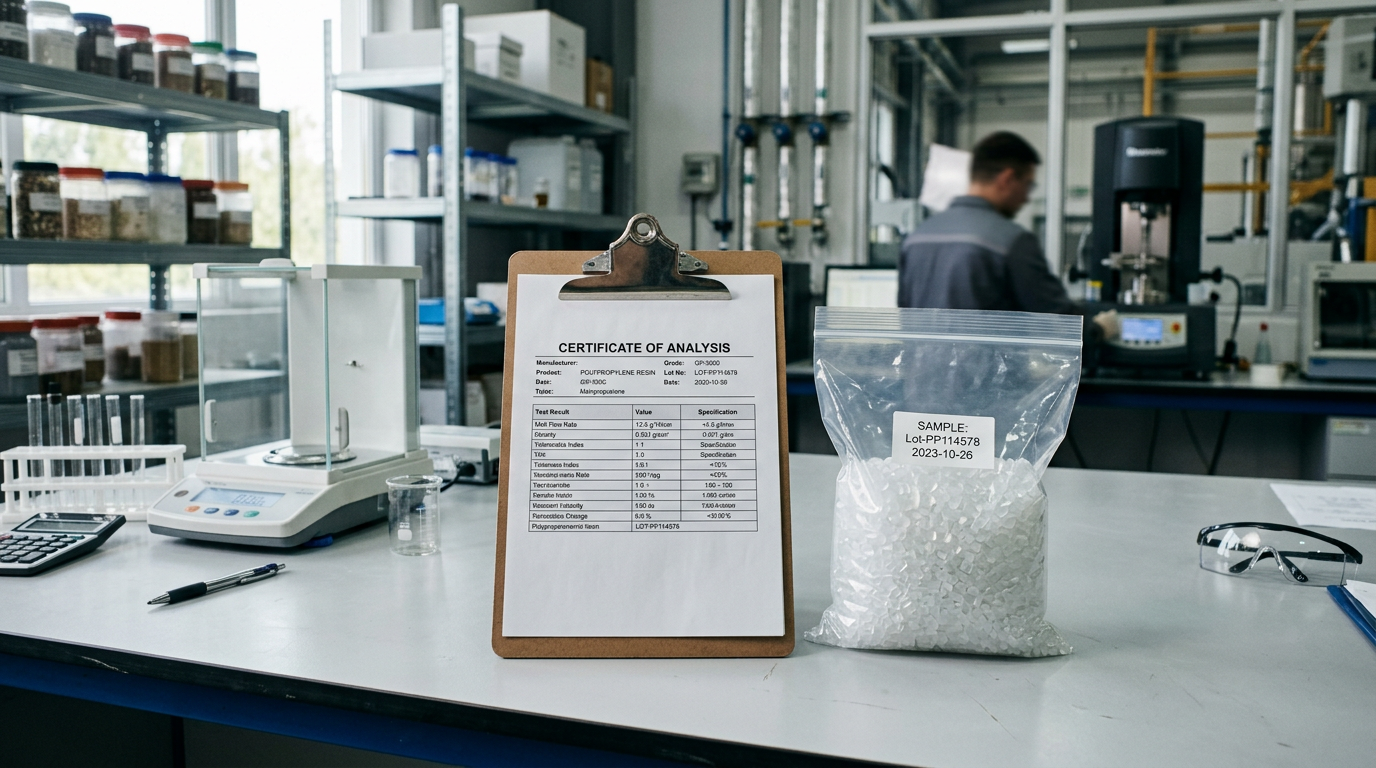
A virgin lot leaves the reactor, gets pelletized, and ships under a producer COA. That COA names the reactor train, the production date, the tested values for MFI, density, tensile properties, and ash content, plus a unique lot number.
Generic “typical” values without lot numbers or test dates are a red flag. Paperwork like that would never come out of a polypropylene resin producer running a virgin grade through normal QC.
The PIR versus PCR distinction is where procurement docs get sloppy. Post-industrial regrind is manufacturing scrap and trim waste — cleaner and more consistent than PCR, but not recycled content under standards such as GRS (Global Recycled Standard).
A supplier writing “no PCR” on a quote does not automatically mean the resin is virgin. PIR could still be blended in at a known ratio.
Three states exist — virgin, PIR, PCR — and the documentation needs to distinguish all three explicitly.
State-owned Chinese producers like PetroChina Dushanzi and Sinopec ship reactor-fresh grades — T4401 random copolymer for PP-R pipe, T30S homopolymer for monofilament — with a COA matching the producer datasheet for each lot. That is the canonical virgin supply pattern: lot-level traceability to a named reactor complex, no intermediate compounder reprocessing in the chain.

What a Virgin PP COA Should Document
A virgin PP Certificate of Analysis should document four things:
- the unique lot number
- the production date
- tested values per ASTM D1238 (MFI) and ASTM D792 (density)
- the reactor train or production unit
The lot number is what makes the rest meaningful. Without it, you cannot trace a problem back, you cannot match the lot to a shelf-life window, and you cannot prove generation = 0.
Properly stored PP has a shelf life of up to two years, and that only matters if the COA carries the date that started the clock.
Generation tracking is the deeper reason virgin’s paperwork carries weight. Each processing step — compounding, grinding, reprocessing — is a degradation cycle, and repelletized regrind adds a heat pass that compounds property loss.
Without generation tracking, no one knows how many times a regrind lot has already been reprocessed, especially when a virgin-to-regrind ratio is blended in at the compounder. Virgin is the only state where generation = 0 is verifiable from the producer’s paperwork.
I qualify dual-source virgin grades the same way every time. Pull three COAs from the second source, compare each value against the primary supplier’s running average, then commit only after the line runs all three lots cleanly.
If the COA shows MFI at the edge of the spec, ask for the molecular-weight distribution data before you accept the lot. Paper parity is not line parity.
When Virgin Polypropylene Is a Regulatory Must vs a Consistency Preference
Virgin is a legal requirement when the application falls under one of three standards:
- FDA 21 CFR 177.1520 (food contact)
- USP Class VI (medical device)
- NSF 61 (potable water systems)
Natural (virgin) polypropylene meets USP Class VI, USP 85, USP 88, and USP 661 ratings and complies with FDA 21 CFR 177.1520(a) and (c). Recycled or “white” PP does not hold USP Class VI.
NSF 61 tests for extractables and heavy metals; enforcement is state-level (California, Massachusetts), but the standard itself is the gate.
One nuance trips up specifiers reading the standard cold. FDA compliance refers to the material, not the finished part.
A USP Class VI compliant resin loses its standing if the part is handled in a non-controlled environment downstream. The documentation chain has to extend past the resin lot into the converter’s process — virgin grade is necessary, not sufficient.
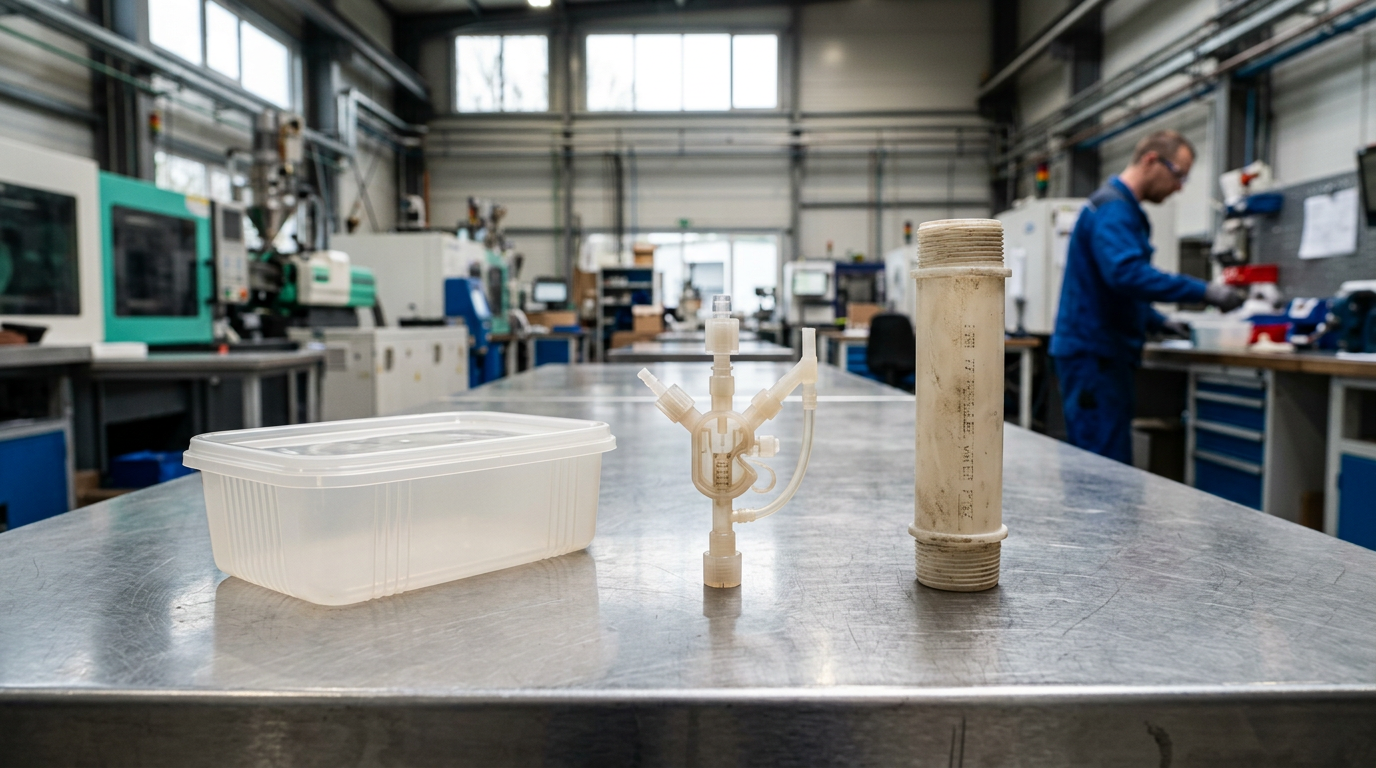
Outside the regulated trio, virgin versus PIR-blended is a consistency call, not a legal one. Pipe, woven bag, and general injection-molding lines run perfectly well on prime PIR at known ratios when the application has no extractable or migration concern.
For grade selection within virgin — homopolymer versus random copolymer versus impact copolymer — the choice is set by mechanical and processing properties, with virgin documentation as the baseline.
What Most Procurement Docs Get Wrong
The common mistake is treating “virgin” as a chemistry property the lab can verify. It cannot — virgin and once-reground pellets from the same reactor are chemically indistinguishable without generation-tracking paperwork upstream.
Audit the COA chain before the lot, not the pellet after, and write the supplier’s three-state status (virgin / PIR / PCR ratio) into the purchase order.
Six months later, when a batch comes in with a fractional MFI shift, the documentation chain is the only thing that tells you whether you bought what you specified.