

A Hyosung pipe-grade datasheet states “PPR 125, MRS 12.5 MPa.” The grade number is ten times the minimum required strength at 20 C over 50 years (ISO 12162:2009). That makes it a hydrostatic strength class, not a temperature rating.
A pipe extruder already committed to PP-R needs a tighter specification than that single number. The resin is a random copolymer, the melt flow sits at the bottom of the PP range, and the classification number tells only half the pressure story.
What Qualifies a Resin as a PP-R Pipe Grade
A PP-R pipe grade is a pipe-extrusion polypropylene random copolymer whose hydrostatic strength is classified under ISO 12162 and whose compliance is certified against a pipe-system standard such as ISO 15874 or GB/T 18742.
The choice among polypropylene’s three main grades is already settled for pipe. ISO 12162:2009 Table 2 assigns PP copolymer a minimum design coefficient of 1.25 versus 1.6 for homopolymer, so the copolymer retains more of its measured strength for design stress.
One compliance detail is worth checking: hydrostatic testing on producer datasheets is claimed for “pipes produced with” the resin, not for the pellet itself. Both Hyosung PP-R datasheets cite “ISO/DIS 15874-2,” the draft designation, not the published standard.
How Tight Is the Melt-Flow Window on a Pipe Grade
PP-R pipe grades from two unrelated producers cluster at 0.22 to 0.25 g/10 min at 230 C / 2.16 kg, well below the 0.3 to 0.5 g/10 min band that circulates as a pipe-grade minimum.
| Grade | Producer | MFI (g/10 min) | Condition | Method |
|---|---|---|---|---|
| R200P (PP-R) | Hyosung | 0.25 | 230 C / 2.16 kg | ASTM D1238 |
| R202P (PP-RCT) | Hyosung | 0.22 | 230 C / 2.16 kg | ASTM D1238 / ISO 1133 |
| RA130E (PP-R) | Borealis | 0.25 | 230 C / 2.16 kg | ISO 1133 |
The extrusion line, not the pipe’s end use, holds melt flow this low. PP-R’s linear chain architecture gives it limited melt strength, and a resin that flows too easily sags inside the die, producing thicker wall at the bottom and thinner wall at the top.
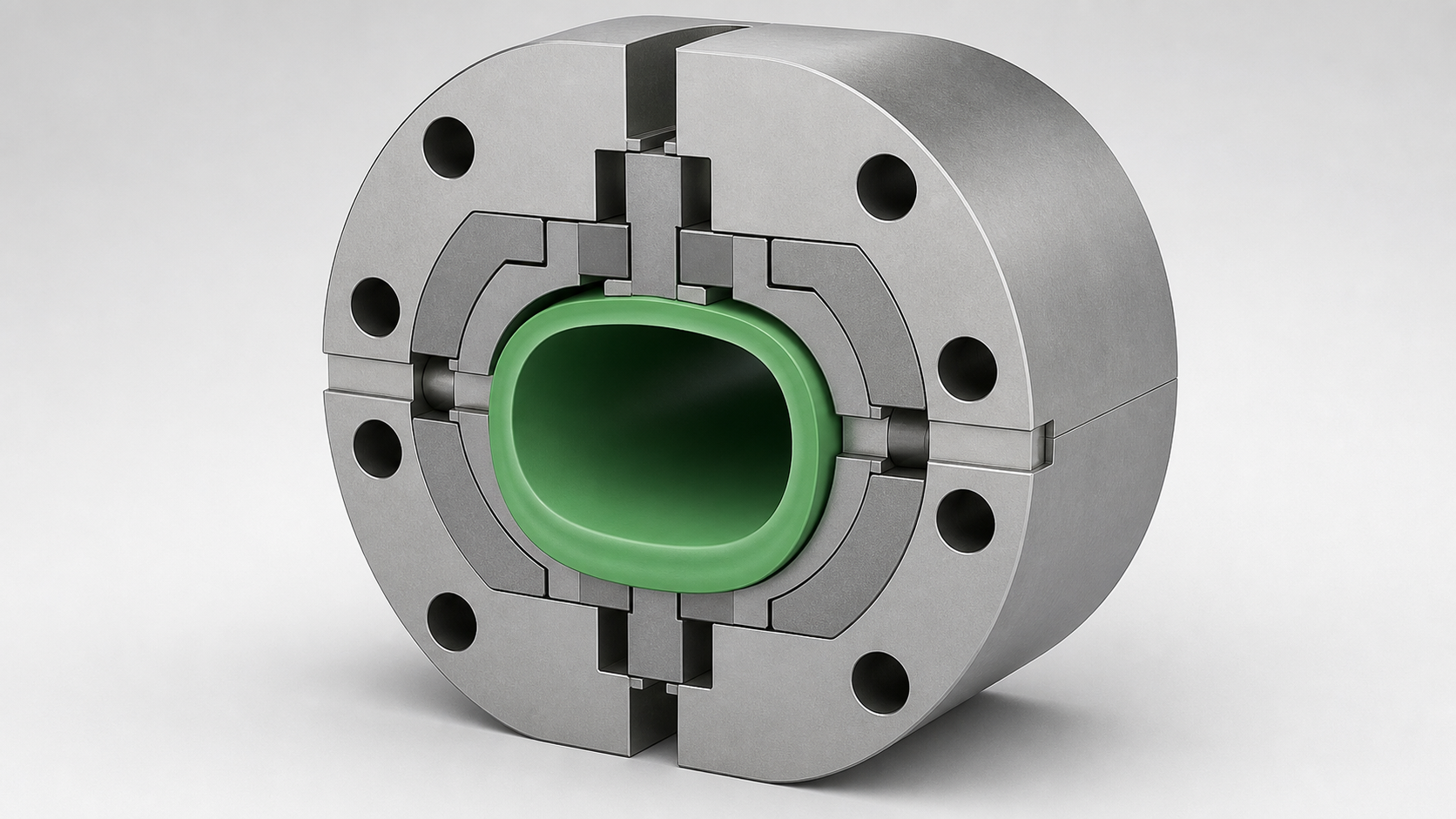
Pipe-extrusion random copolymer such as PetroChina Dushanzi T4401 sits in this melt-flow band. MFI alone does not tell you whether a grade will draw clean: you also need molecular-weight distribution data to judge melt-strength behavior on the line.
A quoted grade whose TDS prints a figure above 0.3 g/10 min at 230 C / 2.16 kg is either a general-purpose random copolymer or an injection-molding grade, not a pipe resin.
What the Number in a PP-R Grade Designation Classifies
ISO 12162:2009 Clause 4 requires the classification number to be 10 times the MRS in megapascals. MRS is the 97.5% lower confidence limit of hydrostatic strength at 20 C over 50 years, extrapolated per ISO 9080.
The rungs in the range that covers PP-R grades:
| Classification number | MRS (MPa) | Lower confidence limit range (MPa) |
|---|---|---|
| 63 | 6.3 | 6.3 to < 8 |
| 80 | 8.0 | 8.0 to < 10 |
| 100 | 10.0 | 10.0 to < 11.2 |
| 112 | 11.2 | 11.2 to < 12.5 |
| 125 | 12.5 | 12.5 to < 14 |
Grades actually sold for pipe classify at 112 and 125, above the “100” that trade shorthand treats as the top of the ladder.
A buyer reading the 63 / 80 / 100 series as a temperature scale rather than a strength scale will miss the grades sitting above that range entirely.
The classification sets only the resin side of the pressure equation. Wall thickness, expressed as SDR (outer diameter divided by wall thickness), sets the rest.
ISO 12162:2009 Clause 5 states that CRS values, the elevated-temperature strength classification, “are not intended for use in applications with temperature profiles, e.g. as defined in ISO 10508.” PP-R’s application is exactly such a system.
The material classification lets grades be compared, but converting a CRS figure into a pressure class by arithmetic is a confident, checkable error.
The MRS/CRS Inversion Between PP-R and PP-RCT
Two grades from one producer illustrate why the classification number alone does not pick the right material for hot-water service. Hyosung’s R200P (PP-R) classifies at MRS 12.5, CRS 3.3 MPa; its R202P (PP-RCT) classifies at MRS 11.2, CRS 5.0 MPa.
The PP-RCT sits one rung lower on MRS, the number the designation encodes, while carrying 52% more CRS. Ranking quotes on the classification number alone selects the weaker material for the duty the system is designed for.
Which TDS Figures Verify a PP-R Raw Material Grade
Four figures on a TDS settle whether a quoted grade is what the quote claims: melt-flow rate with its test condition, density, hydrostatic classification, and pipe-standard certification.
- MFI with test condition and method. The number must carry its temperature, load, and test standard (ASTM D1238 or ISO 1133). Hyosung R202P prints 0.22 g/10 min under both methods, but ASTM D1238-23 says the two “differ in technical content,” so a dual-labelled figure is a typical value, not a dual-certified measurement.
- Density. PP-R pipe grades sit near 0.90 g/cm3.
- Hydrostatic classification. An MRS value in megapascals with a 20 C / 50-year basis. A grade code such as PPR-P00 (Sinopec Zhongyuan) that carries no MRS at all is a producer namespace, not a property claim.
- Pipe-standard certification. The TDS should name the pipe standard the lot was tested against, and the certificate should cite the published standard rather than a draft designation.
ISO 12162:2009 Clause 3.4 defines CRS with a temperature and time subscript: CRS at theta and t. Both Hyosung datasheets print CRS bare, without either qualifier.
The figure that governs hot-water service arrives missing the two values the classification standard requires. Ask for the temperature and time basis in writing before comparing two producers’ CRS numbers.
PPR-P00 prints a melt-flow tolerance of plus or minus 0.1 on a nominal 0.25 g/10 min, putting the acceptance band at 0.15 to 0.35. Two lots that both pass can differ by more than a factor of two in melt flow.
That gap is what has to be re-qualified on the line when swapping to an “equivalent” grade. Pipe standards cap how far melt flow may shift between pellet and pipe for exactly this reason.
Where Most Specifications Go Wrong
The COA gives you four numbers; the spec sheet gives you the window; the application tells you which corner of the window you actually need.
Most grade specifications stop at the classification number. ISO 12162:2009 Clause 8 permits a material to be “designated to the next lower classification number,” so a quote reading “PPR 100” could describe a resin whose MRS is actually 11.2. The designation is a floor, not a measurement.
Pin the specification to the MRS and CRS figures on the datasheet, confirm the melt-flow value carries its test condition, and verify which pipe standard the lot was certified against. Everything else on the quote is a namespace.