

BASF’s current datasheet for PA66 with 25% glass fiber prints two numbers for every mechanical property: a dry-as-molded column and a conditioned column. Tensile modulus reads 8600 MPa dry and 6500 MPa once the part equilibrates to ambient humidity. The strength numbers that win nylon the spec are the dry numbers, and almost no part runs dry.
The conventional split is clean: nylon is the high-performance engineering plastic, polypropylene (PP) is the commodity. That split holds — until the nylon part sits in a humid plant, picks up water, and sheds stiffness while it grows in size.
Read the nylon datasheet in the right conditioning state, and the PP-vs-nylon decision turns less on headline strength than on whether the part can tolerate that drift. For anything exposed to humidity, water, or chemicals, PP’s flat, inert behavior can be the right call despite the lower top-line spec.
What Nylon’s Strength Looks Like After It Picks Up Water
Conditioned nylon loses 15-25% of its stiffness and grows in every dimension, because water acts as a plasticizer inside the polyamide chain. Glass-reinforced PA66-GF25 drops from 8600 to 6500 MPa tensile modulus and 175 to 120 MPa stress at break as it conditions to 50% relative humidity (ISO 527). Flexural modulus falls the same way, 7600 to 6000 MPa.
Unfilled nylon moves harder, because there is more polymer fraction for water to soften. Tensile modulus drops roughly 30-50% and yield strength 20-30% between dry-as-molded and conditioned. The dry headline runs on the order of 20-40% above the value the part actually carries.
The dimension shifts too. Unfilled PA6 swells about 0.5-0.6% at 50% RH equilibrium, enough to close a designed clearance or bind a press fit. PP absorbs under 0.01% water and stays put.
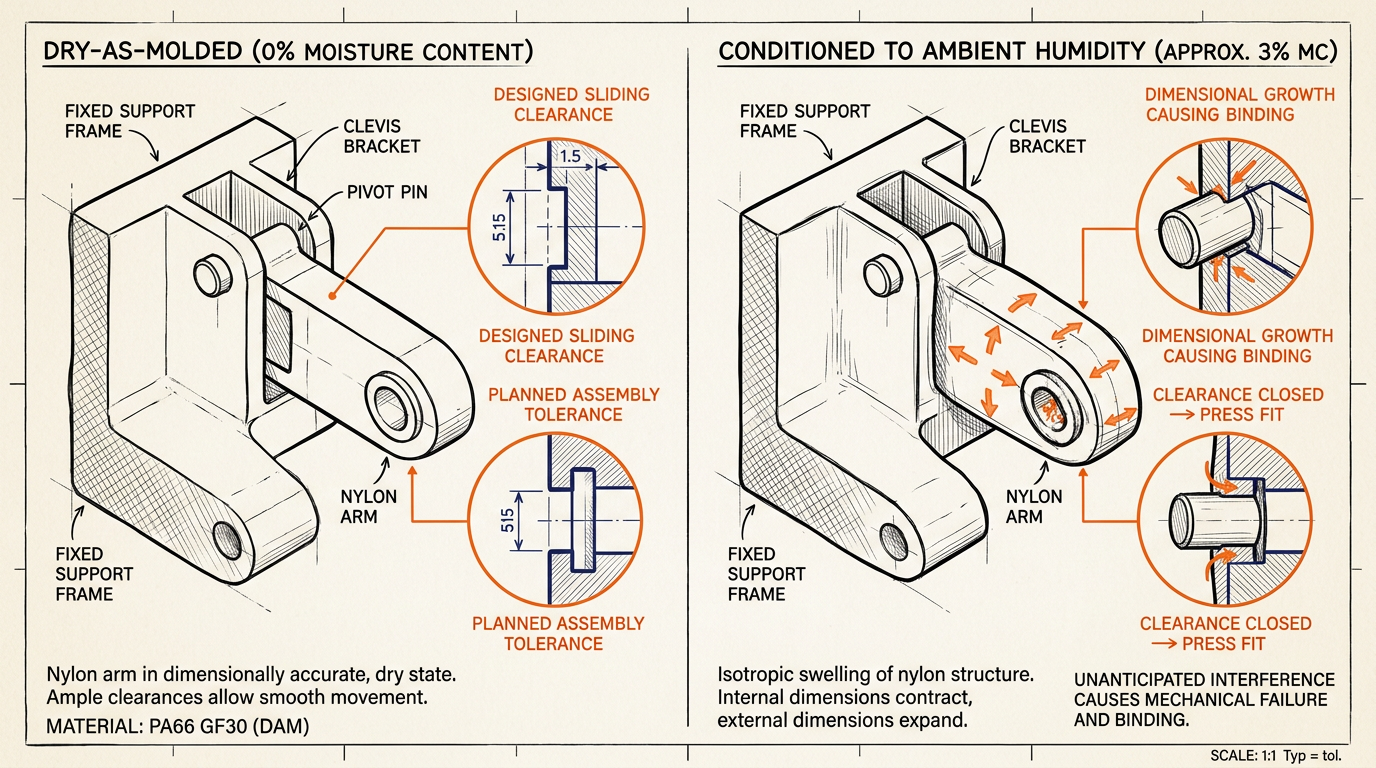
Acetal copolymer sits between the two, growing about 0.2% at the same equilibrium. It is the usual third candidate when a part needs more stiffness than PP but less movement than nylon.
| Property (ISO method) | PA66-GF25 dry | PA66-GF25 conditioned | PP (homopolymer) |
|---|---|---|---|
| Tensile modulus | 8600 MPa | 6500 MPa | 1300-1600 MPa |
| Stress at break | 175 MPa | 120 MPa | 25-40 MPa |
| Flexural modulus | 7600 MPa | 6000 MPa | 1100-1500 MPa |
| Dimensional growth at 50% RH | — | 0.5-0.6% (unfilled basis) | ~0% |
| Water absorption (D570) | 1.7-2.1% EMC | — | <0.01% |
One number cuts the other way. Notched Charpy impact rises from 8 to 10 kJ/m² as the same grade conditions, and notched Izod from 9.7 to 11.5.
Water trades stiffness for toughness — the conditioned part is more forgiving of a knock, just less rigid under load. Treating moisture as pure degradation misreads what is happening.
Before specifying off a nylon spec sheet, find out whether the numbers are dry or conditioned. A dry-as-molded modulus you size a bracket around is a best case the part leaves within days.
Where Nylon Still Wins Once Both Sides Are Conditioned
Even conditioned, PA66-GF25 holds a tensile modulus of 6500 MPa — about four to five times PP’s 1300-1600 MPa. Moisture narrows nylon’s structural lead; it does not erase it.
For a load-bearing part, the honest comparison is PP against glass-reinforced nylon, and reinforced nylon still wins the stiffness fight with room to spare.
Heat is the cleaner win, and moisture does not touch it. PA66-GF25 carries an HDT-A of 245°C and a short-cycle service ceiling near 240°C, against PP’s roughly 100°C. Anything near a heat source rules PP out before the conditioning question comes up.
Modified PA66-GF25 is the workhorse for under-hood and electrical-connector brackets where stiffness and HDT both matter.
Wear is the third advantage. Nylon’s low friction and abrasion resistance make it the default for unlubricated bearings, gears, and bushings — duty where PP’s softer surface gives up early.
None of these advantages depend on the conditioning state. The moisture story changes how much margin you are buying, not which material does the job when the part is structural, hot, or sliding.
Why PP Shrugs Off Both Water and Chemicals
PP resists strong acids and bases because it has no hydrolyzable bond in its backbone, and that same gap explains why it ignores water. Nylon’s amide bond is the link that absorbs moisture — and it is the exact bond that strong acids, strong bases, and phenols cleave by hydrolysis.
A PA66 chain carries roughly a hundred of these sites. Moisture sensitivity and chemical vulnerability are not two separate weaknesses; they share one root cause.
PP has no amide bond to attack, so it stays inert where nylon degrades: dilute and concentrated mineral acids, caustic solutions, and most aqueous chemistry. For a pump housing, a chemical-contact fitting, or a part washed down daily, that inertness outweighs nylon’s mechanical headline.
PP also lands two structural bonuses for free. It runs about 20% lighter — 0.905 g/cm³ against nylon’s 1.13-1.15 (ISO 1183) — and costs roughly half as much per kilogram.
PetroChina Dushanzi grades cover the homopolymer and random-copolymer range for these moisture-stable, chemical-contact parts. On a weight- or cost-sensitive part with no real heat or structural demand, those two facts close the case on their own.
The field failures bear this out. Nylon parts that cycle between wet and dry service embrittle and deform as they swing through conditioning states — the problem is the swing, not any single published value. PP never enters that cycle.
Making the Right Choice
Match the part’s governing duty to the resin, then read the nylon datasheet in the right state to size the margin. Structural load, continuous heat, and wear point to nylon — glass-reinforced when the part actually carries load. Chemical contact, moisture and dimensional stability, low weight, and cost point to PP.
The conditioning story does not flip that split; it tells you how much of nylon’s lead survives once the part leaves the mold. The decision goes wrong when a specifier copies dry-as-molded stiffness onto a part that lives at 50% RH, then watches the clearance close and the bracket flex.
The fix costs nothing: ask whether each nylon number is dry or conditioned before it goes into the calculation. A reinforced nylon still beats PP on stiffness and heat by a wide margin — but only PP gives you a number that does not move.