

Two PP compounds at identical 20 wt% elastomer loading can land on opposite sides of a cold-impact specification. One fractures at 0 °C with zero ductile failure. The other absorbs 23 kJ/m² and stays ductile past 60% of its cross-section.
The loading sets how much rubber is present. The spacing between rubber domains is what the brittle-to-ductile transition responds to, and that spacing depends on particle size as well as volume fraction. A compounder who pushes wt% without improving dispersion pays in stiffness and may still miss the cold-impact target.
How Much POE Goes Into a PP Compound
Modifier producers publish a working range of 5 to 30 wt% POE in polypropylene, depending on the target impact performance.
What moves a formulation inside the band is the impact target and the test temperature attached to it. At 25 wt% and above, rubber-toughened PP reaches its brittle-to-ductile transition below -10 °C in notched Izod testing per ASTM D256.
At the bottom of the band, the rubber domains sit too far apart to generate the interparticle stress field the transition requires. Because the densities of the rubber phase (~896 kg/m³) and the PP matrix (~901 kg/m³) nearly coincide, weight fraction and volume fraction are interchangeable for this system.
How POE Loading Changes PP Stiffness and Impact
Every step up the loading band costs modulus. In one producer’s patent example set, doubling the elastomer from 10 to 20 wt% in a clarified PP random copolymer reduced the 2% secant modulus by about 14%. Room-temperature notched Izod tripled from 8 to 25 kJ/m², and ductile failure went from 0 to 100%.
The cold end is where the trade-off breaks down. That same 10 to 20 wt% step bought almost nothing at -20 °C: Izod went from 3 to 7 and back to 6 kJ/m², with ductile failure peaking at 10% and falling back to zero. More elastomer bought a warm-weather part, not a cold one.
Heat-deflection temperature follows the same direction, though no source in this research quantified the slope. Talc or mineral filler can recover part of the lost stiffness, but that is its own formulation decision.
How POE Dispersion Controls the Cold-Impact Result
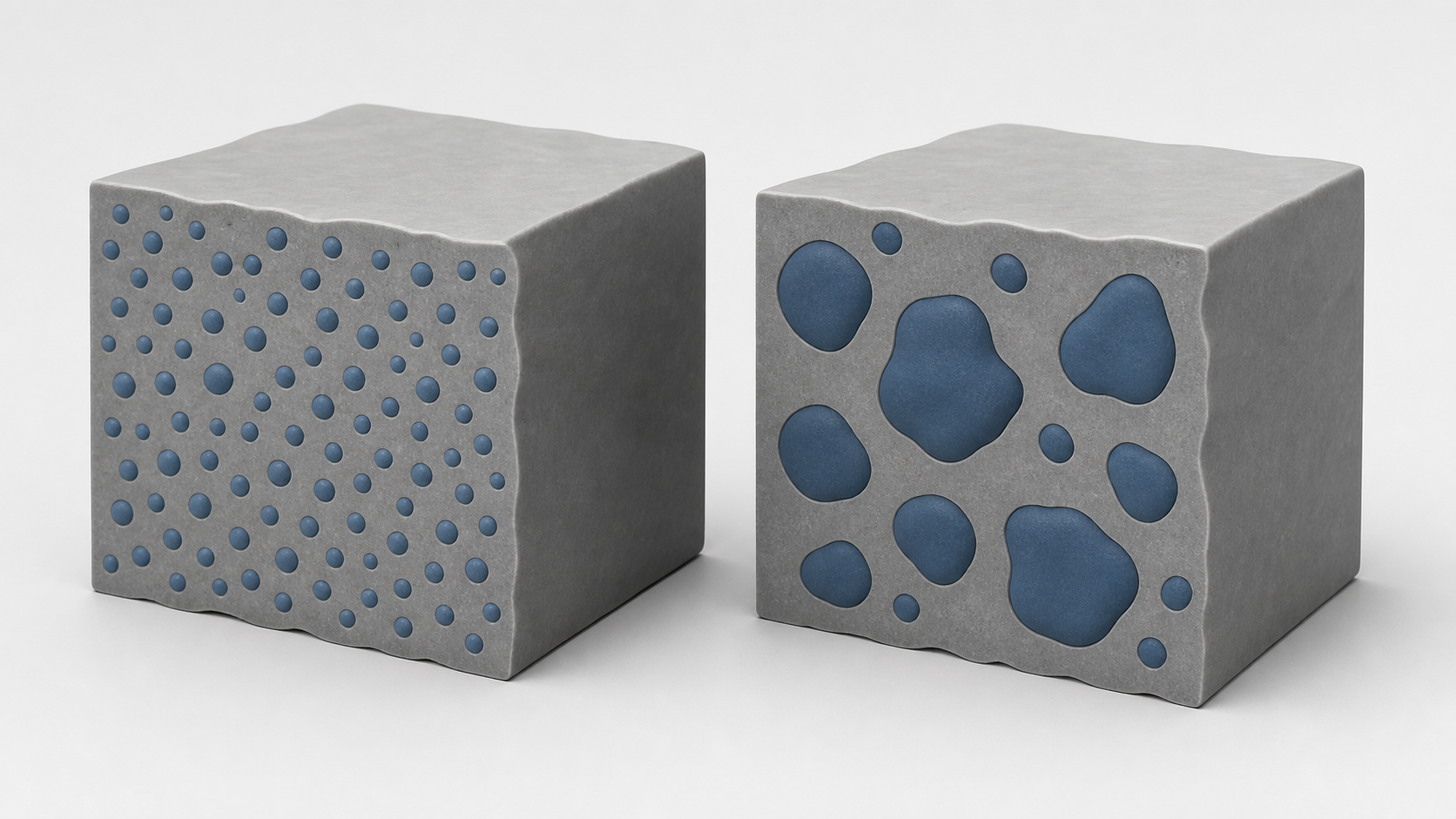
Rubber-domain spacing, not weight fraction alone, governs the brittle-to-ductile transition. The critical interparticle distance criterion, fitted by Wu on nylon rubber blends and adopted for PP by assumption, makes this precise: spacing falls when volume fraction rises or when particle diameter falls.
The Scaling Gap Between Theory and Real Blends
Deblieck and colleagues at SABIC showed in Polymers (2021) that the inverse critical ligament size in real PP blends scales to the greater-than-fifth power of the rubber volume fraction (fit exponent 5.3). An ideal even dispersion would need only the third power.
The gap means 15 vol% of evenly distributed rubber reaches the same brittle-to-ductile temperature as 30 vol% poorly distributed. Dispersion is the lever that halves the elastomer bill.
The Proof at Fixed Loading
A granted Dow patent (US 10,870,746 B2, 2020) confirms the scaling in a single formulation set. At a fixed 20 wt% modifier in a clarified RCP, reducing the dispersed domain from about 300 nm to about 200 nm took the 0 °C Izod from 8 to 23 kJ/m². Ductile failure went from 0 to 60%, at the same stiffness.
The finer dispersion tripled cold impact without adding a gram of elastomer.
One caveat works the other way. Below a critical particle diameter of about 330 nm in a modeled case, the rubber particle cannot cavitate, and cavitation is the step that unlocks ligament ductility. There is a window in particle size, not a direction.
When an Impact Copolymer Is the Better Route
A PP compound can carry its rubber phase from two makers. The producer builds one into the pellet during copolymer synthesis in a second gas-phase reactor stage. The result is an impact copolymer with its morphology already set.
The compounder adds another afterwards in the extruder by melt-blending a separate POE elastomer into a homopolymer or random copolymer base.
If the required impact sits inside what an available impact copolymer delivers, the ICP is simpler than melt-blending a separate modifier. If the target sits outside the reactor grade’s capability, a homopolymer plus POE puts the formulation back in the compounder’s hands.
Where EPDM Still Wins for PP Impact Modification
POE has displaced EPDM in most compounded TPOs, on metallocene tailorability, pellet-form convenience, and cost. A distributor reports POE typically requires 5 to 10% less loading than EPDM for equal impact in PP compounds.
The structural difference is in the chain. POE is a saturated ethylene-alpha-olefin copolymer with butene or octene as the comonomer. EPDM is an ethylene-propylene-diene terpolymer whose third monomer leaves residual unsaturation in the backbone.
A draft Indian Standard (BIS PCD 12, circulated for comment in 2022) proposed encoding this distinction as designation codes B, O, and E inside one elastomer family.
Some TPOs still require EPDM or EPR to reach the desired elastomeric properties. Where a compounder’s impact target, temperature window, and processability all sit inside POE’s range, there is no reason to reach for EPDM.
How to Match a POE Grade to Your PP Before Ordering
The modifier’s melt index and the PP’s melt flow rate are quoted at different ASTM D1238 conditions: 190 °C / 2.16 kg for the elastomer, 230 °C / 2.16 kg for the polypropylene. The two datasheet numbers cannot be divided into a viscosity ratio.
What a compounder can do is compare within each scale. WANSUPER® 65015 from Wanhua Chemical Group (Yantai) is a metallocene ethylene-butene copolymer made by solution polymerization. It carries an MI of 1.2 g/10 min at 190 °C / 2.16 kg.
That MI sits at the low-flow end of a commercial POE range spanning 0.5 to 30 g/10 min at the same condition. Low flow is a formulation position, not a quality mark.
Match the elastomer specification to your own PP before you order: density 0.862 g/cm³, Shore A 46, DSC Tg -58 °C, elongation at break greater than 800%, tear strength 17 kN/m.
What a Datasheet Tg Does and Does Not Promise
A DMTA glass transition is measured at about 1 Hz. A notched Izod impact test runs at roughly 3,000 Hz, three decades faster.
At the standard 7.8 K/decade time-temperature equivalence, a rubber phase whose DMTA Tg sits at about -60 °C stops cavitating, and stops toughening, at about -36 °C under impact.
DSC and DMTA measure the same transition by different methods. For this class of elastomer the two readings land close together, but the frequency argument applies to the DMTA value, and that is the number to ask a supplier for when specifying against impact.
Quoting the DSC reading of -58 °C as if it were the DMTA service floor would promise about 22 degrees of ductility the part does not have. The elastomer’s own flexibility at low strain rate is real.
The shift under impact loading is also real, and both numbers belong on a cold-service specification.
What the Tolerance Band Means on a Purchase Order
A draft BIS specification proposes MFR tolerances of plus or minus 20% at 1 g/10 min and above, widening to plus or minus 30% below 1 g/10 min. At a nominal MI of 1.2, a conforming lot can arrive anywhere from about 0.96 to 1.44 g/10 min.
A compounder matching viscosity to their matrix is matching to a band, not a point. Name the producer and the plant on the purchase order, because a trade code alone does not pin the material.
The Common Mistake
A compounder who pushes loading without improving dispersion will spend stiffness on every kilogram and may still miss the spec at the test temperature that counts. The loading pays for itself only when the dispersion is right, and dispersion is the free lever: same stiffness, same cost, same weight fraction, up to three times the cold impact.
The specification matching is the last step, not the first one to skip. Check the melt index at its 190 °C condition, the Tg at its 1 Hz measurement rate, and the tolerance band against the compounder’s own matrix before the container ships.