

_Industrial scale-up as an engineering discipline_
A successful laboratory formulation often creates a sense of confidence.
The polymer exhibits excellent molecular characteristics.
Water reduction exceeds expectations.
Slump retention satisfies the original design objectives.
Repeat laboratory batches produce encouraging results.
At this stage, many development teams naturally assume that commercial production is simply a matter of increasing reactor size.
Industrial experience demonstrates otherwise.
The transition from laboratory synthesis to continuous manufacturing represents one of the most technically demanding phases in the development of any polycarboxylate ether (PCE) superplasticizer.
The chemistry remains fundamentally the same.
The engineering environment changes completely.
Heat transfer, mixing efficiency, reaction dynamics, equipment geometry, process control, operator experience, and raw-material variability all become increasingly important as production scale expands.
For this reason, industrial scale-up is not a routine manufacturing exercise.
Scale-up is an engineering discipline in its own right.
What Changes Between a 2-Liter and a 20-Ton Polymerization Reactor
Laboratory polymerization runs under controlled conditions: small reactors remove heat efficiently, mixing stays uniform, raw materials are carefully prepared, and environmental variables hold steady.
Scaling a PCE polymerization from a 2-liter reactor to a 20-ton reactor changes every one of those conditions.
Heat generated during polymerization travels much greater distances before leaving the reaction vessel.
Mixing patterns become more complex.
Local concentration gradients develop more easily.
Feeding systems introduce additional process variation.
Reaction kinetics become increasingly influenced by equipment design.
The chemical reactions remain identical at both scales, but the physical environment surrounding them does not.
As a result, industrial reactors rarely behave as enlarged laboratory vessels.
They behave as entirely different engineering systems.
Why Heat Removal Gets Harder as Reactor Volume Increases
Free-radical polymerization is an exothermic process.
Every polymer chain formed releases heat.
In laboratory equipment, this heat is removed rapidly because of the high surface-area-to-volume ratio.
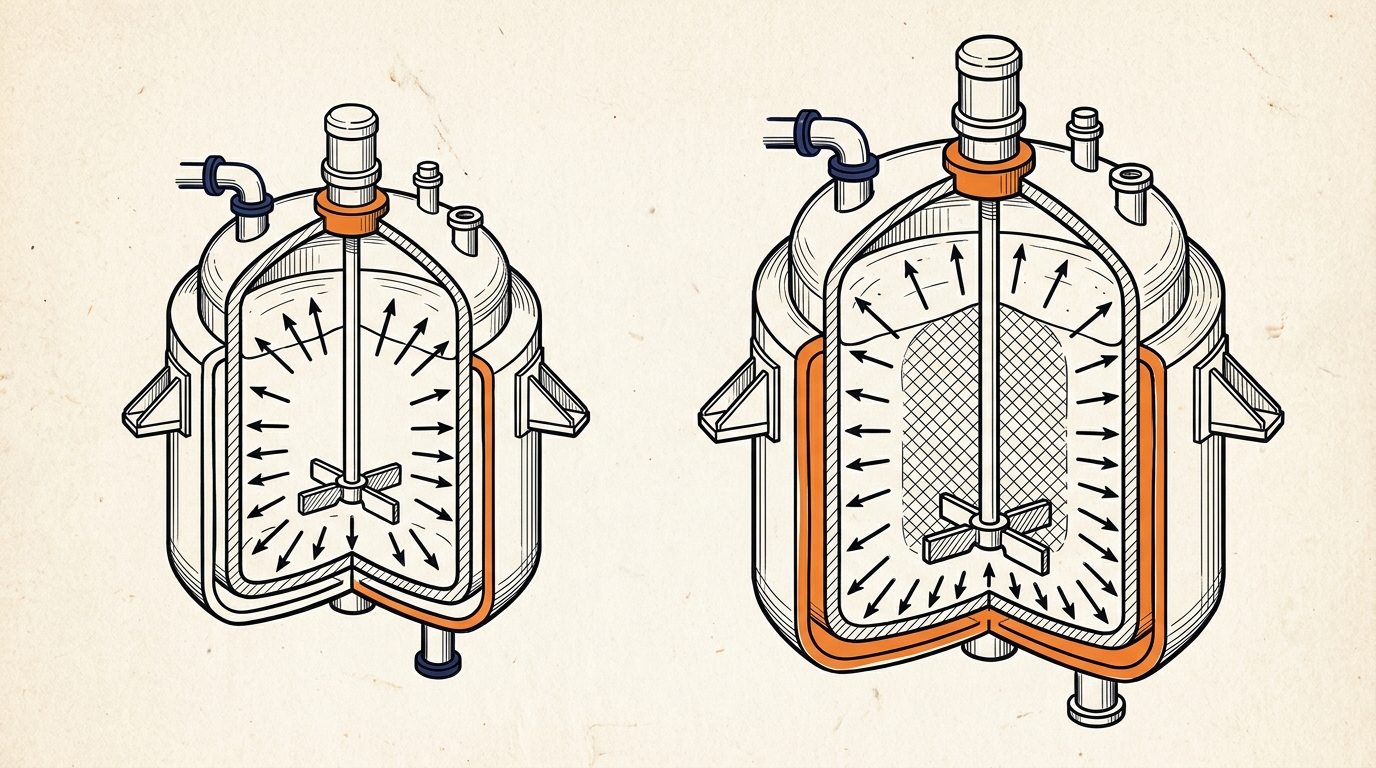
Industrial reactors operate under very different conditions.
As reactor volume increases, heat removal becomes progressively less efficient.
Temperature gradients may develop between different regions of the vessel.
Local overheating can accelerate reaction rates, while cooler regions may polymerize more slowly.
The consequence is not merely temperature variation.
Heat transfer influences:
- Molecular-weight distribution
- Polymer chain growth
- Solution viscosity
- Reaction stability
- Batch reproducibility
Experienced manufacturers therefore devote considerable attention to reactor design, cooling systems, and temperature-control strategies long before commercial production begins.
How Mixing and Impeller Design Affect Molecular Uniformity
Polymerization depends on more than temperature alone.
Every growing polymer chain requires a consistent supply of reactants.
Inadequate mixing can create localized regions with different concentrations of monomers, initiators, or chain-transfer agents.
Even brief concentration differences may influence molecular architecture.
Several engineering factors therefore become important:
- Impeller design
- Rotational speed
- Reactor geometry
- Feed-point location
- Circulation efficiency
- Residence-time distribution
These variables rarely appear in academic publications because they are specific to manufacturing equipment.
Within industry, however, they often determine whether polymer quality remains stable during long production campaigns.
How Feeding Strategy Controls PCE Polymer Architecture
Commercial polymerization is rarely performed by charging every raw material into the reactor simultaneously.
Instead, manufacturers carefully control feeding profiles.
Monomers, initiators, and auxiliary materials are introduced according to predetermined schedules designed to regulate reaction kinetics.
Published HPEG 2400 synthesis routes stage the acid monomer and the initiator over a controlled feed rather than charging them in one shot.
Small adjustments in feeding rate may influence:
- Polymer chain length
- Grafting efficiency
- Molecular-weight distribution
- Residual monomer concentration
- Product viscosity
For this reason, process recipes are closely guarded intellectual property within many construction chemical companies.
The macromonomer, typically a polyether grade such as HPEG 2400, provides the structural building block.
The feeding strategy determines how that building block becomes part of the finished polymer.
What Skills a PCE Scale-Up Team Needs Besides Chemistry
Many successful laboratory chemists discover that commercial manufacturing demands additional expertise beyond formulation science.
Industrial scale-up requires understanding of:
- Chemical reaction engineering
- Process instrumentation
- Equipment capability
- Heat-transfer analysis
- Fluid dynamics
- Production scheduling
- Operational safety
- Quality systems
Scale-up projects succeed when multidisciplinary teams work together.
Chemists define molecular objectives.
Process engineers translate those objectives into manufacturing conditions.
Production operators ensure consistent execution.
Quality specialists verify reproducibility.
Commercial success emerges from collaboration rather than individual expertise.
What Pilot Production Validates Before Full-Scale Manufacturing
Between laboratory development and full commercial manufacturing lies an essential intermediate stage.
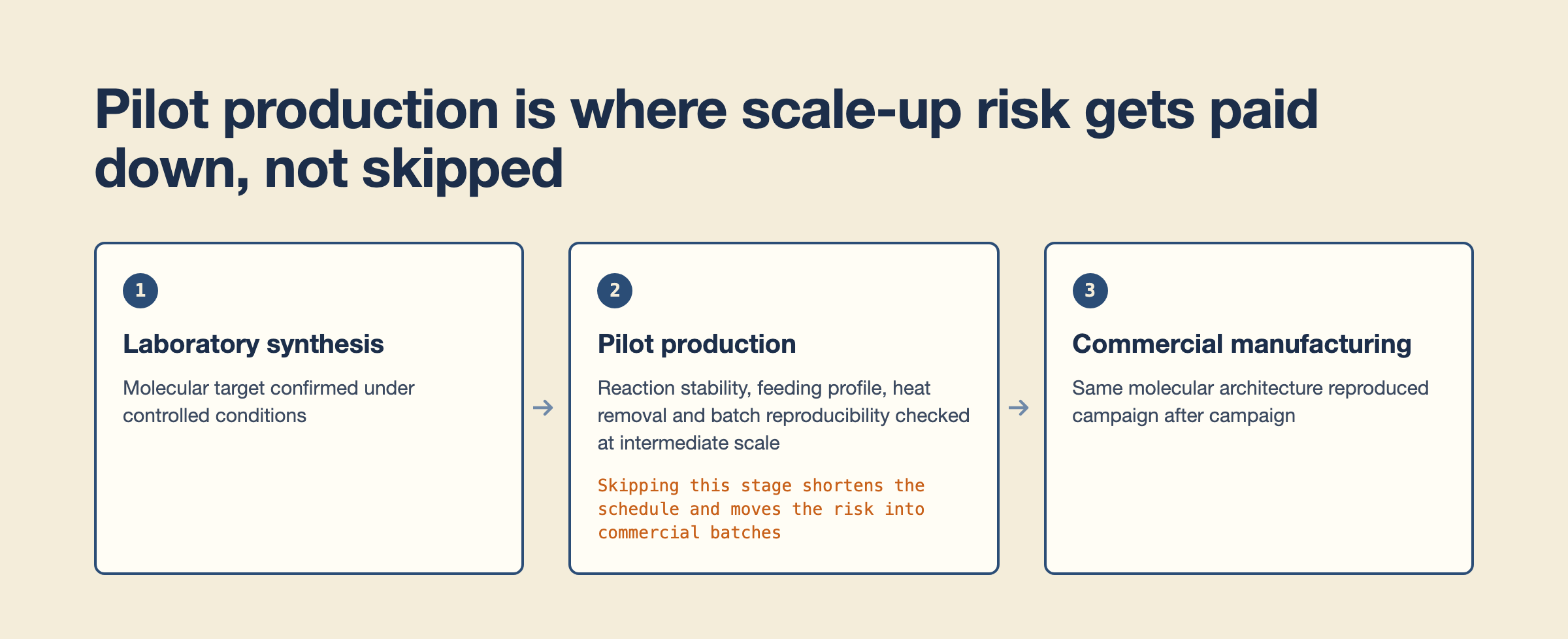
Pilot production.
Pilot reactors provide an opportunity to evaluate formulation behavior under conditions that more closely resemble industrial manufacturing while limiting commercial risk.
Typical pilot objectives include:
- Confirming reaction stability
- Optimizing feeding profiles
- Evaluating heat removal
- Measuring viscosity development
- Assessing batch reproducibility
- Identifying operational bottlenecks
- Generating qualification samples for customer testing
Skipping this stage may shorten the development schedule.
The same shortcut raises technical risk once commercial production begins.
Pilot-scale validation therefore represents an investment in manufacturing reliability rather than an additional development expense.
Scale-Up Failure Case: A Lab Feeding Profile Copied Into a Multi-Ton Reactor
A construction chemical producer developed a promising laboratory formulation designed for extended slump retention in infrastructure concrete.
Initial 1-liter synthesis of the PCE demonstrated excellent polymer characteristics, and early mortar testing exceeded performance expectations.
Confident in the formulation, the company proceeded directly to commercial production using a multi-ton reactor.
Within several batches, unexpected variations appeared.
Product viscosity fluctuated.
Polymerization time increased.
Concrete performance became less consistent.
Detailed investigation revealed that the laboratory feeding profile had been transferred directly to industrial equipment without accounting for differences in heat transfer and mixing efficiency.
Rather than modifying the molecular formulation, engineers redesigned the production process.
Feed rates were adjusted.
Cooling capacity was optimized.
Agitation parameters were refined.
The resulting polymer exhibited essentially the same molecular architecture originally achieved in the laboratory – but now with the consistency required for commercial manufacturing.
The lesson was clear.
Industrial success depended less on changing chemistry than on adapting engineering.
Why Batch-to-Batch Consistency Is a Competitive Advantage
Customers rarely evaluate the sophistication of a polymerization reactor.
They evaluate the consistency of the product delivered.
Every shipment is expected to perform predictably regardless of production date or manufacturing campaign.
The same expectation runs upstream, where a producer judges each delivery of construction chemical raw materials by whether it behaves like the last one.
This expectation transforms manufacturing consistency into a competitive advantage.
Organizations capable of maintaining stable production over many years generally benefit from:
- Reduced formulation adjustments
- Lower quality-control costs
- Fewer customer complaints
- Faster product qualification
- Greater production efficiency
- Stronger technical reputation
These benefits often exceed the value created by incremental improvements in laboratory performance.
How Industrial Manufacturing Differs from Laboratory Research
Laboratory research asks whether a formulation can work.
Industrial manufacturing asks whether it can work every day.
This distinction defines the difference between scientific discovery and commercial technology.
Successful scale-up does not attempt to reproduce laboratory conditions exactly.
Instead, it redesigns the manufacturing process so that industrial equipment produces the same molecular architecture through different engineering conditions.
Understanding this principle allows manufacturers to move beyond trial-and-error production toward systematic process optimization.
What Scale-Up Should Preserve: Molecular Architecture, Not Procedures
Scale-up should be viewed as a process of preserving molecular architecture rather than copying laboratory procedures.
The objective is not to reproduce every operating condition.
The objective is to reproduce the same polymer structure, despite the inevitable differences between laboratory and industrial equipment.
Once this distinction is understood, many apparent scale-up problems become engineering challenges rather than chemical mysteries.
How Digital Process Control Improves Batch Consistency
Heat removal, mixing, and feed timing are far easier to hold steady when the reactor reports its own condition while the batch is still running.
Industrial production is increasingly supported by:
- Advanced process control (APC)
- Online analytical instrumentation
- Digital twins
- Predictive maintenance
- Real-time quality monitoring
- Automated data acquisition
- Statistical process analytics
These technologies catch process deviations earlier and cut batch variability. That matters more for PCE than for most polymers, because performance depends on holding the same molecular architecture across thousands of batches.
Molecular design creates the polymer. Process instrumentation is what reproduces it.
What to Do When a Proven Formulation Fails at Scale
When a formulation that behaved well in the laboratory starts drifting in a production reactor, audit the process before touching the recipe.
Feed rate, cooling capacity, and agitation are the variables that changed when the reactor changed, not the chemistry.
Reproducing laboratory results at production scale means finding the industrial operating window that delivers the same polymer structure, not scaling every quantity by the same factor.
Plants that reformulate after every complaint are solving the wrong problem. Producers who hold their specification over long campaigns are usually the ones who invested early in pilot work and process instrumentation, not the ones with the cleverest formulation on paper.