

Copolymer polypropylene resists dimethylformamide (DMF) at room temperature, and DMF does not dissolve it under any ordinary condition. Every chemical-resistance chart converges on the same cell: PP rates “resistant” to DMF at 20 °C, with negligible absorption on a one-month immersion test.
The verdict is settled. What the chart cell cannot tell you is why, and where the rating starts to soften. Both decide whether a PP drum, liner, or wetted part is fit for your service — or whether you are treating an ambient, unstressed-immersion result as a guarantee for hot, loaded duty.
Does DMF Attack Copolymer PP at Room Temperature?
Copolymer PP carries a top resistance rating to DMF at 20 °C — “no effect to slight effect” on a two-tier chart, grade A on the four-tier system used for resin-maker immersion data. Weight gain on an unstressed specimen runs under 0.2 % over six months at ambient.
That puts DMF among the safer organic solvents for PP, not a borderline case. DMSO also rates resistant at 20 °C, while acetonitrile drops to limited resistance.
The chart rating comes from ASTM D543-style immersion: a small dumbbell specimen soaked for one month, unstressed. ISO 175 describes the equivalent method.
Read that for what it is. It tells you a relaxed, room-temperature PP coupon barely absorbs DMF. It does not certify a loaded, elevated-temperature part — a different question, answered further down.
Why a Nonpolar Polyolefin Resists a Polar Aprotic Solvent
PP resists DMF because the two sit roughly 8 MPa^0.5 apart on the solubility-parameter scale, far outside the window where a solvent can swell a polymer. PP’s Hildebrand parameter is about 16.5 MPa^0.5; DMF’s is 24.8.
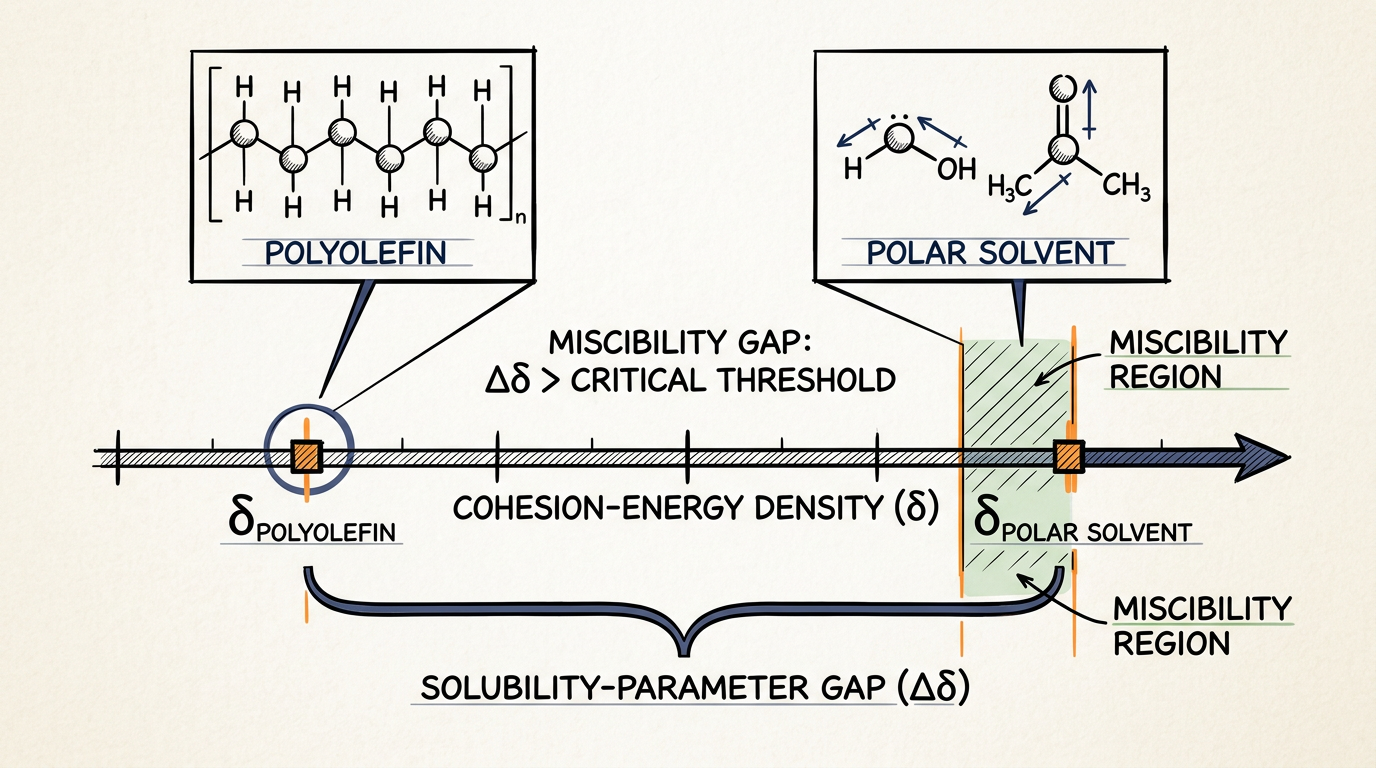
Like dissolves like — and these two are not alike. Miscibility generally needs the parameters within about 3–4 units of each other, and an 8-unit gap is a wide miss.
The Hansen breakdown sharpens it. DMF’s cohesion splits into dispersive 17.4, polar 13.7, and hydrogen-bonding 11.3 MPa^0.5 — most of its grip comes from polarity and hydrogen bonding. Those are exactly the interactions a polyolefin chain cannot offer, because its cohesion is almost entirely dispersive.
The resin makers state the rule plainly: absorption by polypropylene rises as temperature climbs and falls as the polarity of the medium increases. Run that backward and it explains the chart — the higher a solvent’s polarity, the less PP takes it up. A high-polarity aprotic solvent like DMF is close to a worst case for wetting a polyolefin.
A second barrier sits behind the parameter math. PP is semicrystalline, and the crystalline fraction is effectively impermeable — solvent can only reach the amorphous regions between crystallites. Nothing solvates those crystallites cold anyway, which leads to the misconception worth correcting next.
Will DMF Dissolve a PP Part?
No — and the more useful fact is that nothing dissolves polypropylene at room temperature. PP has no practical cold solvent at all. It goes into solution only in hot nonpolar aromatics or chlorinated solvents — p-xylene, tetralin, decalin, or 1,2,4-trichlorobenzene heated to roughly 130–165 °C.
DMF is not on that list at any temperature. A polar aprotic solvent has no path to dissolve a dispersion-bonded crystalline polyolefin.
So a PP part dissolving in DMF is the wrong failure mode to watch. Dissolution is off the table. The real risk at elevated temperature is absorption — the part takes up a little solvent, swells, and softens — not a part going liquid.
One field report makes the distinction concrete. A researcher stored a DMF-plus-dissolved-polymer mixture in a cheap, unspecified plastic vial, and within a day the vial leaked and the base distorted. That is no verdict on spec PP: “plastic” is too coarse a word, and a dissolved polymer changes the solvent system.
How Does Temperature and Copolymer Type Change DMF Resistance?
Two variables move the ambient verdict — service temperature and copolymer subtype — and charts list neither for DMF. Absorption rises with temperature, so the grade-A cell at 20 °C drifts toward the test-advised band as the medium climbs toward 60–90 °C. At 60 °C, unstressed weight gain still stays under about 0.5 % over six months.
Push the temperature high enough and the limit you hit first is not solvent attack. It is oxidative degradation and antioxidant extraction — the polymer ages out before DMF ever dissolves it.
Subtype shifts the swelling, never the dissolution verdict. The split between random and impact copolymer decides how much: polypropylene copolymers swell more than homopolymers because they absorb more.
- Impact (block) copolymer carries an amorphous EPR rubber phase that takes up the most solvent and swells the most.
- Random copolymer runs lower-crystallinity than homopolymer but absorbs less than impact grade — Dushanzi T4401 is a typical random-copolymer reference.
- Homopolymer is the tightest permeation barrier of the three.
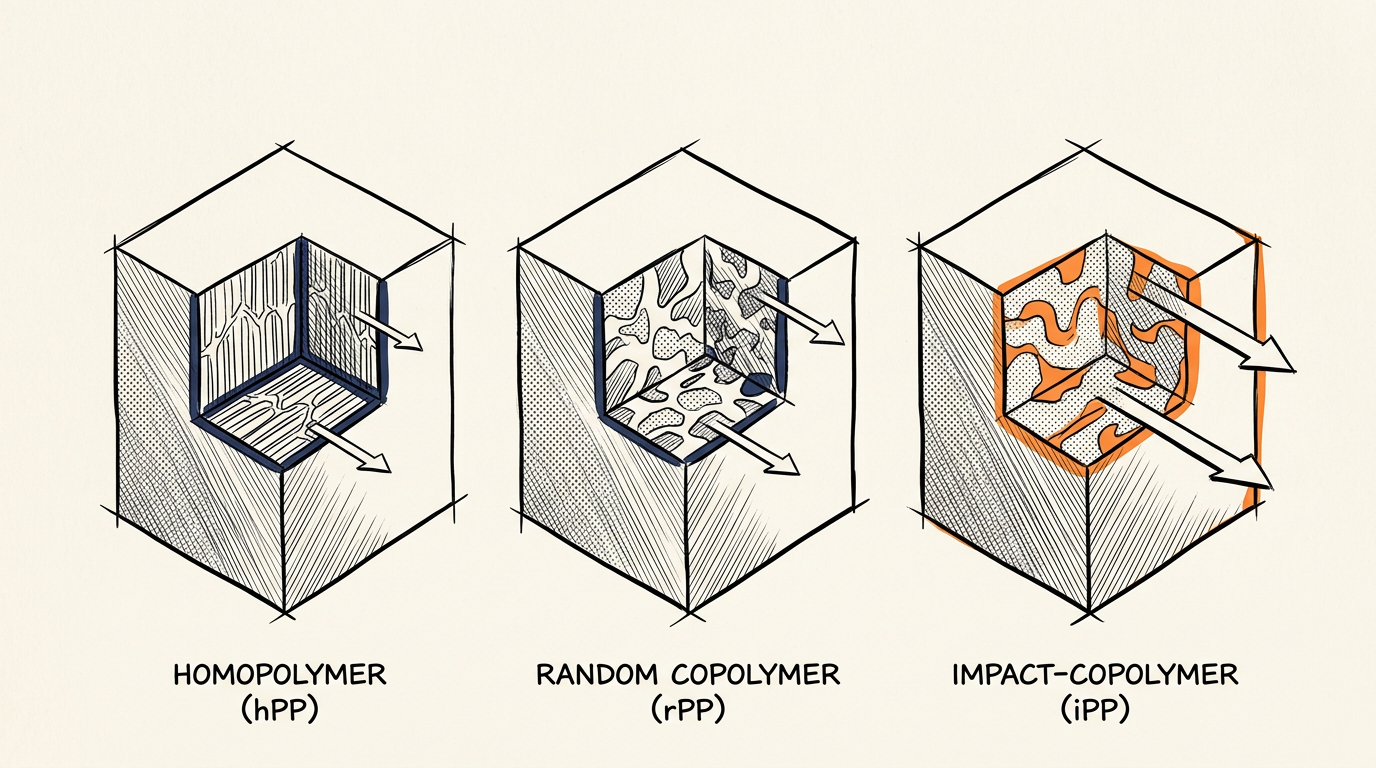
All three resist DMF. The one to qualify for dimensional stability is an impact-copolymer part run hot, where the swelling premium shows up on a loaded dimension.
PP also has excellent environmental stress-crack resistance. The polar-organic and detergent cracking that plagues polyethylene is not seen in PP. The environments that do crack it are strong oxidizers — 98 % sulfuric acid, chromic/sulfuric mixtures, concentrated hydrochloric/chlorine — not DMF.
Is Copolymer PP Fit for DMF Storage and Handling?
Copolymer PP is fit for DMF containment and contact at ambient — drums, liners, tubing, labware, and wetted parts all sit inside the resistance envelope.
The independent confirmation comes from the solvent side. DMF technical data sheets name high-density polypropylene, alongside PTFE and polyethylene, as a preferred seal material, with stainless steel or aluminum for the tanks. The solvent maker and the resin maker agree from opposite directions.
A few handling points decide the install. DMF has practically no corrosive effect on ordinary metals except copper and its alloys, so a PP-lined or PP-gasketed steel vessel is a clean pairing. DMF is also hygroscopic — storing it under nitrogen protects the solvent, not the PP.
Bastone supplies both sides of this pairing, copolymer PP resin and DMF (CAS 68-12-2), so one specifier can spec the container and the contents against the same data.
Hold the line on two conditions: keep service near ambient, and watch contact duration on any loaded part. For hot or stressed DMF service, verify against the supplier’s temperature-specific data rather than the ambient chart cell — especially if the part is impact copolymer.
What the Chart Cell Leaves Out
Treat the “PP: resistant to DMF” chart entry as an ambient, unstressed-immersion result, not a service rating. At room temperature it is correct and well-supported — PP sits too far from DMF on the solubility scale for the solvent to gain any purchase, and dissolution is physically off the table.
The two parameters the cell omits set the margin: service temperature, which raises absorption as it climbs, and subtype, where an impact-copolymer part swells more than random copolymer or homopolymer. Neither changes the yes; both change the margin.
The part that needs a second look is the loaded impact-copolymer fitting running warm — where a top chart rating and dimensional stability stop being the same claim.