

As of early 2026, a kilogram of HDPE and a kilogram of polypropylene quote within roughly 10-20% of each other, both stamped “chemically resistant” on the quote. So the part gets sourced on price.
I’ve watched that one decision crack a PP outdoor tank in a winter yard. I’ve watched it creep an HDPE cap open on a 90 °C hot-fill line. A scrapped run costs far more than the cents the cheaper resin saved.
For a rigid container, tank, cap, board, or trim part, the small price gap is the wrong variable. The right one is the single property that decides whether the part survives: cold-impact toughness, stress-crack life, hot-fill service temperature, a flexing hinge, or stiffness per unit weight.
Match that property to the resin that owns it, and the price difference stops mattering.
HDPE vs PP Price: Why the 10-20% Gap Is the Wrong Variable
The price gap between HDPE and PP is real but small, and one property mismatch in the field dwarfs it. HDPE averaged about USD 1.04-1.17/kg in the US from December 2025 into Q1 2026; PP reached about USD 1.24/kg in North America by March 2026 — the same roughly USD 1.0-1.3/kg band.
That closeness is the trap. When two resins quote within cents and carry the same generic “chemically resistant” label, the default is to buy the cheaper and call them interchangeable — and they are not.
A scrapped run or a cracked tank costs far more than the resin spread ever saved. This is the head-to-head rigid-part call; the broader polyethylene vs polypropylene comparison sets HDPE against the other PE grades.
The cheapest grade that meets the spec is the right grade — but only when “spec” means the part’s one failure-critical property, not the unit price. Commodity prices also move (PP rose more than 20% between December 2025 and March 2026), so pick on the governing property and the call holds wherever the two trade this quarter.
When Cold Impact and Stress-Crack Life Decide: HDPE
HDPE owns the cold-service and stress-crack duties — outdoor tanks, jerricans, drums, chemical IBCs — because it stays ductile where PP turns brittle and resists slow cracking that price-defaulted parts ignore. Two failure modes drive it, surfacing months after the part ships.
Cold-Impact Toughness
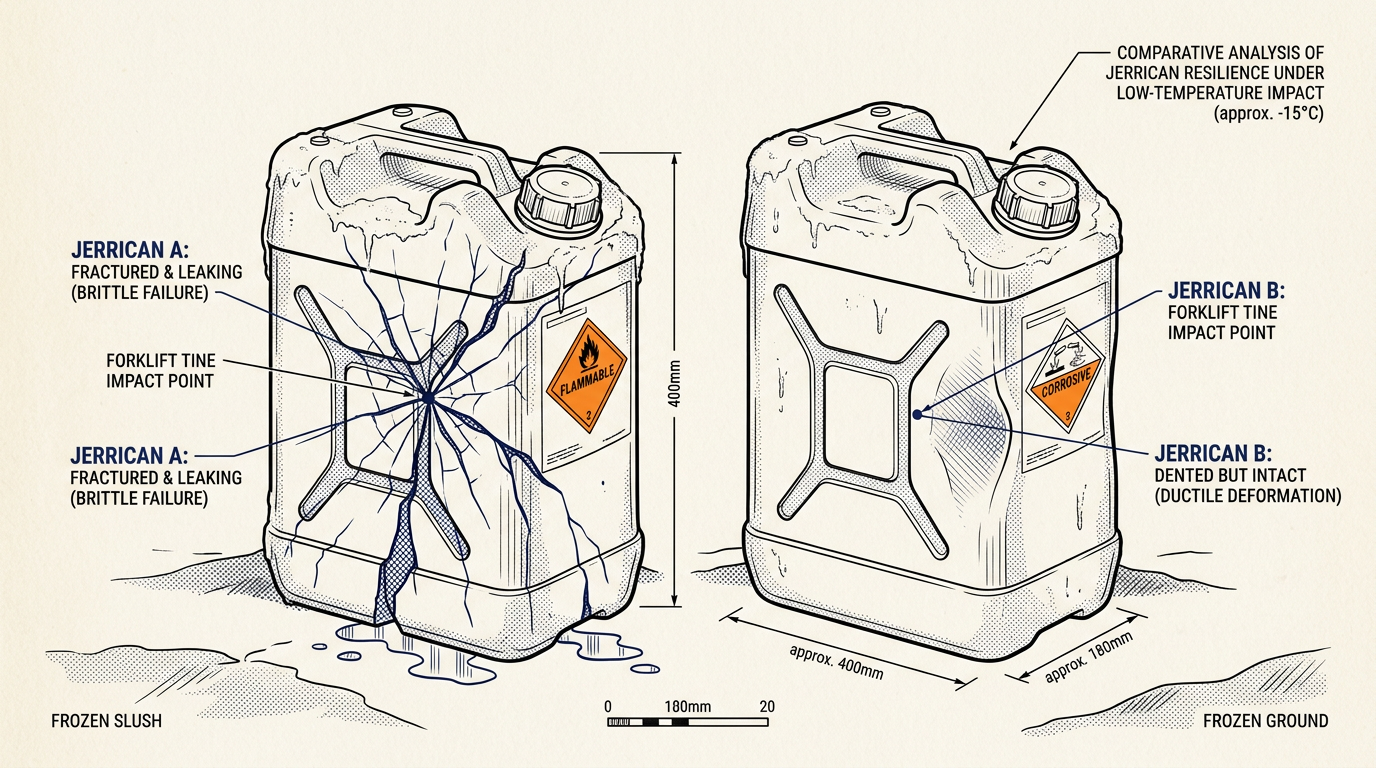
HDPE stays tough down to about -40 °C, while homopolymer PP turns brittle near freezing. PP’s low-temperature brittleness sits around -5 °C to 0 °C, and impact strength drops sharply below 0 °C (32 °F). For a part that lives outdoors, that delta is the story.
A PP jerrican sourced on price holds through summer trials, then splits in the first hard winter when a forklift nudges it. HDPE absorbs the same knock at -20 °C and keeps its shape. For outdoor tanks, drums in unheated warehouses, or cold-climate transport jerricans, cold-impact toughness alone picks HDPE.
Environmental Stress-Crack Resistance
HDPE under sustained tensile stress can slow-crack when it contacts surfactants, detergents, or polar solvents — a failure mode separate from impact, and the one that ends drum service. A unimodal HDPE drum holding detergent or bleach develops fine cracks at stressed corners long after it passed every short-term test.
The fix is grade, not resin family. Bimodal PE100 grades pair short polymer chains for processing with long chains that resist crack growth. A PE100 blow-molding grade such as TUB121N3000 is the slot for a surfactant or detergent drum that has to last years under load.
PP, by contrast, is largely immune to slow crack growth, so for a low-stress container in a warm climate it is a legitimate call. Know which failure mode governs your part before you price it.
When Heat, Hinges, and Stiffness Decide: PP
PP owns hot-fill, dishwasher, steam, flip-top closure, and stiffness-per-weight duties, and on every one an HDPE part sourced on price fails or deforms. Three properties separate them; service temperature is the most misread.
Hot-Fill and Service Temperature
PP runs hotter than HDPE in continuous service, the opposite of what some spec tables print. HDPE tops out around 80 °C continuous (about 180 °F) before it softens and creeps. PP carries a heat-deflection temperature reaching roughly 99 °C at 0.45 MPa and melts at 160-170 °C, holding shape through hot-fill, dishwasher, and steam cycles.
The common field mistake is assuming HDPE handles hot-fill because a property table listed its “max service temp” above PP’s, inverting reality. An HDPE cap on a 90 °C hot-fill line creeps and loses seal.
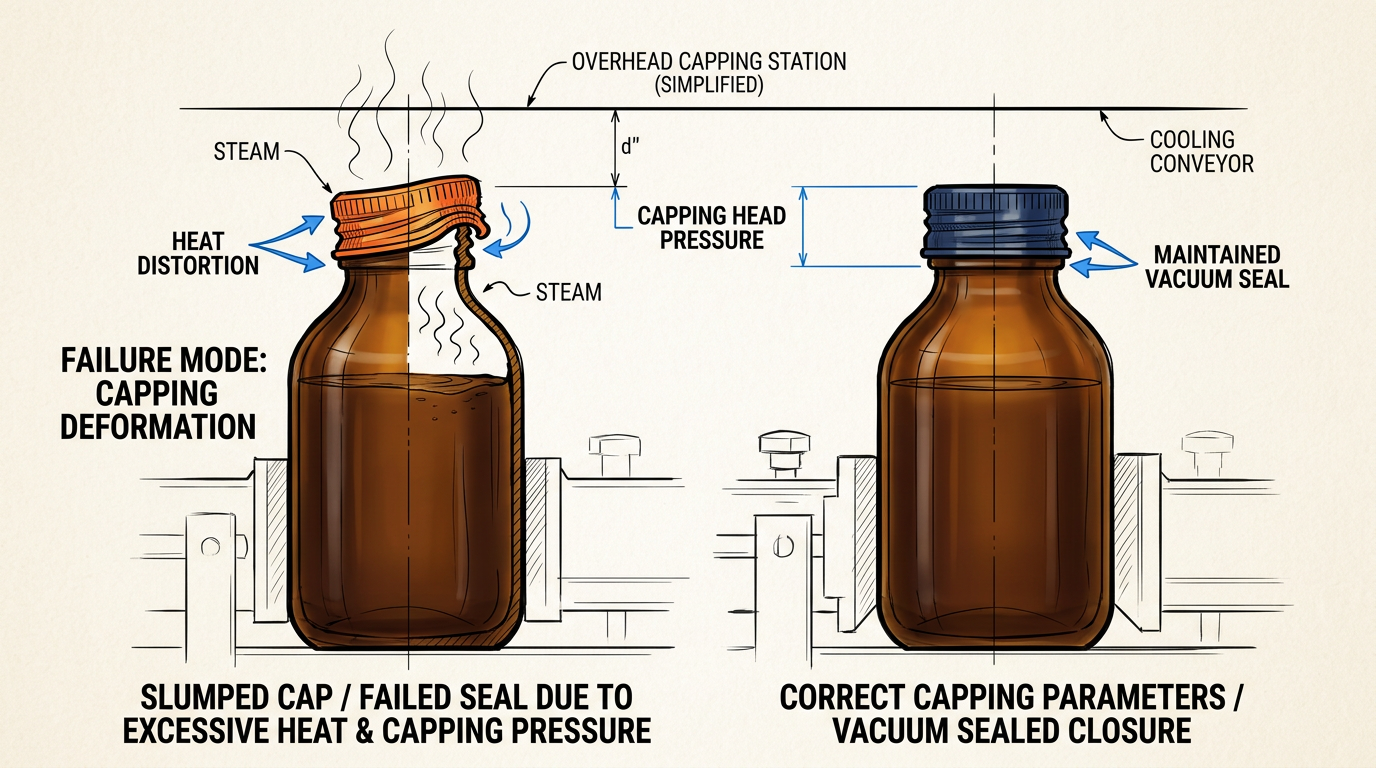
For any part that sees sustained heat above 80 °C, PP is the resin. China’s commodity PP for these duties runs mostly through the PP supply channel of PetroChina — including the Dushanzi complex behind grades like T4401 — and Sinopec.
Living Hinge
PP is the only one of the two that makes a working living hinge. Its fatigue resistance lets a flip-top cap flex through thousands of cycles without failing at the fold, where an HDPE hinge fatigues and cracks.
This one is binary — no grade of HDPE rescues a flip-top closure. A snap-cap spec sourced as HDPE to save a few cents fails at the hinge, full stop. If the part flexes at a hinge, it is a PP part.
Stiffness Per Unit Weight
PP carries a higher flexural modulus than HDPE at a lower density, so it delivers more stiffness per pound — the heavier resin is not the stiffer one. PP runs roughly 1,200-1,500 MPa at about 0.90 g/cm³, against HDPE’s 800-1,400 MPa (about 200,000 psi by ASTM D790) at about 0.95 g/cm³.
For a cutting board or load-bearing panel where stiffness at minimum weight matters, PP gives a stiffer part at lower mass. From there the PP grade family of homopolymer, random, or impact copolymer is the next call.
HDPE vs PP Chemical Resistance: The Stored Chemical Decides
Chemical resistance is directional, not a single ranking, so the specific chemical decides between HDPE and PP rather than the blanket “chemically resistant” label. PP edges HDPE on oxidizing acids — concentrated sulfuric, chromic, and nitric — so it is the call for a part contacting those.
HDPE handles a broad sweep of acids, bases, alcohols, salts, bleach, and detergents, which is why it dominates general chemical drums. Neither handles aromatic or halogenated solvents — toluene, xylene, chloroform, methylene chloride — where a fluoropolymer like PVDF or PTFE is the right material.
Read the stored chemistry against the part before the “chemically resistant” label settles it.
Price the Failure, Not the Pound
Stop pricing HDPE against PP per pound and start pricing what the part costs you when it fails. The spread is noise next to a scrapped run or a cracked tank in a customer’s yard — the exact field cost the cheaper-resin habit ignores.
Name the one property that ends the part — cold-impact, stress-crack life, hot-fill heat, a flexing hinge, or stiffness at minimum weight — and the resin is decided before you look at the quote. Write that property into the spec, and the next buyer does not relearn the lesson the hard way in a winter yard.