

Every metric ton of polyvinyl butyral (PVB) interlayer film carries roughly 260 kg of a single plasticizer: triethylene glycol di-2-ethylhexanoate, or TEG-2EH.
TEG-2EH (CAS 94-28-0, also sold as 3G8) is produced from 2-ethylhexanoic acid in three stages: esterification with triethylene glycol, vacuum recovery of the excess acid, and refining to spec.
The consumption figure and the stage parameters that follow come from a 2020 disclosure by Ouyang Kongbo of Anhui Wanwei, a Chinese PVB-chain producer; they document one plant’s practice, not a universal standard.
Step 1: Esterification of 2-EHA and Triethylene Glycol
Esterification runs in a stirred, steam-heated kettle held at 180 to 220 °C, where triethylene glycol (TEG) reacts with an excess of 2-ethylhexanoic acid under a nitrogen blanket.
The acid arrives as a finished upstream product of 2-ethylhexanal oxidation, so the ester plant inherits its purity and color as fixed inputs. The nitrogen gauge pressure is barely positive, 0.01 to 0.02 kPa, enough to keep air out of a vessel running hot enough to darken any ester.
How the Two-Step Reaction Reaches Completion
TEG carries two terminal hydroxyls, and they esterify in sequence: acid plus glycol forms the monoester and one water, then a second acid molecule converts the monoester to the diester.
Both steps are reversible. Unless water leaves the system continuously, conversion stalls short of the diester, which is why the kettle’s vapor line matters as much as its heating coil.
Overhead vapor passes through a condenser into a phase separator. The condensed 2-EHA layer drains back to the kettle while the water layer is rejected, and that steady water removal pulls the equilibrium toward the diester.
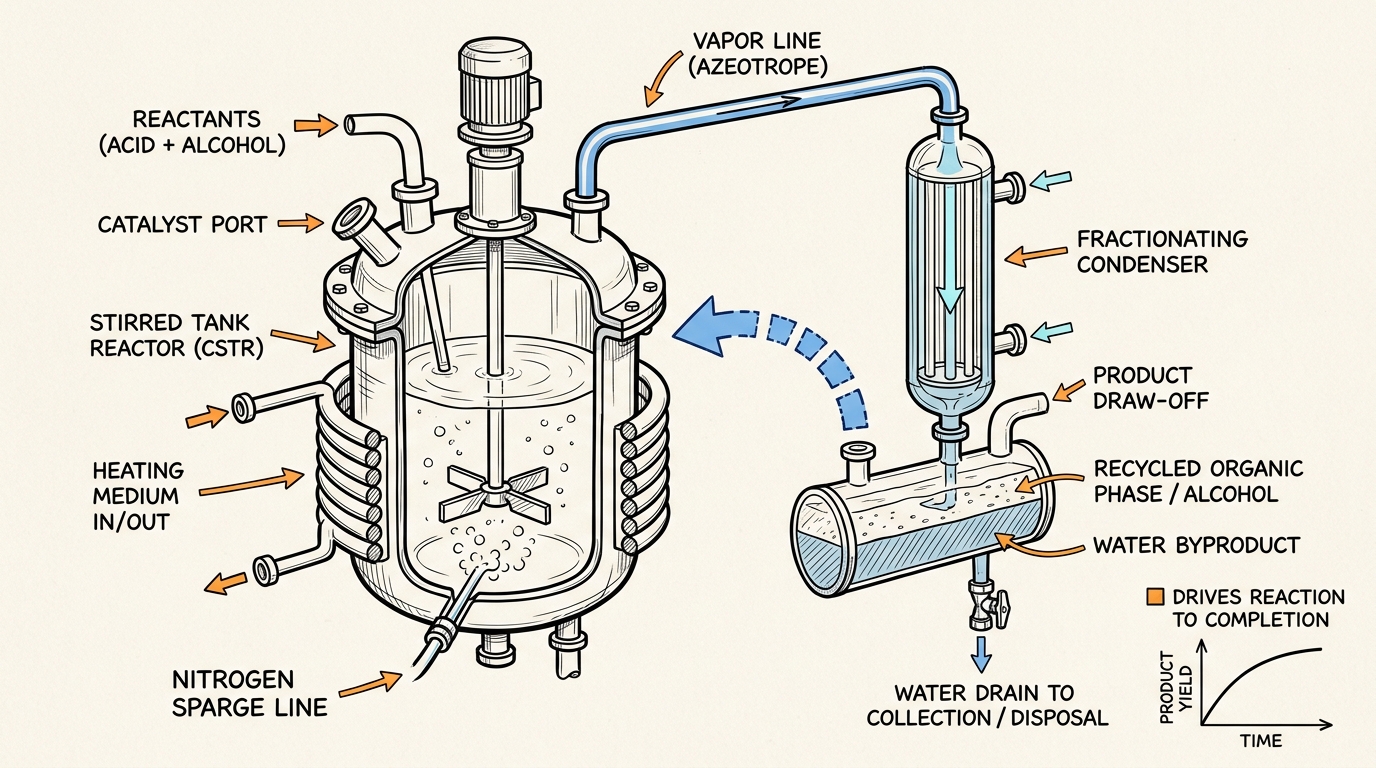
Ouyang’s endpoint is analytical, not scheduled: the batch closes when sampled monoester content falls to 0.5 to 1.5 percent.
Why the Catalyst Is Tin Chloride, Not Sulfuric Acid
The disclosed system pairs stannous chloride (SnCl2) as the main catalyst with titanium dioxide and activated carbon as co-catalysts, a combination developed over years by Jinquan Co. and Anhui Wanwei.
Sulfuric or phosphoric acid would drive the same reaction at lower catalyst cost, but the plant pays elsewhere: corroded equipment, a neutralization step, salt-laden wash water, and a darker ester.
A 2020 Eastman patent puts a number on the color penalty. Its p-toluenesulfonic acid run reached 96.3 percent diester but produced a dark-brown product that required bleaching.
Tin chemistry avoids that trade. Silva and Cardoso’s 2016 esterification study, run on oleic acid rather than 2-EHA, ranked SnCl2 the most active of six tin catalysts and noted it needs no end-of-batch neutralization.
In the kettle, the tin system works at atmospheric pressure and leaves with the activated carbon in the first filtration pass. SnCl2 itself is not static: it sheds hydration water above 80 °C, so the species catalyzing at 200 °C is not the dihydrate you charged.
Direct esterification is not the only industrial route. The same patent claims transesterification of methyl 2-ethylhexanoate with TEG over potassium carbonate at 135 to 165 °C, reaching over 99 percent diester in 3.5 hours.
Both paths draw on the same upstream chain; the methyl ester comes from 2-ethylhexanal, the aldehyde that otherwise oxidizes to 2-EHA.
Don’t substitute one catalyst family for the other without re-qualifying the endpoint spec; the residues, monoester tails, and color loads differ, and the refining train downstream was sized for one of them.
Step 2: Recovering and Recycling Excess 2-EHA
Excess acid comes off the crude ester by vacuum stripping at 15 to 40 kPa absolute and 200 to 240 °C for 3 to 5 hours, with nitrogen sparged through the kettle bottom.
The stripped acid condenses into a collection tank and charges the next batch. Stripping ends on a number, not a clock: the batch is done when kettle acid value falls to 1 to 6 mg/g.
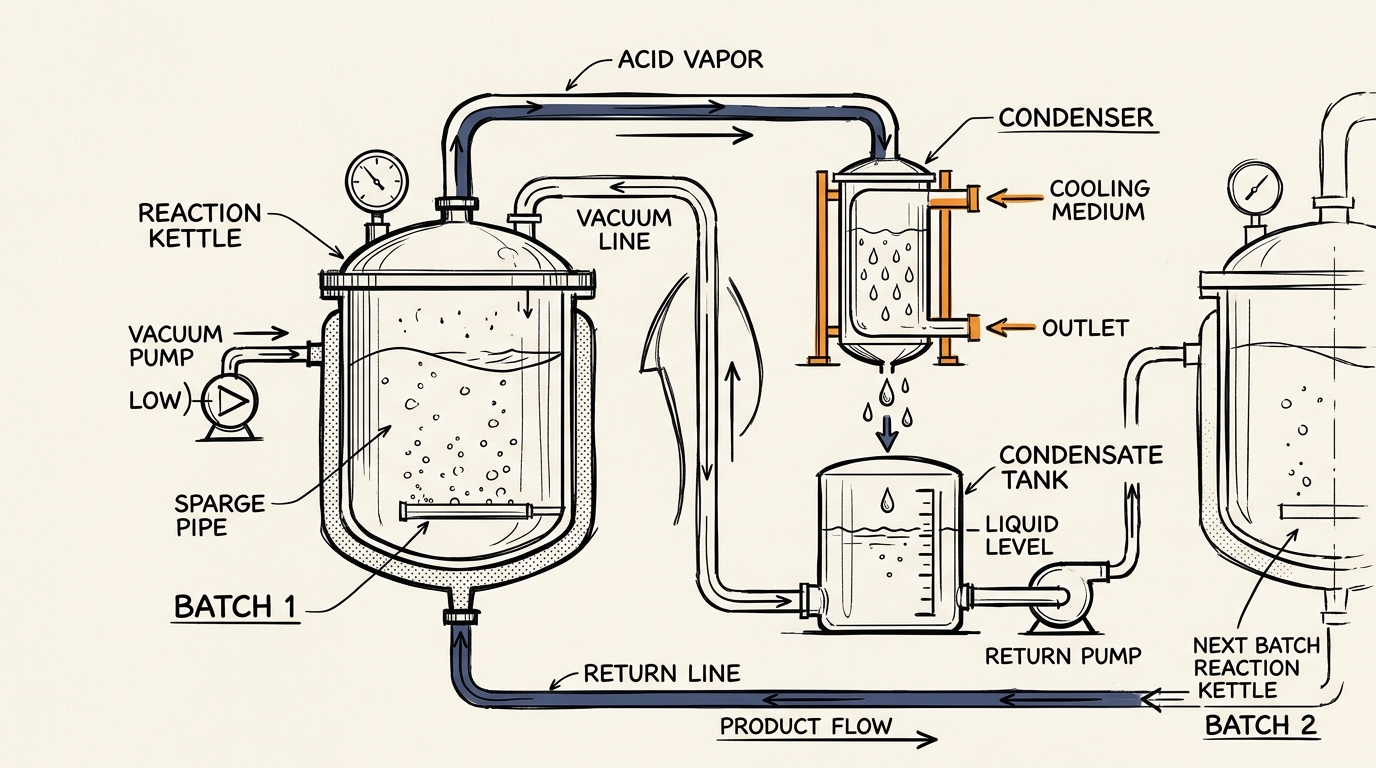
Each cycle tops the loop up with fresh technical-grade 2-EHA to cover losses. Hold that makeup acid to the same purity bar as the virgin charge; whatever rides in with it concentrates over successive recycles.
If I audit one thing on a line like this, it is the acid-value trend across recycle batches. A creeping endpoint is the earliest sign the loop is accumulating heavies the strip step cannot remove.
Step 3: Refining Crude TEG-2EH to Finished Spec
Refining takes the crude ester from an acid value of 1 to 6 mg/g down to 0.1 mg/g or less, while bringing purity to at least 98 percent.
The Five-Operation Refining Train
Ouyang’s disclosure runs five unit operations in fixed order:
- Plate-and-frame filtration removes the spent tin catalyst together with the activated carbon that carried it.
- Vacuum de-lighting strips residual free 2-EHA and other light ends.
- Water washing with pure water pulls out water-soluble residues.
- Dehydration removes the water the wash left behind.
- Fine filtration polishes the ester before it goes to storage.
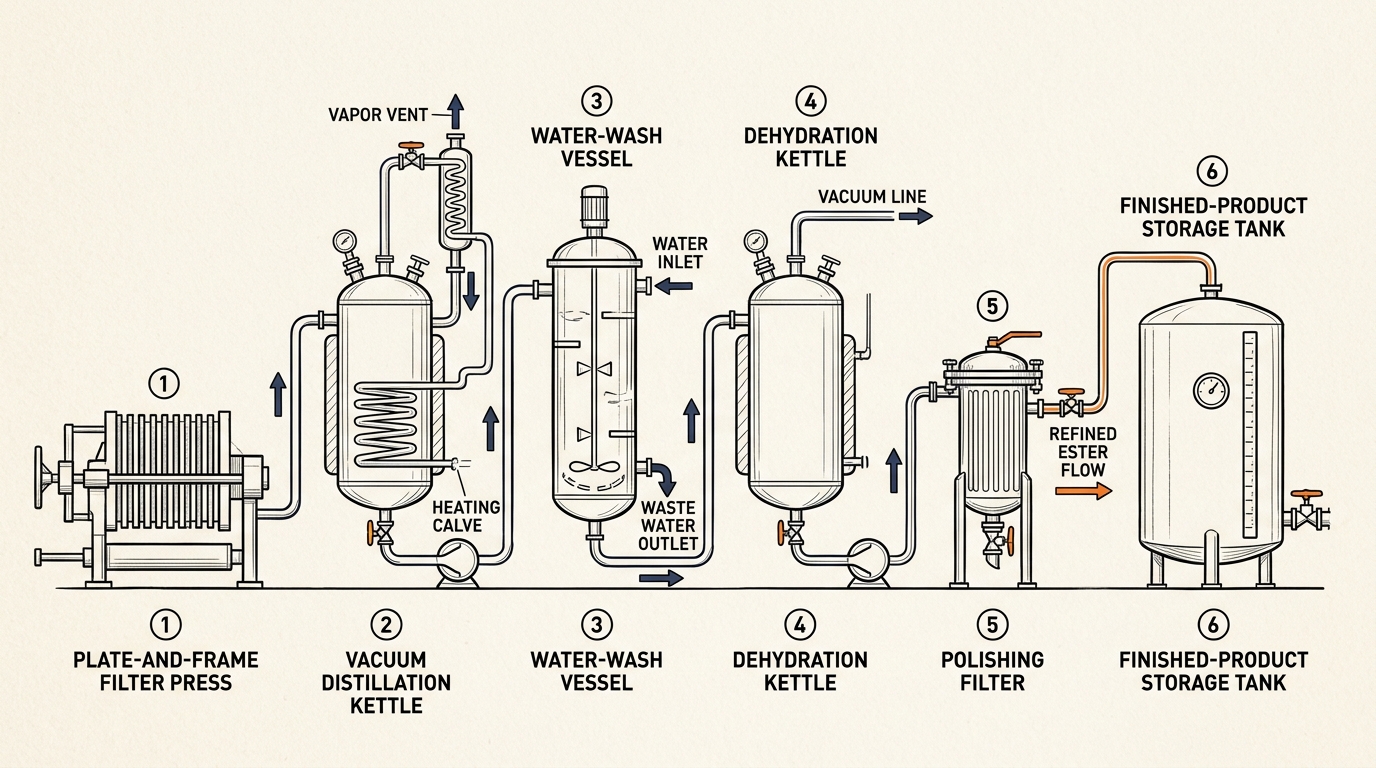
No bleaching step appears anywhere in that train. That absence is the payoff of the catalyst choice in Step 1: with tin instead of a Brønsted acid, color never gets bad enough to need fixing.
Reading the Finished-Product Spec
Finished TEG-2EH under the disclosed practice is a colorless, transparent oil meeting four numbers:
| Parameter | Disclosed spec (Ouyang 2020) |
|---|---|
| Purity | ≥ 98% |
| Acid value | ≤ 0.1 mg/g (titrated as NaOH) |
| Flash point | ≥ 207 °C, open cup |
| Color | ≤ 20 Pt-Co |
Set those numbers against a commercial datasheet and they appear to disagree. Eastman’s published TEG-EH datasheet lists a flash point of 186 °C Setaflash closed cup and an acidity of 0.05 weight percent maximum.
Neither sheet describes a worse product; the test methods differ. Open-cup flash values run higher than closed-cup values on the same liquid, and acid value in mg/g sits on a different basis than acidity in weight percent.
The COA gives you the numbers; the method column tells you whether they compare. Cross-producer comparison without the method notes is how in-spec product gets rejected at incoming inspection.
Color is the spec the ester plant only half-controls. Holding platinum-cobalt (Pt-Co) color at 20 or below depends on the Step 1 nitrogen blanket and on feedstock acid that has not yellowed. Oxygen exposure degrades 2-EHA color long before the acid reaches a kettle.
What This Means in Practice
Judge a TEG-2EH line by three endpoint numbers: monoester of 0.5 to 1.5 percent closes esterification, acid value of 1 to 6 mg/g closes stripping, and 0.1 mg/g defines finished product.
The catalyst family, not the reaction chemistry, decides what kind of plant gets built. Tin-based catalysis at atmospheric pressure trades a modest catalyst cost against pressure-rated vessels, acid-resistant metallurgy, neutralization wastewater, and a bleaching step.
Feedstock discipline is process discipline. Every attribute of the 2-EHA charged to the kettle, color above all, either passes through to the PVB film or gets scrubbed out downstream at the refiner’s expense.