

DMDS is dimethyl disulfide, CH3SSCH3 — a colourless to pale-yellow organosulfur liquid with a strong garlic odour, CAS 624-92-0, bought by refineries and petrochemical plants as a sulfur carrier.
It holds 68 % sulfur by mass and releases it as hydrogen sulfide when heated with hydrogen over a catalyst.
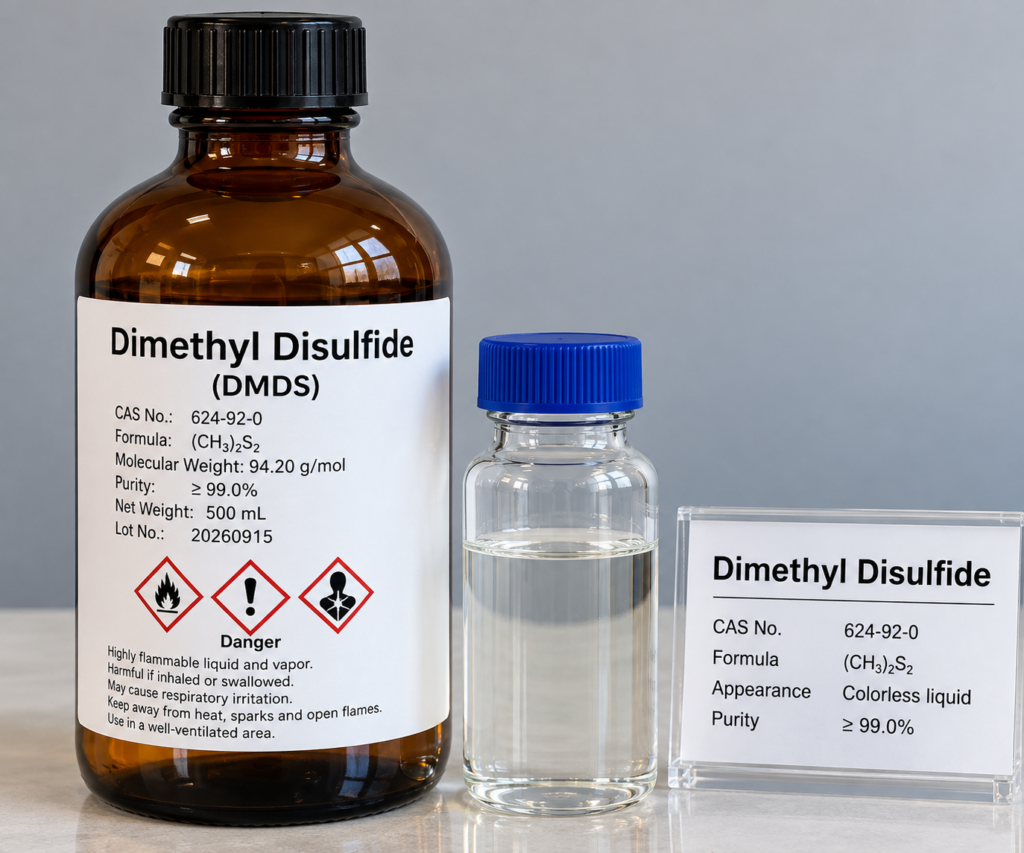
DMDS Properties and Identifiers
DMDS is identified by CAS 624-92-0 and shipped under UN 2381, and it behaves as a dense, poorly water-soluble liquid that boils just above 100 °C and flashes below room temperature.
| Property | Value |
|---|---|
| CAS number | 624-92-0 |
| EC number | 210-871-0 |
| UN number | 2381 (class 3, subsidiary risk 6.1, packing group II) |
| Formula | C2H6S2 (CH3SSCH3) |
| Molecular mass | 94.2 |
| Appearance | Colourless to pale-yellow liquid |
| Odour | Characteristic garlic / onion |
| Boiling point | 109–110 °C |
| Melting point | −85 °C |
| Relative density (water = 1) | 1.06 at 20 °C |
| Solubility in water | 2.5 g/L at 20 °C (poor) |
| Vapour pressure | 3.8 kPa at 25 °C |
| Relative vapour density (air = 1) | 3.2 |
| Flash point | 10 °C closed cup (ICSC 1586); 24 °C closed cup (HSDB) |
| Auto-ignition temperature | > 300 °C |
| Explosive limits in air | 1.1–16 vol % |
| Sulfur content | 68.1 % by mass |
| Odour threshold | 0.00078–0.0036 ppm |
| Occupational exposure limit | 0.5 ppm, 8-hour TWA, skin notation |
What Is DMDS Used For
DMDS is used industrially as a sulfur carrier: the sulfiding agent that converts a fresh hydrotreating catalyst to its active form, and the sulfur source dosed into petrochemical furnaces to cut decoking operations.
Outside process units it serves as an intermediate in fine chemicals and as an anti-corrosive in metallurgy. It is registered in the US as a pre-plant soil fumigant which, co-applied with chloropicrin, is expected to serve as a methyl bromide replacement. Separately from that registration, it is listed as a food flavouring substance and as a fragrance ingredient.
Refinery Catalyst Sulfiding
Sulfiding converts the metal oxides on a fresh hydroprocessing catalyst into the sulfides that are its active state, and DMDS is the agent dosed into the start-up feed to supply the sulfur. Hydrotreaters and hydrocrackers are the usual units; propane dehydrogenation co-feeds DMDS for a different purpose, to hold coking down on the Pt–Sn catalyst.
Decomposition over the catalyst begins between 160 and 190 °C, and injection typically starts once the reactor inlet reaches 180 °C. Complete conversion comes later and depends on pressure, space velocity and catalyst type; a refiner’s account puts it above 460–500 °F.
The order quantity comes from the catalyst charge. A hydroprocessing catalyst picks up 5–13 wt % sulfur during activation depending on its metal loading; dividing the sulfur required by the agent’s sulfur content gives the tonnage. Topsoe sizes with 67.2 wt %, so 100 t of catalyst at 10 wt % uptake takes about 14.9 t of DMDS, and the manual recommends holding 15 % excess on site — 25 % when the activation runs on once-through gas.
Anti-Coking in Steam Crackers
In an ethylene furnace DMDS is dosed continuously into the feed or dilution steam, where the H2S it releases sulfides the coil surface and suppresses carbon monoxide formation. Industrial practice is an initial sulfidation step followed by continuous addition through the run.
A published trial on ethane at cracking conditions measured continuous DMDS raising coking rates about sevenfold on alloys without aluminium, while carbon oxide formation fell by a factor of five; its authors still conclude that industrial use cannot be avoided, because of the carbon oxides rather than the coke. On heavy feeds such as naphtha DMDS does act as a coke inhibitor, so the ethane result does not carry across the whole feed slate.
Dose has an optimum below the usual industrial one. In a study combining lab cracking with data from a running ethane plant, 20 ppmw gave a coking rate 52 % below the plant’s own 111 ppmw dose, with CO lower as well.
DMDS vs DMS and TBPS
All three are sulfur carriers that break down to H2S, and they differ in how much sulfur a tonne delivers, how easily it comes off, and what hydrocarbon is left behind. By mass DMDS carries 68.1 % sulfur, TBPS 454 about 54 % and dimethyl sulfide 51.6 %, so a job sized in tonnes of sulfur needs roughly a quarter more TBPS than DMDS.
TBPS gives its sulfur up at a lower temperature than DMDS, which can leave fewer undecomposed mercaptans at sulfiding conditions. What each leaves behind matters more than the temperature: DMDS decomposes mainly to methane, with methyl mercaptan — water-soluble, so it follows the sour water — when conversion is incomplete, while TBPS yields isobutane and tert-butyl mercaptan, which boil higher and stay with the liquid.
Gas-phase sulfiding requires DMDS; TBPS cannot be used that way. Dimethyl sulfide is the compound of the three that also appears in natural-gas odorant blends, which is one reason the two names are confused.
DMDS Specification, Packaging and Storage
A DMDS specification is short: purity by GC, water by Karl Fischer, acidity, colour and density. The grade traded commercially is 99.5 % pure; our own DMDS is supplied at ≥ 99.5 % in 200 L drums or by ISO tank.
The methods on those lines are the general ones for each property — ASTM E203 for water by volumetric Karl Fischer, D1613 for acidity, D1209 for platinum-cobalt colour, D4052 for density on a digital meter — and no published ASTM or ISO method is written for a DMDS purity assay, so that line reads simply “by GC”.
On the transport document DMDS is UN 2381, class 3 with a 6.1 subsidiary risk, packing group II. Customs classification is secure only to 2930.90, the residual six-digit line for organo-sulfur compounds; the national subdivision below that depends on the use the goods are entered for, and the US schedule breaks out a pesticides line ahead of the residual one.
Storage follows the flash point and the aquatic toxicity: fireproof, containers well closed, separated from oxidants, and in an area without drain or sewer access. Above 10 °C ICSC requires a closed system with ventilation and explosion-proof electrical equipment.