

A distributor’s pitch lands on your desk: rebuild the cobalt drier on neodecanoic acid and the Repr. 1B comes off the product.
The harmonised entry does come off. The label does not go blank.
Both consequences are yours to own. The classification is what ships on your product, and the acid under the metal decides how much cobalt a kilogram of soap delivers.
Switching the acid changes which hazard class the finished salt carries rather than clearing its label, and it costs roughly a seventh of the metal in every kilogram of neutral soap. The swap earns its keep only where that harmonised Repr. 1B is the specific thing your product cannot carry.
Does the 2-Ethylhexanoic Acid Classification Travel to the Salt?
The classification attaches to the acid, not to the metal. Annex VI entry 607-230-00-6 covers “2-ethylhexanoic acid and its salts, with the exception of those specified elsewhere in this Annex”, and it has applied since 1 February 2025.
Cobalt bis(2-ethylhexanoate), CAS 136-52-7, has no separate index number in that Annex. On a plain reading the group entry is what reaches it, and the salt ships with Repr. 1B; H360D.
That one row is why a whole family of metal octoates changed classification in a single step.
The Cobalt Institute’s March 2026 CLP table prints the harmonised and self-classified columns separately:
| Cobalt carboxylate | CAS | EU CLP harmonised | Self-classification |
|---|---|---|---|
| Cobalt bis(2-ethylhexanoate) | 136-52-7 | Repr. 1B; H360D | Repr. 1B; H360FD, Eye Irrit. 2; H319, Skin Sens. 1A; H317, Aquatic Acute 1; H400 (M = 1), Aquatic Chronic 3; H412 |
| Neodecanoic acid, cobalt salt | 27253-31-2 | (empty) | STOT RE 1; H372, Acute Tox. 4; H302, Skin Sens. 1; H317, Aquatic Chronic 3; H412 |
Cobalt(2+) propionate settles what an empty column actually means. CAS 1560-69-6 carries no harmonised entry either, and its own registrants classify it Repr. 1B; H360Fd.
An empty harmonised column means the Commission has not fixed a classification. It does not mean nobody has made one.
On the acid itself the record is quieter. ECHA’s substance record for neodecanoic acid, CAS 26896-20-8, lists the regulatory contexts the substance appears in, and a harmonised-classification context is not among them.
ICSC 1699, an intergovernmental GHS assessment rather than an EU entry, puts the acid at signal word WARNING with no reproductive-toxicity statement.
ECHA also has an assessment of regulatory needs open on neodecanoic acid, assessed 12 June 2026, status “Under development”, Concern column blank. That is a screening step, not a CLH proposal, an SVHC intention or a restriction.
Umicore’s cobalt-replacement page calls the neodecanoate STOT RE 1 with “a possible reprotoxic Cat 1B classification pending”. The first half matches the record; no published CLH proposal supports the second.
Attaching to a salt and binding a product channel are separate questions. REACH and CLP pressure on 2-EHA and its salts constrains some channels and leaves others alone.
What Neodecanoic Acid Costs in Delivered Metal
Neutral cobalt bis(2-ethylhexanoate) is 17.1% cobalt by weight, against 14.7% for the neutral neodecanoate. That 14% relative drop, roughly a seventh, is fixed by molecular weight rather than by process.
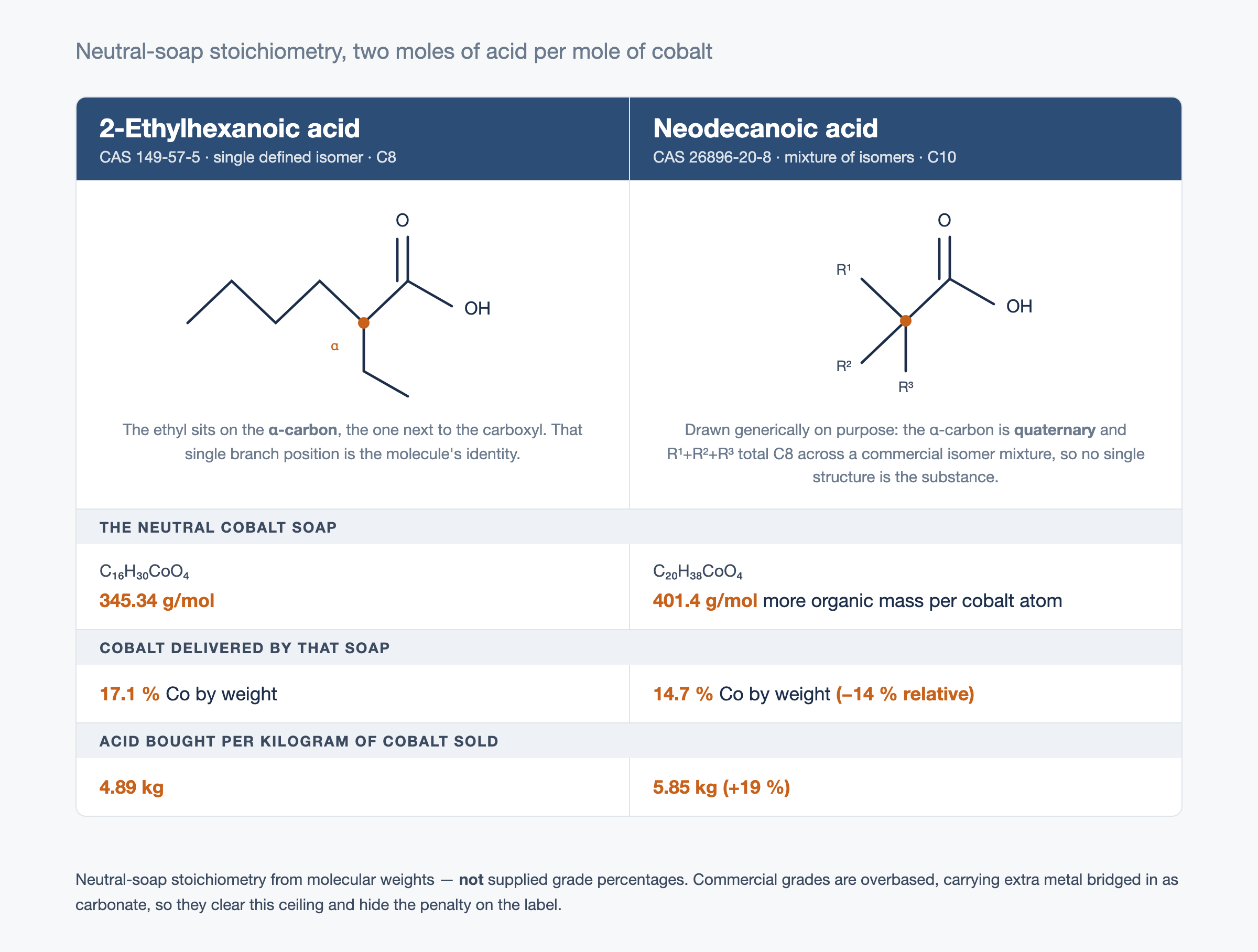
C16H30CoO4 weighs 345.34 g/mol and C20H38CoO4 weighs 401.4, so the C10 acid brings more organic mass per cobalt atom.
On the same neutral-soap basis, one kilogram of cobalt in the finished salt takes:
- 4.89 kg of 2-ethylhexanoic acid, at two moles of acid per mole of cobalt
- 5.85 kg of neodecanoic acid, at the same two moles
- about 19% more acid by weight on the C10 route, before any yield loss
Metal content sits in the denominator of the drier addition-rate equation. Hitting the same cobalt target on resin solids therefore takes about 16% more soap by weight.
Every drier grade states its % metal on the supplied solution, which is how a 6, 10 or 12% cobalt octoate gets dosed in the first place.
The penalty does not show up where a buyer would look for it first. Umicore’s supplied grades put VALIREX Co 10 D60 (octoate) and Co 10 Neo D60 (neodecanoate) at the same 10% cobalt, in the same dearomatized D60 carrier.
The highest-metal cobalt grade in that range is a 21% neodecanoate, on a supplied and overbased basis rather than a stoichiometric one.
Overbased carboxylates carry extra metal bridged in as carbonate rather than bound to the acid, which is how a formulated grade clears its own neutral-soap ceiling. Every commercial grade examined here sits above that ceiling.
Your drier customer sees no penalty on the label, and is right. You see all of it, in the acid you buy per kilogram of cobalt you sell.
A drier COA gives you % metal on the supplied solution. It will not tell you which acid delivered that metal, or what the soap cost to build.
Do not swap the acid under a metal soap without re-qualifying the dosage. Where the classification never reaches your product’s channel, this is a documentation decision rather than a chemistry one.
Ask your 2-ethylhexanoic acid supplier for registration status and the assay basis in writing.
Which Acid Your Carboxylate Should Be Built On
Run the lookup on the exact CAS you ship, both columns, before anyone prices a reformulation.
Neodecanoic acid earns the rebuild in one situation: the harmonised Repr. 1B is specifically what your product’s channel cannot carry, and no reformulation short of changing the acid removes it. That case is real, and it is worth naming plainly.
Everywhere else, 2-ethylhexanoic acid stays the better build. Nothing forces the entry off the product, you absorb the extra acid per kilogram of cobalt, and the acid you would move to is itself in front of the agency with nothing decided.
Neither route hands you an unclassified salt. The choice is which hazard class you would rather carry on the drum, priced against what the soap costs to build.
One boundary is worth stating, because the distributor’s pitch rarely does. This argument is cobalt’s alone.
The harmonised Repr. 1B entry sits on cobalt bis(2-ethylhexanoate). It does not sit on the manganese, zirconium, calcium, potassium or stannous members of the same family, so nothing here is a reason to rebuild those on a different acid.