

Un tambor de octoato de cobalto 12% contiene el doble de cobalto entregable que un tambor de 6%, y exactamente la misma molécula. El porcentaje en la etiqueta es cobalto metálico disuelto en el portador, no pureza.
La producción explica la etiqueta. Cada grado comercial comienza con una reacción, ácido 2-etilhexanoico (2-EHA) combinándose con una fuente de cobalto, y termina con una dilución en aguarrás mineral que fija el porcentaje de metal. La práctica industrial se divide en dos familias de rutas: reacción directa del ácido con una alimentación de cobalto, y doble descomposición acuosa a través de la sal de sodio.
Reacción Directa de 2-EHA con Cobalto Metálico, Óxido o Hidróxido
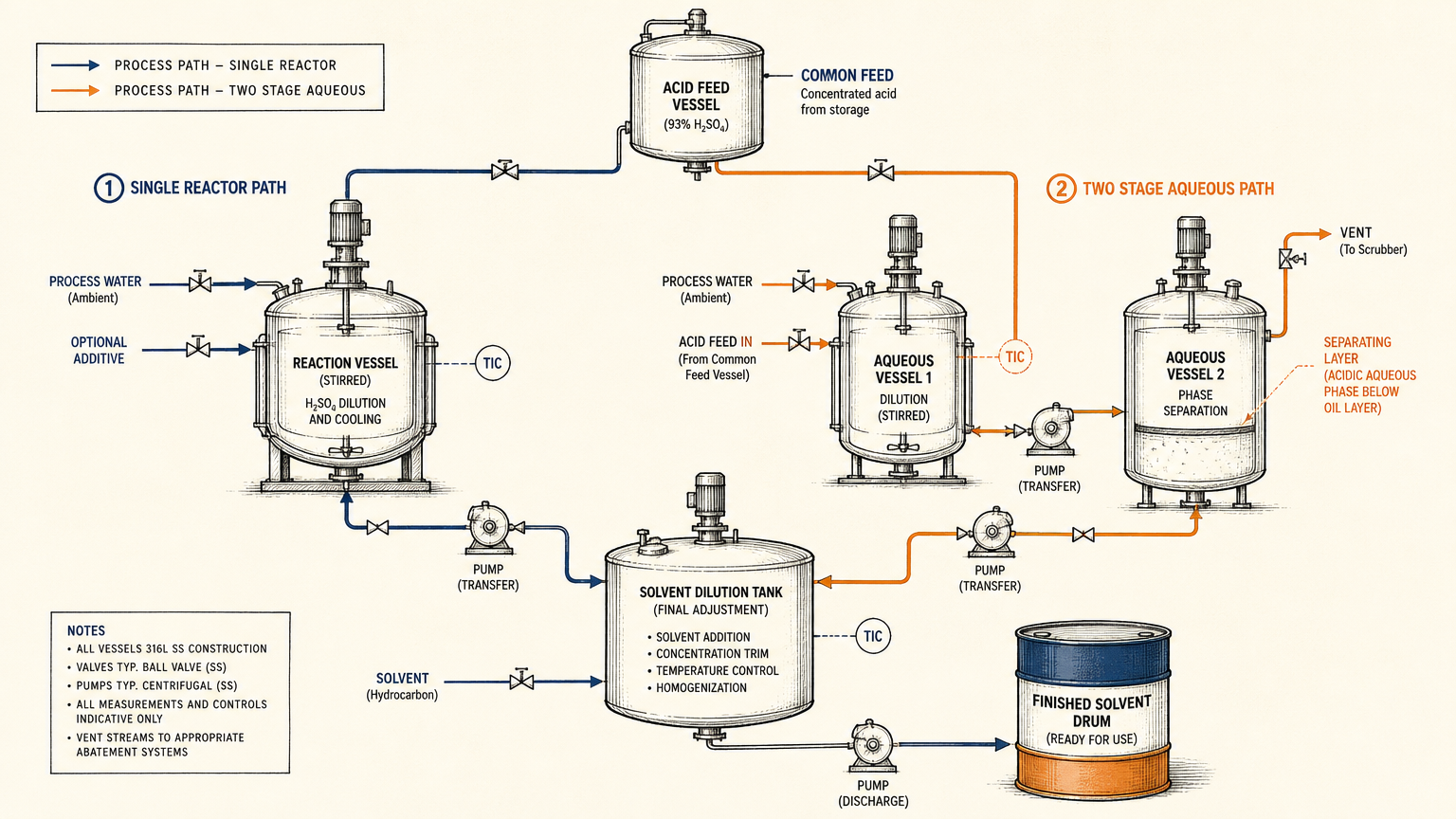
El Banco de Datos de Sustancias Peligrosas nombra tres rutas industriales para el octoato de cobalto: metátesis de una sal de cobalto con 2-etilhexanoato de sodio, oxidación de cobalto metálico en el ácido, y neutralización con carbonato o hidróxido de cobalto. Las dos últimas forman la familia de reacción directa, donde ácido 2-etilhexanoico se encuentra con una fuente de cobalto en un solo recipiente y el agua es el subproducto principal.
Neutralización con Hidróxido o Carbonato de Cobalto
El hidróxido de cobalto reacciona con dos equivalentes de 2-EHA para dar bis(2-etilhexanoato) de cobalto más agua; la versión con carbonato libera dióxido de carbono en su lugar. Realizar la reacción en el aguarrás mineral que se convertirá en el portador ahorra un paso de disolución, por lo que el jabón se forma ya en solución.
La recompensa es una corriente limpia. No entran sodio ni sulfato al recipiente, por lo que no hay nada que lavar después; el acabado se reduce a eliminar agua y ajustar los sólidos a especificación.
Oxidación por Aire de Cobalto Metálico en el Ácido
El cobalto metálico en sí puede ser la alimentación. Unidades piloto documentadas por el Instituto Superior Técnico de Lisboa cargan polvo o perdigones de cobalto con 2-EHA en un reactor de acero inoxidable agitado, con 4-terc-butilcatecol como catalizador de reacción. Se sopla aire durante 10 horas, seguido de una purga de nitrógeno de dos horas.
El acabado aquí es tanto mecánico como químico: el metal sin reaccionar se decanta, las finas de óxido de cobalto se filtran y el exceso de ácido se destila al vacío. La construcción de acero inoxidable no es opcional, porque el recipiente ejecuta una reacción gas-líquido corrosiva durante medio día a la vez.
Las unidades de Lisboa operaron 2-etilhexanoatos de estaño y cobalto en el mismo equipo, lo cual es típico de los octoatos metálicos en general: la ruta permanece constante mientras cambian la alimentación metálica y el tren de acabado.
Doble Descomposición vía 2-Etilhexanoato de Sodio
La doble descomposición, la ruta de metátesis acuosa, construye la sal en dos pasos. El ácido se saponifica primero con hidróxido de sodio para obtener 2-etilhexanoato de sodio; esa sal de sodio reacciona luego con sulfato o cloruro de cobalto disuelto, y el jabón de cobalto se transfiere a una fase de solvente.
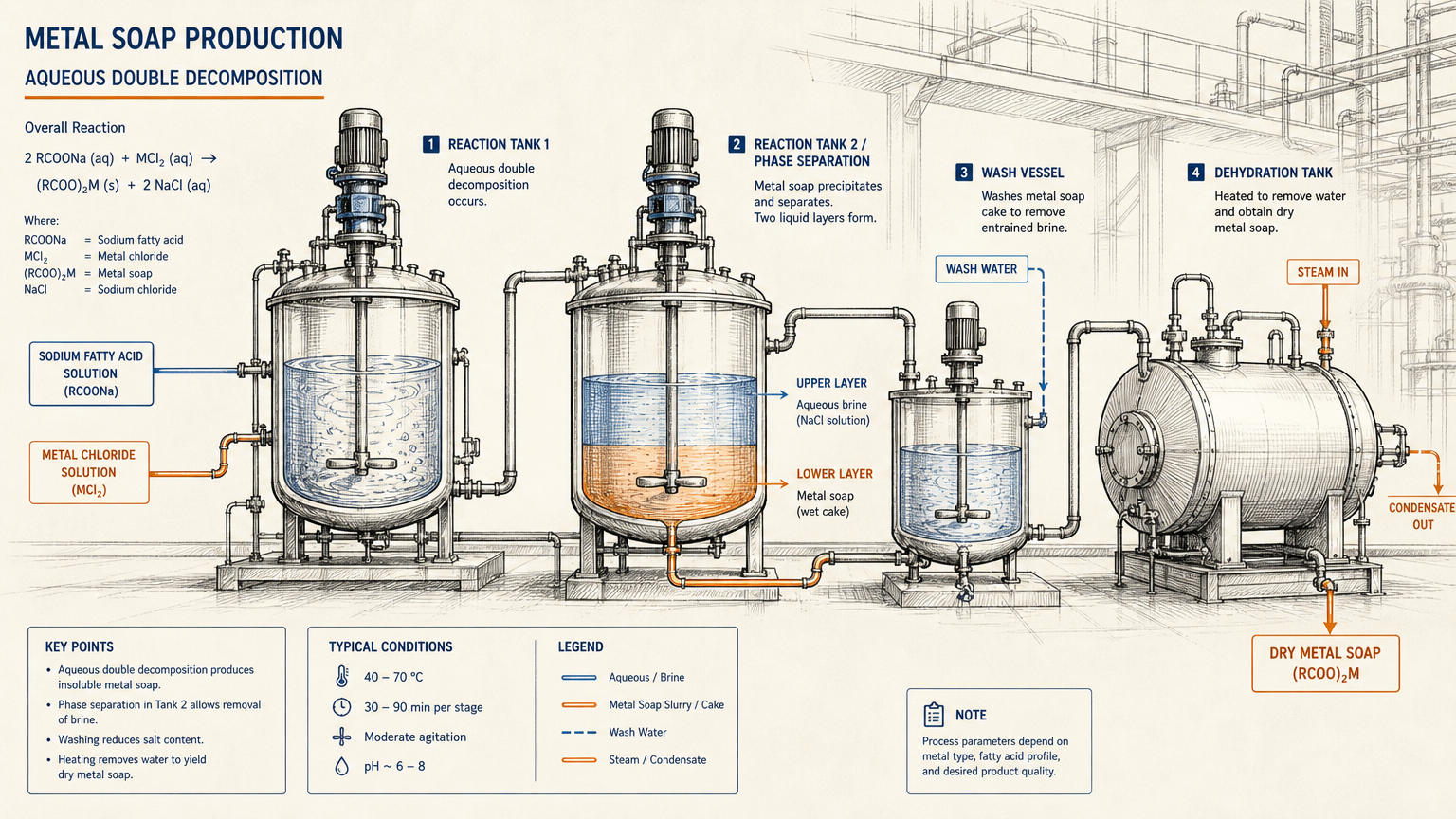
La patente china CN101628869B, otorgada a Shenyang Zhangming Chemical, divulga un conjunto completo de parámetros, con el cobalto proveniente de cátodos gastados de óxido de litio y cobalto (LiCoO2) de baterías:
- Lixiviar el polvo de cátodo gastado en aproximadamente 40% de ácido sulfúrico con peróxido de hidrógeno a 80 a 90 °C, luego purificar el licor mediante extracción con solvente hasta obtener una solución limpia de sulfato de cobalto.
- Saponificar el ácido con 30% de hidróxido de sodio a 70 °C durante 40 minutos, terminando a pH 7.5.
- Reaccionar la sal de sodio con el sulfato de cobalto en solvente de aguarrás mineral a 90 a 95 °C durante otros 40 minutos.
- Lavar con agua, separar las capas y deshidratar a 120 °C durante 40 minutos.
Más del 97% del cobalto se reporta al producto, que la patente describe como un líquido rojo-violeta uniforme. Esos parámetros son la divulgación de un productor, no un estándar de la industria.
La forma de la ruta es general de todos modos: el sulfato de sodio sale con la fase acuosa, y el tren de lavado decide cuánto de él permanece en el jabón.
La calidad de la materia prima establece el límite máximo del ensayo final. La divulgación exige un ácido tipo 2-etilhexanoico con un número de ácido de 385 mg KOH/g, un deber que puede cubrirse con ácido 2-etilhexanoico de grado técnico comprado contra un certificado de análisis (COA).
Por Qué el Octoato de Cobalto se Vende al 6, 10 y 12% de Contenido Metálico
El porcentaje en una etiqueta de octoato de cobalto indica cobalto metálico disuelto en la solución final, no la pureza del compuesto. Los grados difieren en concentración, no en calidad, y la dilución con aguarrás mineral (white spirit) es la etapa de producción que fija el número.
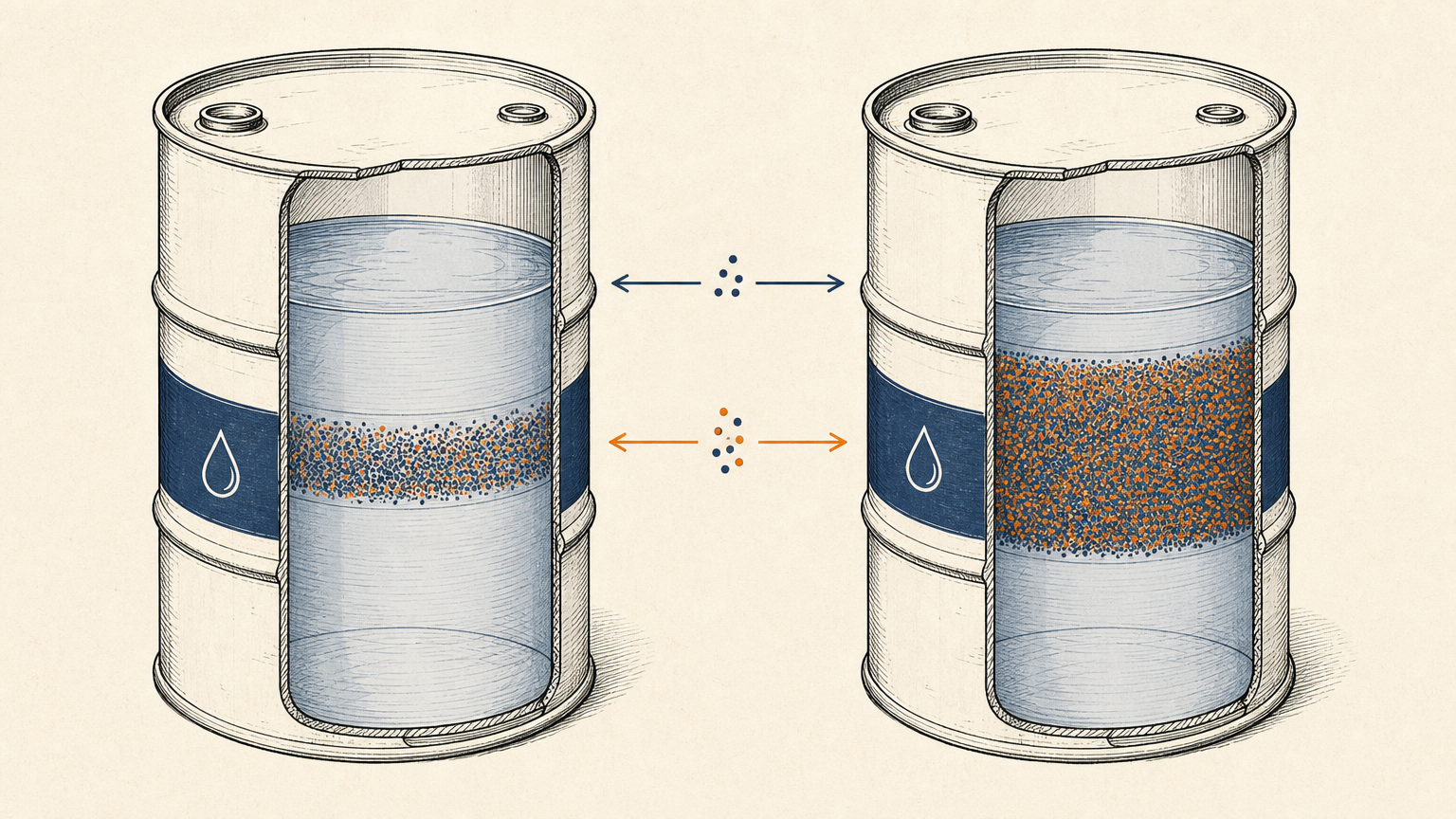
La aritmética se muestra en cualquier hoja de especificaciones. El grado 12% de Shepherd Chemical especifica 11.8-12.2% de cobalto contra un mínimo de 65% de no volátiles, y el catálogo de Aldrich lista el mismo número CAS como una solución al 65 por ciento en peso en aguarrás mineral. Una etiqueta de 12% significa por lo tanto aproximadamente dos tercios de jabón de cobalto y un tercio de solvente.
| Parámetro | Octoato de Cobalto 12% (Shepherd 1348) | Acelerador NL-49P, 1% Co (Akzo Nobel) |
|---|---|---|
| Contenido de cobalto | 11.8-12.2% | 1.0% |
| Portador | Aguarrás mineral | Éster alifático |
| Densidad | SG 1.00-1.06 a 25 °C | 949 kg/m³ |
| Viscosidad | 100 cP máx., Brookfield a 25 °C | 7 mPa·s a 20 °C |
La reactividad se correlaciona directamente con el contenido de cobalto en el rango de aceleradores, y existen grados de menor concentración para precisión de dosificación. Pesar 3 phr (partes por cien de resina) de un producto al 1% es mucho más indulgente que pesar 0.3 phr de uno al 10%.
Precia el metal, no el líquido. Divide cada cotización por su ensayo: una oferta al 6% que parece barata por kilogramo de solución puede costar más por kilogramo de cobalto contenido que un tambor al 12%.
El COA te da cuatro números aquí: ensayo, viscosidad, color y no volátiles. La hoja de especificaciones te da la ventana; la aplicación te dice qué esquina de la ventana necesitas realmente. Vigila las unidades al comparar productores, ya que la viscosidad llega de diversas formas como centipoise Brookfield, segundos de copa de flujo o una letra Gardner-Holdt.
La apariencia tampoco es una señal de pureza. Shepherd lista su grado 12% como un líquido azul, mientras que la patente de cátodos reciclados describe su producto como rojo-violeta.
Por Qué un Catalizador es Implacable Acerca de lo que la Ruta Deja Atrás
El octoato de cobalto realiza la misma función química en sus dos principales mercados: descompone peróxidos e hidroperóxidos en radicales libres a temperaturas de taller. Eso es lo que un laminador de poliéster insaturado compra, y es por lo que los formuladores de pinturas y tintas llaman al cobalto el secante primario clásico.
En el mecanismo que la literatura de recubrimientos acepta ampliamente, el cobalto cicla entre sus estados de oxidación 2+ y 3+, catalizando la absorción de oxígeno y dividiendo hidroperóxidos en los radicales que reticulan el aglutinante. El mismo par redox explica por qué se necesita tan poco metal. Funciona como catalizador, no como reactivo.
El comportamiento catalítico es también lo que hace que una traza importe aquí desproporcionadamente en relación con su concentración. Un catalizador es sensible a cualquier cosa que comparta el tambor con él, por lo que los residuos arrastrados de la ruta de producción pueden mover el rendimiento mientras la cifra de ensayo en el certificado permanece igual.
La presión de sustitución corre en paralelo. La clasificación de toxicidad reproductiva Repr. 1B atribuida al bis(2-etilhexanoato) de cobalto en la UE sigue empujando a los formuladores hacia sistemas libres de cobalto, lo que pone tanto al metal como a sus residuos bajo la misma pregunta de adquisición.
El Proceso Detrás de la Etiqueta
Trate el ensayo como la base del precio y la ruta como una cuestión de calidad. Un producto de metátesis lleva trazas dependientes del lavado de sodio y sulfato que un producto de reacción directa nunca ve; esa diferencia es un sospechoso plausible cuando el tiempo de gel se desvía de lote a lote. Las especificaciones de residuos rara vez se publican, por lo que la cuestión de la ruta pertenece al cuestionario de calificación de proveedores.
La historia de producción termina en un tanque de dilución, y ese es el punto. Las etiquetas 6, 10 y 12% son formatos de dosificación de una sola química, ya sea que el cobalto haya comenzado como hidróxido, perdigones metálicos o un cátodo de batería reciclado. Elija el formato que favorezcan su dosificación y flete, y deje que las matemáticas de metal contenido cierren la comparación.